


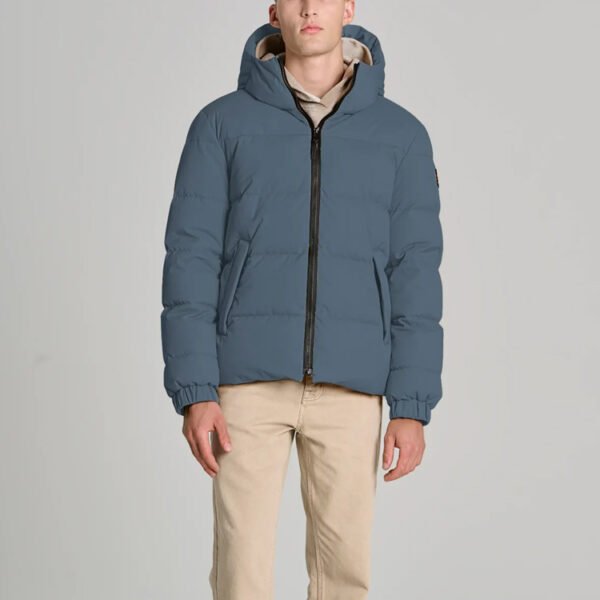

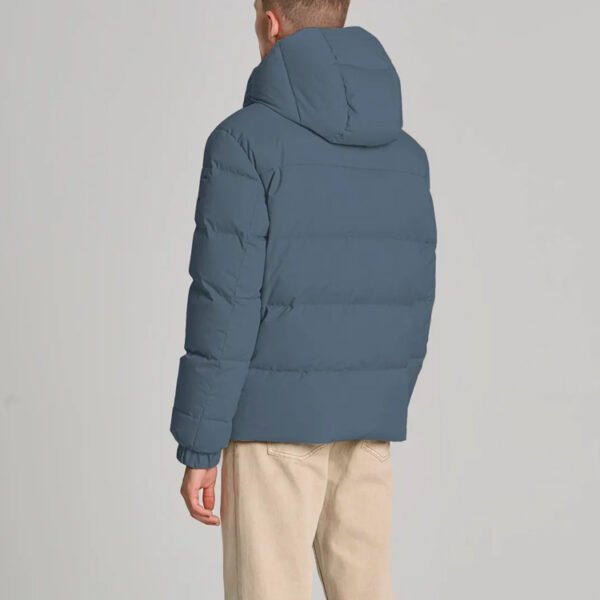




Develop this men's navy puffer vest around controlled freedom at the armholes and hem. Its sleeveless construction removes sleeve restriction, while quilting, collar height, pocket angles, and visible corner adjusters shape how insulation behaves in motion.
Read the Vest as a Layering Mobility System
The supplied image shows a sleeveless padded body with substantial horizontal channels, a raised collar, and a full front closure. Without sleeves, shoulder movement depends primarily on armhole shape, side seam ease, and how the insulated body settles over the underlayer.
That makes layering compatibility the first technical question. A close armhole may reduce drafts but restrict reach over knitwear, while excessive clearance can expose the underarm. The pattern should therefore balance coverage and movement with the buyer's intended base-layer thickness.
Armhole Geometry Replaces Sleeve Engineering
A vest has no sleeve pitch or cuff to absorb reaching motion, so the armhole curve becomes the main mobility control. Its depth, angle, binding width, and relationship to the shoulder seam determine whether the wearer can lift the arms without pulling the quilted body upward.
For VeeWen sampling, the armhole should be assessed in both a relaxed stance and an elevated reach. Buyers should inspect channel distortion, shoulder pressure, and side seam drag, because insulation can magnify small pattern errors that appear acceptable on a flat garment.
Quilting Stabilizes Volume but Limits Flexibility
The image clearly shows broad horizontal quilt channels across the chest, waist, and lower body. These channels organize the padded volume and establish a repeatable visual rhythm, but each seam line can also limit local expansion when the torso bends, twists, or reaches.
The development trade-off is therefore channel consistency versus mobility reserve. Narrower or more numerous channels may distribute volume differently, while broader channels can create a bolder appearance. The correct option should be selected through wear testing, not inferred warmth or flexibility claims.
Hem Adjusters Shape Hip Movement
Small cord details are visible at both lower corners of the vest, indicating an adjustable hem direction. Hem control can reduce lifting during movement and help manage drafts, yet excessive tightening may compress the lower body or interfere with seated comfort and pocket use.
The prototype review should compare a relaxed hem with a lightly controlled setting during walking, sitting, and torso rotation. VeeWen can then document the usable adjustment range, ensuring the finished cord path supports movement without creating exposed hardware or uncomfortable pressure points.
Pocket Angles Need Functional Clearance
Two angled hand pockets are visible across the lower front, positioned to invite entry from above and toward the sides. Their angle, opening length, bag shape, and insulation bulk will influence whether hands enter naturally while the wearer stands, walks, or sits.
Pocket placement should be checked against the side seam, quilt breaks, and hem adjuster path. A lower opening may improve hand comfort but can become difficult under a tightened hem; a higher opening may improve access while changing the vest's visual balance.
VeeWen Workflow and Final Approval Checkpoint
VeeWen's workflow should translate this vest argument into a layered fit sample. The team can record the intended underlayer, map armhole and hem control points, then evaluate the quilted body while the wearer reaches, bends, sits, and accesses both pockets.
Approve the next stage only after the selected size set confirms shoulder freedom, stable collar and snap alignment, usable pockets, and comfortable hem adjustment. Separately confirm shell, fill, lining, and warmth specifications, since the supplied image does not verify those properties.
Buyer Questions
What is the vest's main mobility mechanism?
Armhole clearance provides shoulder freedom, while adjustable hem control helps the insulated body move without excessive lifting around the hips.
Which base layer should buyers use for fitting?
Use the intended base-layer thickness during fitting, because armhole comfort and side seam ease depend on the vest's planned layering context.
What pocket issue requires special attention?
Check hand entry, seated access, pocket bag bulk, and interaction with the adjustable hem, especially when the hem is lightly tightened.
What is the commercial minimum for this vest?
VeeWen's exact commercial minimum is MOQ: 100 pieces per style, subject to finalized specifications and approved development details.
Approve the Layering Fit
Share the target base layer, size range, shell direction, and trim requirements so VeeWen can review armhole mobility and hem control for MOQ: 100 pieces per style.

Reviews
There are no reviews yet.