
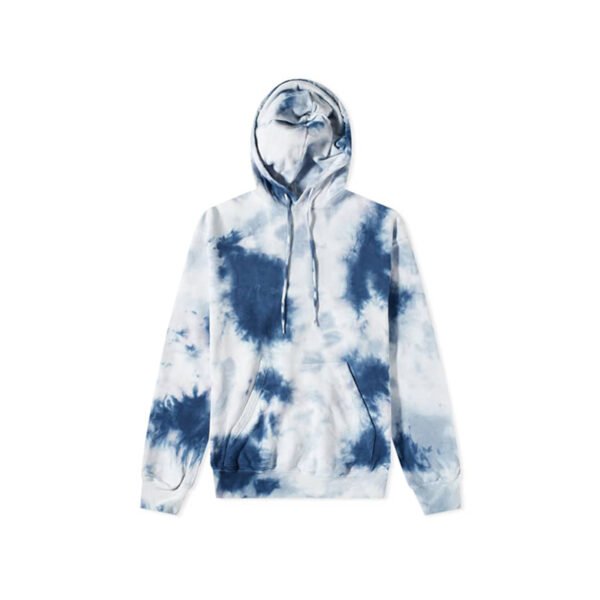

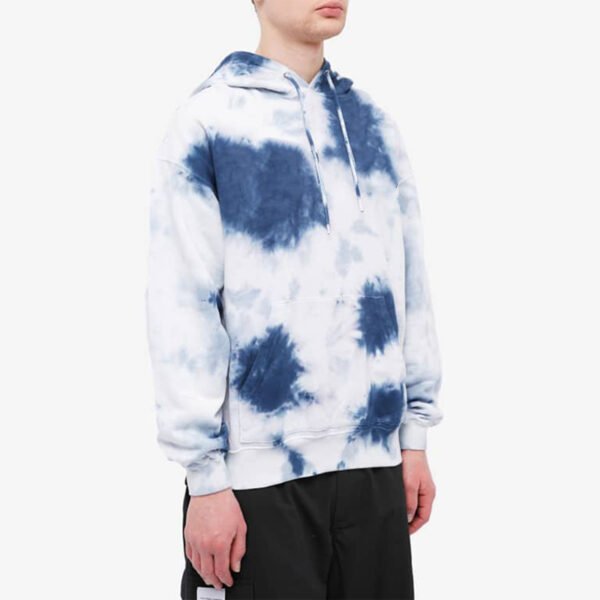


This custom tie-dye pullover hoodie is developed around neck rib recovery and neckline shape. The supplied image shows a substantial hood, drawcord exits, irregular blue-and-white color distribution, ribbed cuffs, ribbed hem, and pouch pocket, making neckline stability central to fit and presentation.
Why Neck Rib Recovery Matters
A pullover hoodie's neckline is repeatedly stressed during head entry, hood adjustment, drawcord movement, and garment removal. The neck rib must recover after these actions while retaining a shaped opening that does not collapse into the chest.
The supplied image shows a pronounced hood entrance rather than a narrow crew opening. That construction creates comfort and styling flexibility, but it also makes rib recovery important because the hood edge carries repeated directional tension around the face and shoulders.
Reading the Tie-Dye Distribution
The visual evidence shows blue and white tie-dye arranged in irregular cloud-like areas, including stronger concentration near the shoulders, sleeves, and lower body. Such distribution makes small neckline distortions easier to notice because contrast emphasizes the hood and upper chest.
A stable neckline helps the color pattern remain visually intentional when the wearer moves. If the opening stretches unevenly, the surrounding tie-dye can appear shifted or unbalanced, particularly where the drawcord exits and the shoulder panels begin.
Neckline Shape and Hood Entry
Neckline shape depends on the hood opening circumference, hood panel geometry, seam allowance, rib or binding length, and the angle at which the hood joins the body. These details determine whether entry feels easy, whether the hood sits forward, and whether the front neck collapses.
VeeWen's sample review should assess head entry without relying solely on a flat measurement. The opening needs enough ease for practical wear, while the seam and rib relationship should preserve a clean frame around the face and maintain the intended relaxed silhouette.
Drawcord Pull and Local Stress
The supplied image includes drawcords emerging near the center front of the hood. When tightened, those cords gather the hood and transfer force toward the neckline, potentially changing the opening shape or pulling the front body upward.
The development sample should therefore be checked with the drawcord both relaxed and adjusted. Buyers should observe whether the rib recovers evenly, whether the hood remains centered, and whether cord tension creates visible rippling across the upper chest.
VeeWen Development Workflow Checkpoint
VeeWen can record the hood opening, rib length, rib width, drawcord exit position, shoulder measurements, cuff recovery, and hem recovery as one linked approval set. This keeps neckline decisions connected to the hood pattern rather than treating rib as an isolated trim.
The review should compare the approved neckline on the body and on the wearer, including movement and hood adjustment. If raised artwork is selected, its placement should be checked after neckline behavior is approved so decoration does not mask fit issues.
Trade-Offs and Buyer Approval
A tighter rib can improve recovery and definition but may restrict entry or make the hood feel less relaxed. A softer or longer rib can improve comfort, yet it may permit the opening to spread, reducing structure and changing the hood's resting shape.
The buyer should approve a measurable balance between entry comfort, recovery, and visual framing. Before bulk authorization, confirm the neckline dimensions, drawcord behavior, tie-dye placement tolerance, decoration method, and final material reference together.
Buyer Questions
What is the main fit risk in this hoodie?
The main risk is uneven neckline stretching caused by hood entry and drawcord adjustment, which can disturb comfort, hood alignment, and the tie-dye pattern's visual balance.
Should the hood opening be measured flat or worn?
Both checks are useful. Flat measurements control production consistency, while worn evaluation confirms entry comfort, hood position, and recovery under realistic movement and adjustment.
Can raised artwork be added to this hoodie?
Raised foam or puff artwork may be developed, but artwork scale, placement, adhesion, hand feel, and durability require confirmation through the approved production method.
What is the minimum commercial quantity?
MOQ: 100 pieces per style. Final tie-dye direction, materials, neckline construction, decoration, and production details require confirmation before order authorization.
Approve the Neck Recovery
Share your target hood measurements, tie-dye direction, and decoration artwork with VeeWen. Approve neckline recovery in worn and flat checks before proceeding with MOQ: 100 pieces per style.


Reviews
There are no reviews yet.