


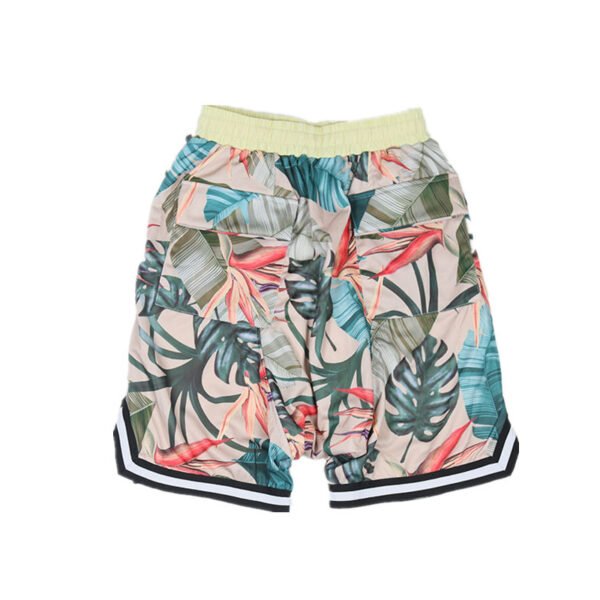




This short development treats topstitch gauge as a visible design system. The tropical print, exposed zip pockets, elastic waist, and striped hem create several high-contrast lines that must remain evenly spaced across a deliberately relaxed resort silhouette.
Why Topstitch Gauge Defines the Product
Topstitch gauge is the controlled distance between a seam edge and visible stitch line. On these shorts, that distance frames the zip pockets, waistband, and hem, so inconsistency can make the relaxed garment look accidental rather than intentionally engineered.
The image's black pocket zippers and striped hem create strong visual anchors against a pale tropical ground. Even minor stitch drift will be easier to notice around those anchors, particularly when the garment is viewed front-on or photographed for wholesale presentation.
Pocket Edges and Hardware Alignment
The paired zip pockets should be developed as mirrored construction features, with consistent stitch distance, zipper exposure, and top and bottom termination. Their vertical orientation gives the front visual order despite the dense foliage and floral print.
During sample review, measure gauge at several points rather than checking one attractive area. Confirm pocket angle, tape parallelism, zipper length, and reinforcement placement, because a consistent line is only useful when the complete pocket assembly remains balanced.
Striped Hem as a Measurement Reference
The contrast hem appears as a bold black-and-white band, turning the lower edge into a built-in construction reference. Stitching that wanders across the band can interrupt the stripe rhythm and make the leg openings appear uneven.
The buyer should inspect both legs laid flat, then review the shorts on-body for hem level and opening balance. Because the leg volume is loose, controlled gauge helps the trim read as deliberate structure without making the garment visually rigid.
Print, Grain, and Stitch Interaction
An all-over tropical print can disguise small sewing errors in one area while emphasizing them in another. VeeWen should review whether print direction, panel placement, and seam allowance expose contrasting motifs or create unintended visual breaks at pockets and side seams.
The construction route should preserve practical alignment without promising exact pattern matching where the supplied evidence does not confirm it. The trade-off is clear: tighter visual control may increase handling requirements, while excessive correction can compromise the relaxed product character.
VeeWen Development Workflow
VeeWen can build this product around a gauge map covering waistband, pocket openings, side seams, hem bands, and reinforcement points. The map should accompany the first sample so every visible line has an agreed reference.
After the buyer reviews the sewn sample, approved gauge points can be translated into machine settings, operator instructions, trim placement notes, and inspection photographs. This workflow connects the product's visual argument to repeatable production decisions rather than generic finishing language.
Buyer Approval Checkpoint
The buyer should approve a complete sample with the final print direction, zippers, waistband, drawcord, and striped hem. Inspect both legs flat and worn, checking stitch distance, pocket symmetry, hem level, and the visual continuity of the trim.
Release is appropriate when the topstitch lines remain consistent across the garment and support the print instead of competing with it. If gauge varies materially, correct the sewing setup before approving grading, packing standards, or production quantities.
Buyer Questions
Why is topstitch gauge central to these shorts?
The exposed pocket zippers and striped hems create strong reference lines, so uneven stitch spacing becomes immediately visible and can weaken the garment's intended technical resort appearance.
Is the fabric composition confirmed by the supplied image?
No. The image supports a lightweight printed woven appearance, while fiber content, GSM, finishing, colorfastness, and performance require confirmation from the approved material reference.
What should the first sample prove?
It should prove pocket symmetry, zipper alignment, waistband balance, hem stripe placement, repeatable stitch spacing, and clean interaction between construction lines and the tropical print.
What is the commercial minimum for this product?
The exact commercial minimum is MOQ: 100 pieces per style, with final production dependent on approved materials, measurements, trims, construction details, and inspection checkpoints.
Approve the Construction Gauge
Share the target measurements, print artwork, trim choices, and preferred fabric reference so VeeWen can map visible stitch lines and prepare a buyer-review sample.



Reviews
There are no reviews yet.