


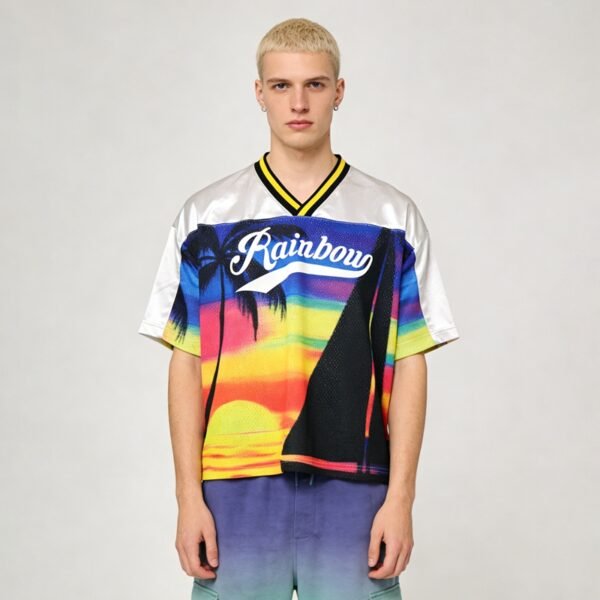


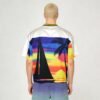



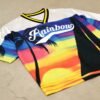

Develop this jersey around a vivid tropical sublimation field and a controlled dimensional graphic. The visual combines a white athletic body with saturated sunset bands, palms, and a sailboat silhouette, making edge stability and low-bulk layering central approval points for a wearable streetwear production sample.
Why Edge Control Leads the Development
Dimensional silicone or applique details add localized thickness, so their perimeter must transition cleanly into the printed mesh. A controlled edge reduces snag points, prevents a visibly heavy outline, and preserves the jersey's flexible hand while the graphic remains optically raised.
Here, the source wording calls out a 3D silicone print, while the image shows a broad, uninterrupted sunset panel across the back. That combination suggests the raised feature should be restrained to selected marks, leaving the sublimated field light, continuous, and visually dominant.
Reading the Visual Composition
The white sleeves, striped collar, and colorful back create a clear separation between athletic framing and illustrated body artwork. Any dimensional application should respect that hierarchy, avoiding unnecessary buildup near armholes, collar joins, or the large color transitions that define the silhouette.
The black palm and sailboat shapes provide natural candidates for selective raised treatment because their contrast makes edge quality immediately legible. Development should determine whether the silicone follows complete silhouettes, partial accents, or small graphic points without disturbing the sunset print.
VeeWen Development Checkpoint
VeeWen's product-development workflow should begin with a placement map identifying every dimensional element, its intended height, and its distance from seams. A first sample can then test applique registration against the sublimated artwork before grading multiplies any edge or bulk issue.
At the approval stage, review the jersey flat and on-body. Confirm that the applique remains smooth through movement, that the mesh does not pucker around attachment zones, and that the graphic alignment remains consistent across the requested size range.
Managing Bulk Against Mobility
A raised print can strengthen visual depth, but excessive thickness may stiffen the body panel or create uncomfortable pressure when worn beneath outer layers. The practical target is a dimensional effect that reads clearly without turning the flexible jersey into a rigid graphic board.
The broad rear artwork increases the importance of distribution. Keep heavier applications away from high-flex areas where possible, and use the sample to compare localized detail against the natural drape of the surrounding mesh before selecting a production-ready construction.
Grading and Seam Interaction
Because the body artwork spans a wide back area, size grading must coordinate print scaling, applique placement, and seam allowances. A fixed-size raised mark can drift toward armholes or side seams as dimensions change, making the edge appear visually unbalanced.
The development file should therefore preserve placement coordinates relative to stable pattern landmarks. Check the shoulder, side seam, hem, and neckline relationships in multiple sizes, then approve the rule used to enlarge or reposition dimensional elements.
Production Approval Criteria
The buyer should approve this style only when the sample demonstrates clean applique edges, stable attachment, and an even transition into the sublimated mesh. The decision is visual and tactile: both the raised graphic and the jersey's movement must remain convincing.
Final confirmation should record applique artwork, height tolerance, edge treatment, seam clearances, and the care or handling assumptions still requiring verification. With those checkpoints documented, the style can proceed at MOQ: 100 pieces per style with fewer interpretation gaps.
Buyer Questions
What is the main sampling risk for this jersey?
The primary risk is excessive applique bulk or poor edge registration, which can stiffen the mesh and make the high-contrast artwork look visibly uneven.
Should the silicone detail cover the entire back graphic?
Not necessarily. Selective application on defined silhouettes can preserve flexibility, reduce bulk, and keep the sublimated sunset field visually continuous.
What should the buyer inspect across sizes?
Inspect applique distance from armholes, side seams, neckline, and hem, ensuring grading preserves both graphic balance and comfortable movement.
What is the commercial minimum?
The commercial minimum is MOQ: 100 pieces per style, subject to approved artwork, construction details, placement rules, and final production specifications.
Approve the Edge-Control Sample
Send the artwork, size range, and preferred dimensional effect to VeeWen for a focused development review covering applique perimeter, layer bulk, placement, and graded production approval.


Reviews
There are no reviews yet.