


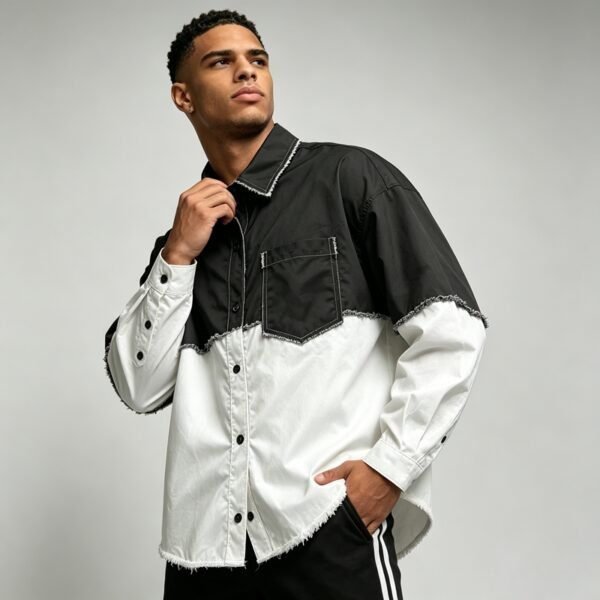



This shirt uses contrast as a construction device rather than a simple color change: a dark upper panel, light lower panel, exposed raw edges, and a curved hem create its identity. The development task is aligning fabric weight across panels so the boundary remains crisp while the lower section falls naturally.
The Horizontal Boundary Controls the Fall
The black upper panel and white lower panel meet across the torso, creating a strong horizontal boundary. That seam is also a mechanical transition: if one fabric is substantially heavier, stiffer, or less flexible, the lower section may twist, pull, or hang unevenly.
The curved hem makes the issue more visible because the lower edge depends on consistent balance around the body. Buyers should assess the shirt closed and open, checking whether the contrast line stays level while the hem maintains a relaxed, intentional arc.
Raw Edges Need Deliberate Management
Raw-looking edges appear at the panel boundary, lower hem, collar, and sleeve areas, giving the shirt a visibly unfinished surface language. Their appeal depends on controlled fraying and stable seam behavior rather than uncontrolled unraveling or inconsistent width.
VeeWen's development review should define the desired edge exposure, fray length, and seam allowance before production. A sample should be handled repeatedly so the buyer can distinguish an intentional raw-edge finish from an edge that loses definition during normal movement.
Weight Matching Protects the Contrast
The source wording references a cotton blend, but it does not verify composition or fabric weight. The image suggests a structured woven appearance, yet visual appearance alone cannot establish GSM, breathability, recovery, or comparative density between black and white panels.
For this axis, buyers should approve hand feel and panel balance together. Two fabrics can share a similar color effect while behaving differently at the join, especially when the lower white section extends into the sleeves and curved hem.
Pocket and Button Details Add Local Mass
A black patch pocket sits above the color boundary, adding a concentrated layer to the upper front. Buttons run down the center front, while multiple cuff buttons create additional local weight at both wrists and may influence sleeve roll and drape.
The technical review should therefore include pocket self-material, attachment method, button placement, and cuff construction. These details are small compared with the main panels, but their positions can alter how the shirt opens, folds, and settles on the wearer.
VeeWen Development Checkpoint
VeeWen's workflow should begin with a panel map that records the black-to-white boundary, curved hem shape, raw-edge zones, pocket position, and cuff details. The material stage should then compare candidate fabrics for weight alignment before finalizing the construction package.
The buyer's checkpoint is a side-by-side review of the shirt on a form and laid flat. Approval should depend on a level contrast boundary, controlled exposed edges, consistent sleeve behavior, and a lower hem that keeps its intended curve.
Resolve the Sleeve-Length Conflict
The source title describes a short-sleeve shirt, while the supplied main image visibly presents long sleeves with buttoned cuffs. This discrepancy must be resolved before grading or costing because sleeve length changes fabric consumption, panel mapping, cuff construction, and the garment's use case.
VeeWen should record the buyer-approved sleeve version as a controlled specification, with the image retained as visual evidence rather than treated as a complete technical sheet. The final decision should also confirm whether the raw-edge treatment continues consistently around the chosen sleeve construction.
Buyer Questions
Is this shirt short sleeve or long sleeve?
The source title says short sleeve, but the supplied image visibly shows long sleeves and buttoned cuffs; buyers must approve the final sleeve version.
What does the cotton blend reference confirm?
It indicates a cotton-blend direction in the source wording, but no percentage, weave, GSM, or performance claim is verified by the evidence.
Can the raw edges be made more subtle?
Yes, the edge exposure and fray direction can be adjusted during development, provided the buyer approves the intended appearance and stability requirements.
What is the minimum order quantity?
The commercial minimum for this development record is MOQ: 100 pieces per style, subject to the approved panel and finishing specification.
Approve the Panel Weight Direction
Share the preferred material hand, sleeve version, and raw-edge tolerance with VeeWen so the contrast boundary and curved hem can be developed accurately.


Reviews
There are no reviews yet.