

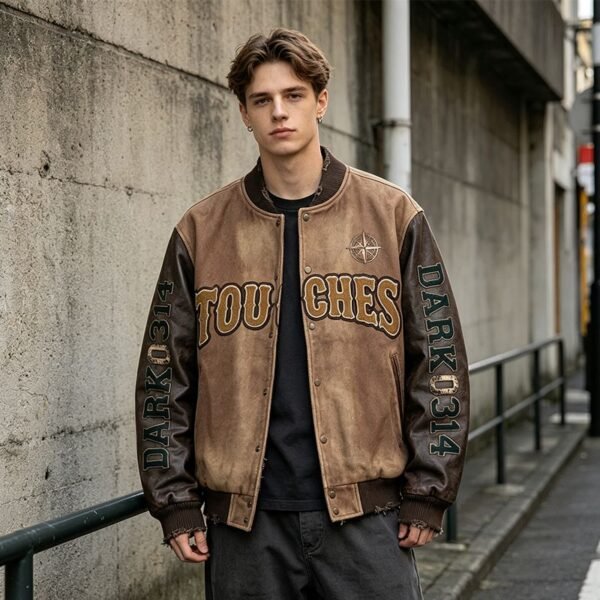


This custom varsity bomber jacket should be engineered around seam appearance, because its contrast panels and large applied lettering expose thread decisions from a distance. The supplied image shows a brown body, dark sleeves, ribbed framing, and decorative lettering whose visual authority depends on controlled stitch color, tension, and edge placement.
Let Contrast Define the Thread Brief
The brown body and dark sleeves create a strong color boundary, so seam thread can either reinforce the panel architecture or introduce unwanted visual chatter. A thread selected only for strength may still look incorrect if its tone competes with adjacent fabric.
The development brief should identify thread colors by seam family: body construction, sleeve attachment, rib joining, lettering, and emblem work. VeeWen's sample review can then assess whether each seam disappears, coordinates, or intentionally contrasts against its surrounding panel.
Control Lettering Edge Appearance
Large sleeve lettering is a dominant visual feature in the supplied image, with contrasting characters running along the arm. Uneven stitch density, thread shine, or inconsistent edge distance could make the lettering appear distorted even when the artwork itself is accurate.
Specify the attachment method, border treatment, stitch direction, and acceptable edge tolerance for the lettering. Review the sleeve while worn or shaped, because arm curvature changes spacing and can reveal thread tension problems hidden on a flat table.
Coordinate Seams with Ribbed Trims
The ribbed collar, cuffs, and hem create dark framing around the jacket, making their joining seams part of the overall graphic language. Poorly matched thread or uneven seam tension can interrupt that frame and make the garment appear less structured.
At sampling, inspect rib attachment around curves, corners, and transition points between shell panels. The buyer should decide whether trim seams match the rib color, shell color, or a deliberately contrasting thread, then apply that rule consistently.
Keep Panel Junctions Visually Quiet
The image relies on a clean two-tone division between the brown front and dark sleeves. Junction seams should support this division without adding a third competing line, especially where pocket openings, snaps, and arm seams meet the contrast boundary.
VeeWen should map seam intersections in the technical package and identify which lines are visible from the outside. The approval sample must check pocket alignment, sleeve insertion, and front closure placement together, since small offsets accumulate around the body.
Translate the Axis into VeeWen Workflow
For this jacket, VeeWen's workflow should convert the visual reference into a seam schedule specifying thread family, stitch type, density, tension target, and visible allowance. That schedule gives sampling and production teams a shared interpretation of seam appearance.
The physical sample review should include close inspection of lettering edges, rib joins, panel junctions, and closure stitching under consistent lighting. Record accepted thread references and construction photographs in the approval file, so later production checks use the same visual standard.
Buyer Approval Checkpoint
Before bulk confirmation, approve a complete construction sample with the final thread colors, lettering attachment, rib trims, closure components, and panel materials represented. Confirm that the jacket retains clean contrast when viewed both from a distance and at seam level.
The decision is whether thread supports the intended varsity structure across every visible detail. Once approved, lock the seam schedule, trim references, and decoration tolerances, then confirm the size assortment under MOQ: 100 pieces per style.
Buyer Questions
Why does thread choice matter on this jacket?
Contrast panels and applied lettering make thread visible. Color, thickness, tension, and stitch density influence whether seams look controlled, coordinated, or visually distracting.
What should be checked on lettering?
Check attachment method, edge distance, stitch coverage, direction, tension, and distortion while the sleeve is shaped, because curved wear can expose issues hidden on flat fabric.
Can seam threads use different colors?
Yes, separate seam families may use coordinated or contrasting threads. The choice should be documented by location and approved physically for consistent appearance.
What is the minimum order?
The exact commercial minimum is MOQ: 100 pieces per style. Confirm the size assortment, color execution, decoration scope, and approved construction before production.
Approve the Seam Appearance System
Share the jacket artwork, panel colors, trim references, and preferred seam character. VeeWen can organize thread families, decoration details, and sample checkpoints into a production-ready approval brief.


Reviews
There are no reviews yet.