
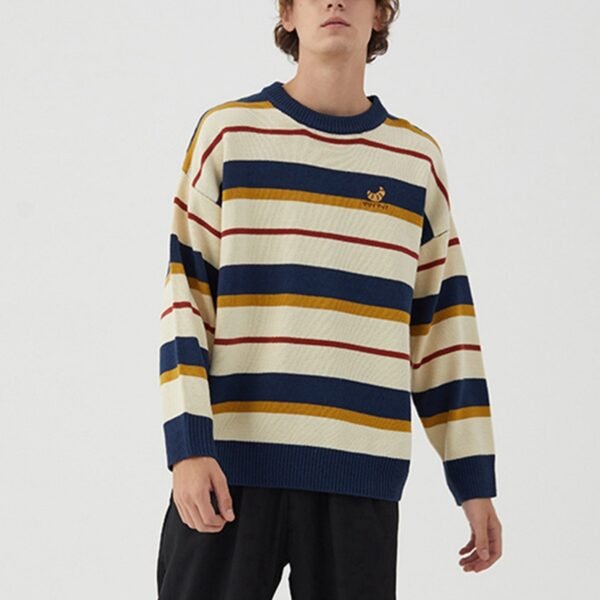
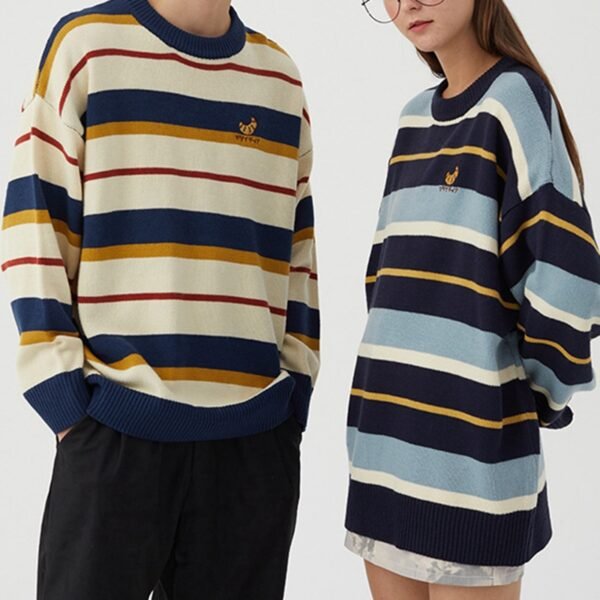







A striped crewneck knit sweater needs panel symmetry because mirrored components govern how bands meet at shoulders, side seams, and cuffs. The visible navy, cream, ochre, and red rhythm creates a clear approval target for development, grading, and final inspection across every size range.
Why Symmetry Controls the Sweater
On a striped knit, small panel or marker shifts change the apparent balance of the whole garment. Mirrored components keep shoulder transitions, sleeve bands, and side-seam meetings visually related, so the relaxed silhouette reads intentional rather than accidentally uneven during inspection.
The supplied image shows a consistent horizontal sequence across the front, with navy bands carrying the strongest visual weight. That contrast makes alignment easy to evaluate, but it also exposes discrepancies quickly when panels, sleeves, or rib sections are joined without a shared placement map.
Reading the Supplied Visual Evidence
The cream ground carries broad navy and ochre bands alongside thinner red lines, creating several alignment levels to control. The front image also shows comparable left and right sleeve treatment, giving the development team a practical reference for mirrored component positioning.
The ribbed navy neckline, cuffs, and hem frame the body panels with repeated dark edges. Their matching finish suggests a deliberate boundary system, although stitch density, rib dimensions, and attachment method remain source references until confirmed through the approved technical package.
Pattern and Panel Engineering
Development should begin with a center-front stripe register, then mirror that register through shoulder, sleeve, and side-panel markers. Each joining point needs a tolerance note because the visual effect depends on bands arriving at comparable heights after knitting, linking, and pressing.
A loose fit gives some movement latitude, yet it does not remove the need for balanced proportions. Body width, sleeve length, cuff depth, and hem height should be graded together so symmetry remains readable rather than drifting as sizes increase or decrease.
Trade-Offs Buyers Should Resolve
Strong stripe symmetry may require additional panel planning, slower matching, or more controlled handling during assembly. Those controls support a cleaner appearance, but buyers should weigh them against target cost, acceptable tolerance, and the number of colors included in the final repeat.
A relaxed unisex block offers broad styling flexibility, while the same volume can amplify visual imbalance if one sleeve or shoulder carries a different stripe position. Confirm whether the commercial intent prioritizes exact mirroring, relaxed variation, or a documented tolerance range.
VeeWen Development Checkpoint
VeeWen can translate this visual axis into a development sequence built around a stripe placement sheet, mirrored component markers, and a size-by-size review of joining points. That workflow keeps the manufacturing discussion tied to this sweater's actual panel relationships rather than generic customization language.
Before sampling approval, the buyer should review the front register, sleeve-to-body transitions, rib boundaries, and grading notes together. VeeWen's product-development decision is whether the approved panel map remains commercially legible at MOQ: 100 pieces per style.
Approval and Inspection Logic
Inspection should compare left and right shoulders, sleeves, cuffs, and side-seam stripe heights against the approved reference. Review under consistent garment positioning, because twisting, compression, or uneven lay can create apparent differences unrelated to actual component placement.
The final checkpoint is a signed visual standard covering stripe order, major band positions, rib framing, and acceptable tolerance. Approve production only when the buyer accepts the balance between repeat precision, loose-fit movement, and the confirmed technical specifications.
Buyer Questions
What should be approved first for this sweater?
Approve the center-front stripe register and mirrored component map first, because those references govern shoulder transitions, sleeve placement, side seams, and graded visual balance.
Is the fiber composition confirmed by the image?
No. The image supports visual construction observations only; fiber composition, yarn count, GSM, and performance details require confirmation from the approved source and technical package.
How does the loose fit affect symmetry review?
The loose fit allows movement, but extra volume can magnify uneven stripe placement. Review the garment laid flat and worn, using agreed shoulder, sleeve, and hem tolerances.
What is the minimum order for development?
The commercial minimum is MOQ: 100 pieces per style. Final quantities, color breakdown, size distribution, and production specifications should be confirmed during order approval.
Approve the Stripe Placement Map
Send the target measurements, color references, and preferred symmetry tolerance to VeeWen for review. We can structure the next checkpoint around panel mapping, graded continuity, and MOQ: 100 pieces per style.


Reviews
There are no reviews yet.