
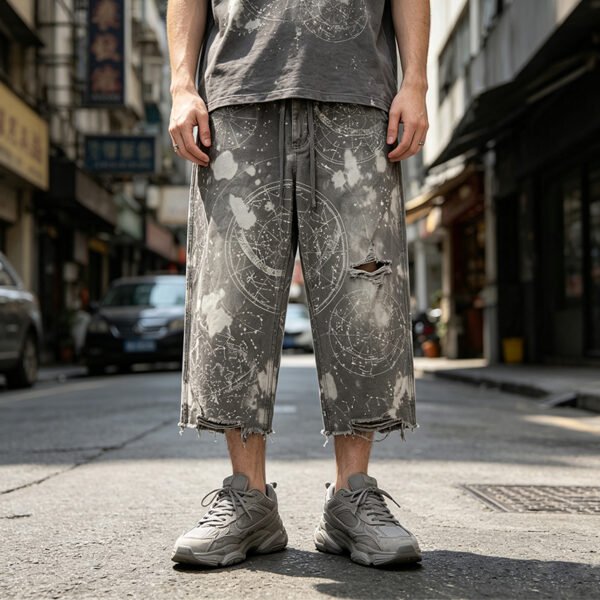




This cropped utility-pants concept depends on internal ease more than decoration alone. The visible roomy silhouette, heavy graphic coverage, torn knee, and frayed hem require a lining that moves independently enough to prevent drag, twisting, or premature exposure while retaining the intended streetwear proportion.
Shell Volume Sets the Lining Brief
The shell appears relaxed from waist through thigh, then narrows visually toward a cropped hem. That proportion creates movement demand at the seat and upper leg, where a tight lining could pull the exterior graphics off center during walking, sitting, or bending.
VeeWen should first convert the reference image into shell and lining measurement blocks, then compare rise, seat, thigh, knee, and hem allowances separately. The approval target is a lining that supports comfort without adding visible bulk beneath the washed outer surface.
Ease Must Protect Graphic Placement
Circular line graphics span both legs and approach the crotch, knee, and lower hem zones. If the lining catches during movement, the shell can rotate around the body, making those continuous visual fields appear skewed even when the printed panels were cut correctly.
During development, VeeWen can map graphic registration against grainlines, center fronts, inseams, and knee landmarks before cutting. Buyers should approve a movement sample from multiple angles, checking whether lining tension changes the graphic balance during ordinary walking and seated postures.
Distress Changes Stress Distribution
The visible knee opening and frayed hems remove material from areas that already experience bending, abrasion, and repeated contact. A lining that is too short, tight, or firmly anchored near those zones may concentrate stress at the shell edges.
The workflow should therefore separate intentional damage from structural reinforcement. VeeWen can propose clean internal seam allowances and controlled attachment points while retaining the irregular exterior character. Buyers should decide how much natural-looking wear is acceptable before durability requirements alter the visual target.
Cropped Hems Need Controlled Internal Length
Both hems finish above the shoe with irregular threads and visibly uneven edge character. Because the exterior length is intentionally unstable, the lining cannot simply be cut to an identical raw edge without risking exposure, twisting, or unwanted peeking during movement.
VeeWen should test lining length relative to the finished shell after washing and distress processing, not only before assembly. The buyer checkpoint is a post-finish sample review confirming that the lining remains discreet while the frayed outer hem keeps its approved irregularity.
Wash Sequencing Affects Balance
The charcoal appearance combines overall fading with pale splatter-like marks and printed orbital details. Washing, abrasion, and finishing can change shrinkage or surface hand across shell and lining differently, which may create bubbling, torque, or a changed drape after treatment.
For this style, VeeWen's development workflow should record shell and lining behavior through the intended wash sequence, with measurements taken before and after finishing. Buyers should approve the resulting hand, ease, color contrast, and graphic stability as one integrated package.
Approval Should Happen by Movement Test
The strongest decision point is not a flat lay alone, because the product's value depends on how a loose cropped shell behaves around the body. Walking, sitting, stair movement, and pocket access reveal lining drag more clearly than static inspection.
VeeWen can organize the approval around a fit sample, graphic placement map, finish swatch, and movement checklist. The buyer should sign off only when comfort, shell-to-lining balance, distress boundaries, and post-wash proportions remain consistent with the visual reference.
Buyer Questions
Is the cotton percentage verified for this pants concept?
No. The supplied image and source wording do not verify composition percentages, so shell, lining, and trim materials must remain To Confirm until technical documentation is approved.
What should be checked first during sampling?
Check seat and thigh ease, lining mobility, cropped length, knee articulation, and graphic registration together, because changes in one area can visibly disturb the others.
Can the distressed finish be adjusted?
Yes, distress boundaries, abrasion intensity, knee opening dimensions, splatter distribution, and hem fraying can be developed as approval points, subject to the buyer's signed visual standard.
What commercial minimum applies to this development?
The commercial minimum is MOQ: 100 pieces per style. Final material, construction, packaging, and production terms require confirmation during the approved product-development process.
Approve the Balance Before Size-Set Development
Send the target measurements, lining preference, wash direction, and graphic files to VeeWen. We will structure the first approval around movement ease, finish behavior, and shell-to-lining balance.


Reviews
There are no reviews yet.