
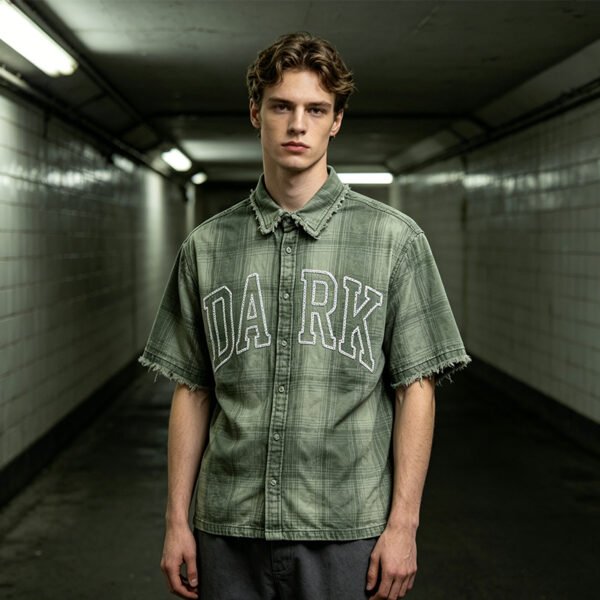
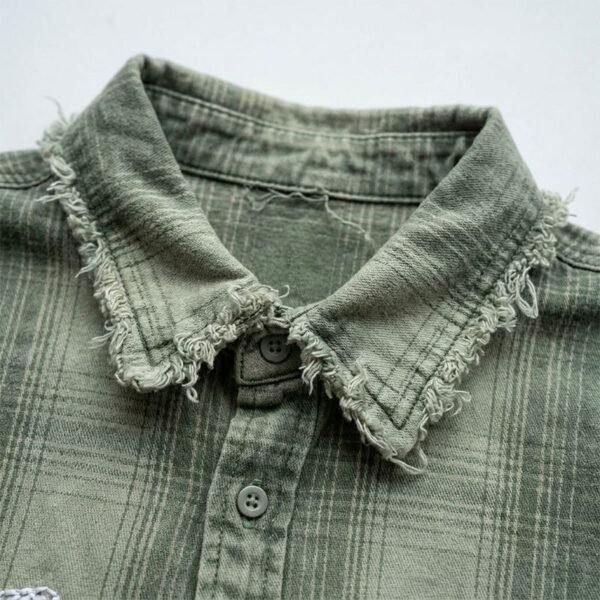

This custom plaid shirt is a development study in neckline discipline. Its muted woven check, pointed collar, raw edges, and oversized outlined lettering create tension between controlled shape and distressed styling. VeeWen can develop that balance through measurable rib recovery, collar geometry, and placement checks.
Why Neck Recovery Controls the Look
The collar is the garment's visual anchor because the plaid shirt carries a pointed shape close to the face. If rib or neckline recovery is weak, the opening can widen, twist, or lose symmetry after handling, undermining the distressed concept.
Recovery is controlled through rib selection, neckline circumference, seam allowance, stitch tension, and stabilization at the collar join. For this style, the objective is not a stiff formal collar, but a relaxed edge that returns to its intended shape consistently.
Reading the Supplied Image
The reference presents a muted sage checked shirt with a centered button placket, pointed collar, short sleeves, and large outlined lettering across the chest. The collar and sleeve edges appear intentionally unfinished, creating a worn surface language.
Those visible choices establish a practical hierarchy for development: preserve the collar silhouette first, then reproduce the raw edge character, and finally balance lettering scale against the plaid repeat. The image supports direction, but does not verify hidden construction.
Managing Distressed Edges
Raw edges are not automatically casual; they still require controlled cut lines and predictable fraying. Excessive unraveling can shorten the sleeve appearance, distort the collar points, and create inconsistent pairs, while insufficient abrasion can make the finish appear accidental rather than designed.
A sample review should compare edge length, thread release, wash response, and symmetry across collar and sleeves. VeeWen's development team can separate approved distress level from production tolerances so the visual effect remains intentional at scale.
Balancing Lettering With Plaid
The outlined chest lettering crosses a high-contrast plaid field, so placement and registration matter as much as graphic size. Misalignment can make the lettering appear tilted, while excessive density may stiffen the front and compete with the collar's shape.
Development should test the lettering method, outline width, backing, and placement against the actual plaid repeat. The buyer should approve a full-front sample because a flat artwork file cannot show how fabric movement changes the perceived alignment.
VeeWen Development Checkpoint
VeeWen should begin by translating the reference into a neckline block with measured collar points, opening dimensions, rib or binding recovery targets, and raw-edge allowances. The first sample then reveals whether relaxed styling survives real handling without losing the intended shape.
At fit review, the buyer can approve neckline geometry separately from distress and graphic execution. This workflow keeps the manufacturing axis visible: the collar is validated as a functional component before final decoration and bulk specifications are locked.
Trade-Offs Before Production Approval
A softer neckline can improve the vintage impression but may sacrifice resistance to stretching. More stabilization can protect shape but reduce the loose, lived-in character. Similarly, aggressive edge treatment increases visual impact while raising tolerance concerns around fraying and length consistency.
The commercial decision is therefore a controlled compromise, not a request for maximum distress. Approve the sample when the neckline returns reliably, collar points remain balanced, and the raw finish looks deliberate within an agreed tolerance range.
Buyer Questions
Is this shirt suitable for menswear streetwear collections?
Yes. The straight body, short sleeves, muted plaid, raw edges, and oversized chest lettering provide a clear menswear streetwear direction for further development.
What should be measured during neckline sampling?
Measure neckline circumference, collar point symmetry, opening width, recovery after handling, seam stability, and the visual effect of any raw-edge treatment.
Can the lettering be changed for a private-label program?
Yes. Lettering scale, wording, outline treatment, placement, and application method can be developed against the approved plaid repeat and target sample.
What is the minimum order requirement?
MOQ: 100 pieces per style. Final material, decoration, packaging, and production details should be confirmed after sample approval.
Approve the Neckline Direction
Send the target measurements, plaid references, lettering artwork, and distress preference to VeeWen. Request a physical sample review focused on recovery, collar balance, edge behavior, and front alignment.


Reviews
There are no reviews yet.