
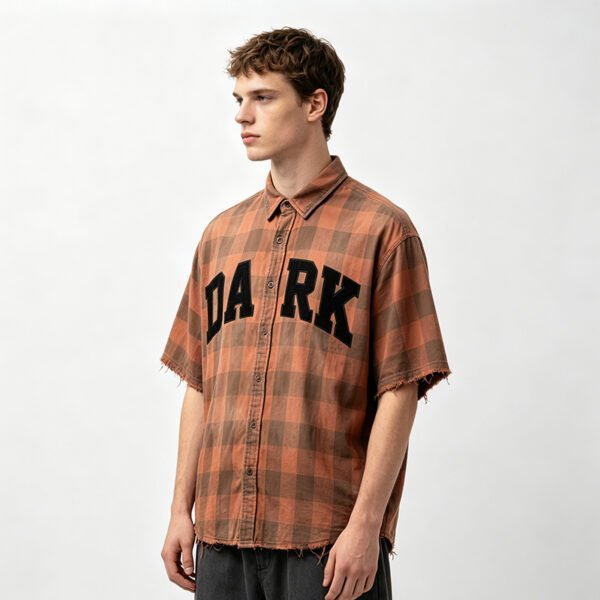



This shirt is defined by controlled contrast: a regular plaid body carries a faded spray-dyed surface, while patch lettering and frayed edges introduce deliberate disruption. The key development question is whether cuff and hem recovery should stabilize those edges without weakening the relaxed vintage proportion shown here.
Why Recovery Matters Against Distressing
Distressing removes visual and sometimes physical continuity at an edge, so recovery must be judged as a stabilizing mechanism rather than a generic quality target. Excessive rebound could pull the sleeve opening inward and undermine the broad, casual proportion visible in the image.
A recovery-led sample should compare raw, lightly stabilized, and rib-bound edge options under repeated handling. Reviewers should inspect opening circumference, waviness, fray length, and how each choice interacts with the plaid repeat before selecting the production direction.
Reading the Plaid and Surface Together
The plaid supplies order through repeating blocks of rust, brown, charcoal, and muted peach, while the spray-dyed appearance interrupts that order with tonal variation. This relationship makes edge control especially important because a tight cuff could appear too polished beside the weathered surface.
Panel matching should therefore be reviewed alongside the distress map, not separately. The buyer should confirm whether plaid continuity is expected across sleeves and body, and whether fading remains intentionally uneven without obscuring the patch placement.
Patch Placement Needs Edge Discipline
The large dark chest patch becomes the shirt's strongest graphic anchor, so surrounding fabric must remain stable enough to support its weight and visual scale. If an opening contracts unevenly, the resulting tension can shift attention away from the centered patch composition.
Development review should record patch location from the button placket, collar break, and side seams. Confirm embroidery or applique construction separately, then evaluate whether sleeve and hem recovery preserve a balanced front view after laundering and normal movement.
Managing a Relaxed Short-Sleeve Proportion
The image presents a roomy short-sleeve silhouette with a straight, easy body and sleeves extending away from the upper arm. Recovery that is too firm would create a tubular sleeve opening, changing the garment from relaxed overshirt to fitted casual shirt.
VeeWen's workflow should begin by locking the opening measurement and edge intention on the technical sheet, then sampling the construction with the selected plaid and surface treatment. Approval should follow a side-by-side proportion review, not a cuff decision made in isolation.
Distressed Edges and Production Repeatability
Frayed sleeve and hem edges create character through irregularity, but repeatability depends on defining acceptable variation. The image supports an intentionally unfinished appearance; it does not establish a precise fray length, stitch density, or wash sequence.
The buyer should provide a reference tolerance for edge length, loose-thread concentration, and panel-to-panel variation. VeeWen can then translate those visual boundaries into sample comments and inspection points, keeping the distressed effect expressive while preventing uncontrolled damage during bulk cutting and sewing.
Approval Gate for VeeWen Development
For this product, the meaningful workflow checkpoint is an edge-behavior review after the first construction sample. Compare opening recovery, fray retention, patch stability, plaid alignment, and overall drape using the same approved measurements and finishing direction.
VeeWen's product-development record should carry the chosen edge construction as a style-specific instruction, with the raw or rib-bound decision tied to the approved visual standard. The buyer can then authorize bulk development at MOQ: 100 pieces per style once the silhouette and surface balance agree.
Buyer Questions
Does the image prove the shirt uses rib cuffs?
No. The visible sleeve edges appear distressed and open; rib construction is a development option requiring buyer approval and technical confirmation.
What should the first sample prioritize?
Prioritize sleeve opening recovery, fray boundaries, plaid placement, patch position, and the interaction between edge stabilization and relaxed body proportions.
Can the distressed finish be made consistent?
Yes, consistency can be guided through approved visual tolerances for fray length, loose threads, fading distribution, and acceptable panel variation.
What is the commercial minimum?
The stated commercial minimum is MOQ: 100 pieces per style, subject to approved specifications and development alignment with VeeWen.
Approve the Edge Direction
Send the intended plaid, patch artwork, and distress reference for a focused construction review, then approve the sleeve and hem recovery direction before bulk development begins.



Reviews
There are no reviews yet.