

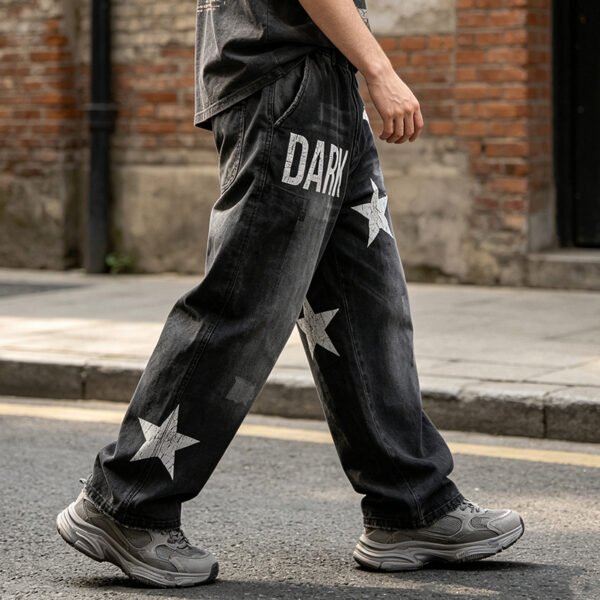


These utility cargo pants center development on graded proportion rather than decoration alone. The close-up reveals a substantial layered pocket, abrasion, frayed edges, and washed black character; the challenge is scaling those details so each size retains the same practical balance and vintage visual weight.
Why Cargo Pockets Expose Grading Errors
A cargo pocket is a strong visual and functional anchor, so inconsistent scaling becomes obvious across sizes. If the pocket remains fixed while the leg expands, it can look undersized; if enlarged too aggressively, it can dominate the thigh and affect movement.
The supplied image shows a deep, layered pocket with a separate flap and distressed edges. That construction needs proportional decisions for width, height, flap overlap, and placement, because each dimension influences access, silhouette, seam stress, and perceived garment balance.
Building a Reliable Base Size
The first approval should establish a complete base-size relationship between waist, rise, hip, thigh, knee, hem, and pocket position. A visually convincing close-up cannot confirm those measurements, so the full block remains a deliberate development checkpoint.
For a relaxed utility fit, buyers should define how much room is intentional through the seat and thigh, then position the pocket within that volume. The pocket should remain reachable without sitting directly over a high-flexibility crease or crowding the side seam.
Scaling Rise and Leg Volume Together
Grading the rise independently from leg width can change how the pants sit and make the pocket appear misplaced. Larger sizes may require additional front and back rise, while smaller sizes need controlled reduction to avoid excess fabric beneath the pocket.
VeeWen should review graded patterns as a silhouette sequence, not merely a spreadsheet of increments. Overlaying the size set can reveal whether thigh expansion, knee shaping, and hem opening progress smoothly, keeping the utility character recognizable from the smallest to largest planned size.
Preserving Distress Through Size Changes
The image shows abrasion concentrated around the pocket flap and adjacent fabric, with frayed edges creating irregular character. Scaling the garment does not automatically scale that appearance; wash exposure, sanding location, and edge finishing must be mapped so distress remains intentional.
The trade-off is repeatability versus individuality. A tightly controlled map supports consistent wholesale presentation, while more variation can strengthen the vintage effect but complicate approval. The buyer should define acceptable visual tolerance before bulk finishing begins, especially around functional pocket edges.
VeeWen Workflow Checkpoint
VeeWen can connect the argument to a size-set workflow by confirming the base block, grading pocket geometry, producing representative size samples, and comparing measurement overlays with worn evaluations. The pocket is reviewed alongside the body, not after grading is complete.
The development record should capture pocket coordinates from the side seam, waistband, and leg landmarks, plus flap dimensions and reinforcement intent. This gives production and finishing teams a shared reference when wash development or sewing adjustments threaten the approved proportion.
Approval Criteria for the Size Set
Before production approval, inspect at least the planned fit book's key size points for waist comfort, rise coverage, thigh ease, knee transition, hem balance, and pocket accessibility. Review front, side, and seated views because cargo volume changes across positions.
The buyer's final decision is whether the graded set maintains the same utility hierarchy and vintage character at every size. Approve only when the pocket remains proportionate, distress stays controlled, and the composition and finishing specifications are documented.
Buyer Questions
Is the 95% cotton and 5% polyester composition confirmed?
It is explicit in the supplied source wording. Fabric construction, weight, finish behavior, and final mill documentation should still be confirmed during development.
Can pocket dimensions vary by size?
Yes. Pocket width, height, flap, and placement can be graded proportionally, provided access, reinforcement, side-seam clearance, and visual hierarchy remain consistent.
Will every pair have identical distress?
A mapped process can improve consistency, but vintage washing may create controlled variation. The buyer should approve a tolerance range using representative preproduction samples.
What is the minimum commercial order?
The commercial minimum is MOQ: 100 pieces per style, with final feasibility depending on approved grading, fabric confirmation, wash standards, and production-ready specifications.
Approve the Graded Utility Set
Share the complete size chart, target pocket measurements, and preferred wash direction to begin proportion testing. VeeWen will align grading, pocket architecture, and finishing tolerances before production approval.


Reviews
There are no reviews yet.