


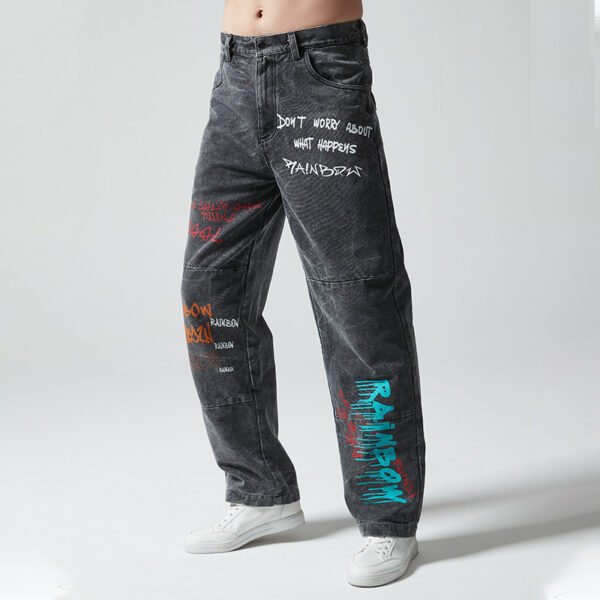

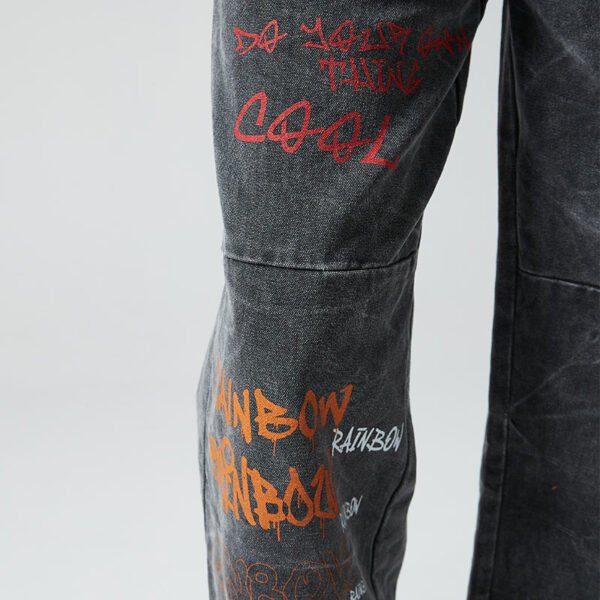


This custom washed jean is built around the relationship between reinforcement and graphic placement. The supplied image shows charcoal denim, front-pocket construction, horizontal leg seams, and multicolor lettering across several stress-prone zones, so bartack planning must protect wear points without disrupting the intended artwork hierarchy.
Why Bartacks Shape the Product
Bartacks are small reinforcement elements, but their location changes how a jean carries repeated pulling at pockets, seams, and openings. In this design, the reinforcement decision must be made alongside artwork placement because each visible interruption can affect both serviceability and graphic balance.
The image shows a waistband, angled front pockets, and horizontal leg divisions that create distinct load paths. Those paths should be identified before final artwork is locked, allowing the development team to place reinforcement where stress concentrates without treating every seam as an identical risk.
Mapping Stress Before Artwork
VeeWen can begin by marking pocket corners, belt-loop attachments, fly ends, seam intersections, and lower-leg joins on the base pattern. The artwork layout can then be overlaid, revealing where bartacks may cross printed or applied graphics and where clear zones should be reserved.
This sequence protects the visual hierarchy visible in the reference, where bright lettering is distributed across a dark washed ground. A technical review should confirm whether each graphic remains readable after reinforcement, topstitching, washing, and normal body movement.
Balancing Reinforcement and Comfort
A bartack that is too dense, too long, or poorly positioned can create stiffness at a movement point. Conversely, insufficient reinforcement may allow pocket corners or belt-loop attachments to deform. The development objective is controlled stress distribution, not maximum reinforcement everywhere on the garment.
The straight relaxed silhouette offers room for graphic storytelling, but the wearer still bends at the hip and knee. VeeWen should evaluate reinforcement positions on a fit sample, checking seated and walking movement so structural additions do not create avoidable pressure or visual bunching.
Wash Effects on Construction
The charcoal surface has a vintage washed character that changes contrast across panels and around seams. Washing can also soften thread, alter edge definition, and make bartacks more or less conspicuous. The wash sequence therefore belongs in the same approval path as construction and artwork.
A representative sample should show the intended prewash construction and postwash appearance before final sign-off. Buyers can then judge whether reinforcement remains secure, whether graphics retain separation from seam shadows, and whether the aged finish supports the planned collection direction.
Coordinating Multicolor Graphics
The supplied image places white lettering high on one leg and brighter red, orange, and turquoise elements lower across the garment. This distribution creates an intentional vertical rhythm, so bartacks should avoid cutting through the strongest letterforms or creating accidental focal points.
Artwork files should include protected zones around critical characters, while technical files should identify reinforcement coordinates independently. That separation lets VeeWen adjust bartack length or placement for construction reasons without silently changing the approved graphic composition.
Buyer Approval Checkpoint
The buyer's approval checkpoint is a washed fit sample reviewed for three outcomes: secure stress zones, comfortable movement, and uninterrupted graphic hierarchy. Any one result can mask weakness in another, so the decision should be recorded against the complete finished garment.
VeeWen's workflow should carry the approved base pattern, graded stress map, bartack schedule, artwork placement, wash direction, and inspection references into production preparation. This creates a practical handoff for the MOQ while keeping later adjustments traceable and commercially controlled.
Buyer Questions
Can bartacks be hidden from the main artwork?
They can often be positioned in protected construction zones, but the final result depends on pocket geometry, stress requirements, graphic placement, and the approved wash appearance.
Is the source-confirmed denim composition verified?
No. The source wording references cotton denim, but this record treats composition, weight, and stretch as requiring confirmation before material approval.
Will washing change bartack visibility?
Yes, washing may change contrast, thread character, and seam definition. Approve reinforcement on a representative finished sample rather than an untreated garment alone.
What is the minimum production quantity?
The commercial minimum is MOQ: 100 pieces per style. Final production planning depends on approved denim, artwork, reinforcement, wash, and graded specifications.
Approve the Stress Map
Share the size range, artwork files, denim reference, and wash direction with VeeWen for a bartack-led fit review before confirming the production-ready development package.

Reviews
There are no reviews yet.