

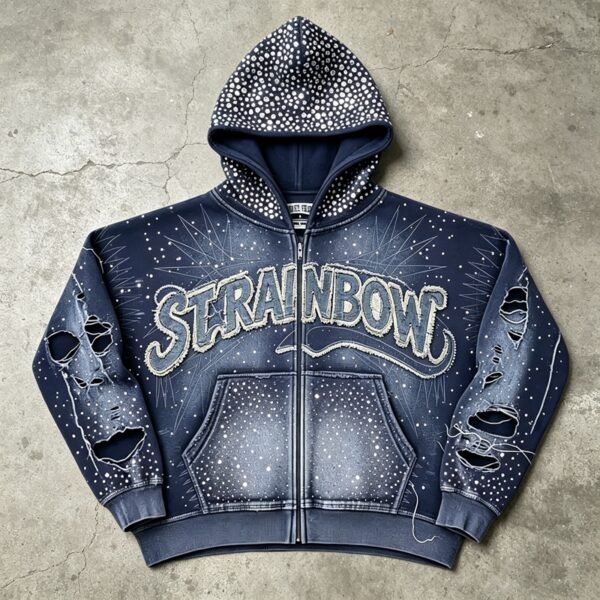







This custom washed applique hoodie is developed around decoration placement, marker direction, and controlled material consumption. The supplied image shows expansive contrasting lettering crossing a center-front zipper, making artwork scale, panel yield, and wash variation inseparable from the approval decision.
Approve the Artwork Field Before Cutting
The image presents lettering as the dominant surface event, with red applique spanning chest and pocket zones rather than sitting as a small logo. Because the zipper interrupts the front, the marker must preserve letter spacing across separately cut panels before decoration begins.
A larger motif increases fabric usage through placement margins, applique blanks, stabilizer, and potential cutting inefficiency. VeeWen's workflow should therefore begin with a graded marker review showing artwork boundaries, zipper centerline, pocket interference, and expected consumption before a physical sample is approved.
Use the Center Front as a Control Line
The center-front zipper provides a fixed directional reference visible in the supplied image. Letters that appear balanced across this line require coordinated left and right pattern pieces, not simply one oversized graphic placed after assembly, especially when wash movement can alter perceived symmetry.
During development, VeeWen can lock the artwork to pattern notches and establish mirrored placement tolerances for each size. The buyer should review a paper or digital marker overlay first, then confirm whether the design prioritizes perfect symmetry or an intentionally irregular vintage effect.
Account for Washed Color Movement
The charcoal surface appears unevenly faded, with lighter variation around seams and panels. That visual evidence suggests the wash is part of the design language, but it also means applique color, stitch visibility, and edge contrast may change after processing.
VeeWen's product-development sequence should place wash trials before final decoration approval when possible, or use documented post-wash decoration testing if decoration must precede washing. The checkpoint is a paired comparison showing untreated and washed samples under consistent lighting, with acceptable shade movement defined.
Protect Material Yield Around Components
The hoodie combines a full front opening, hood, ribbed cuffs, ribbed hem, and a kangaroo-pocket region. These components compete for usable fabric width, while broad applique shapes require stable placement zones away from seams, zipper tape, and pocket openings.
Marker planning should separate shell, rib, and decoration consumption instead of treating the garment as one simple rectangle. VeeWen can use the approved size range and artwork dimensions to identify nesting constraints, while the buyer confirms whether reduced motif size is acceptable if yield becomes unfavorable.
Control Applique Construction at Boundaries
The red lettering has a raised, sewn appearance with dark outlining that gives each character visual weight. Such construction needs defined edge allowance, stitch density, backing, and trimming standards so letters remain legible without distorting the washed knit surface.
VeeWen's development review should inspect applique behavior at the zipper edge, pocket transition, and curved lower lettering. The buyer should approve a decorated panel or first sample against the artwork file, checking registration, edge smoothness, and whether the aged finish remains intentional rather than damaged.
Make the Approval Decision Commercially Clear
This design is strongest when the buyer treats artwork scale and fabric consumption as one commercial decision. Enlarging the lettering may increase shelf impact, but it can reduce marker efficiency, complicate grading, and intensify wash inconsistency across visible front panels.
Before moving toward production, approve the marker map, graded placement tolerances, wash appearance, and decoration sequence together. The commercial baseline is MOQ: 100 pieces per style, while final material, construction, and decoration details remain subject to signed specifications.
Buyer Questions
Is the pictured garment a pullover hoodie?
The supplied main image visibly shows a center-front zipper, so the pictured construction should be confirmed before classifying the final style as pullover.
Why does marker direction matter for this hoodie?
Large lettering crosses separate front zones, while zipper alignment, pocket placement, and grading make orientation directly affect artwork balance and material yield.
Should decoration happen before or after washing?
The sequence should follow wash testing and construction review; approve the selected order only after checking applique registration, edge behavior, and color contrast.
What is the minimum commercial quantity?
The required commercial minimum is MOQ: 100 pieces per style, with final quantities dependent on approved materials, artwork, construction, and production specifications.
Approve the Marker and Wash Direction
Send the target size range, artwork dimensions, and wash preference for a VeeWen review of marker efficiency, applique boundaries, and sample approval checkpoints.




Reviews
There are no reviews yet.