


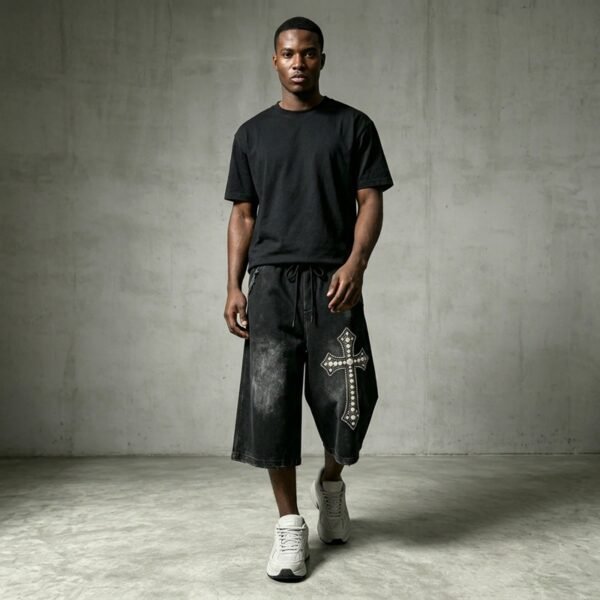







This custom cropped denim jean develops its identity through a cross motif whose placement must remain controlled as front, leg, and pocket-area panels are assembled. The commercial challenge is registration: preserving visual continuity while balancing beadwork, wash character, comfort, and production practicality.
Registration Starts With the Motif Geometry.
The supplied image shows a large cross built from pearl borders, oversized pearl-like centers, and smaller rhinestones on visibly washed dark denim. Because the motif spans changing fabric surfaces, placement tolerances matter more than decoration alone; each panel can shift the perceived geometry.
For development, convert the artwork into a placement map referenced from stable landmarks, including side seams, pocket openings, waistband edges, and hem lines. Registration checks should compare left-right balance and motif scale after washing, pressing, embellishment, and final assembly, not only on paper.
Attachment Must Protect Alignment and Wearability.
The cross appears dimensional rather than printed, so the working sample should isolate attachment sequence from base-garment construction. Stabilizing the denim underneath embellished zones can reduce distortion, while stitch paths, stone spacing, and pearl security require review for wear, laundering, and handling.
A dense focal treatment increases labor, weight, and snag exposure, especially where the legs bend or rub against seating. The buyer must decide whether the visual priority is maximum sparkle, softer hand, or simplified repeatability before approving production-ready artwork and attachment specifications.
Wash Development Can Shift the Visual Balance.
The washed surface is part of the product language: cloudy abrasion marks make the dark ground less uniform and amplify contrast around the pale cross. That finish can also complicate registration because washing changes shade, hand, and sometimes panel dimensions before embellishment is evaluated.
A controlled sequence should therefore define which effects occur before decoration and which are protected afterward. Compare the approved wash standard against embellished panels under retail lighting, checking whether abrasion overwhelms small stones or makes pearl edges appear uneven across matching legs.
Fit Review Should Include Motif Movement.
The cropped capri silhouette and drawstring waist suggest a relaxed, adjustable streetwear direction, but the image does not verify measurements or wearing ease. Panel registration must be assessed on the actual block because crotch shaping, leg rotation, and waistband gathering alter motif alignment.
Fit approval should review the cross while the garment is flat, worn, and lightly tensioned at the waist. Confirm inseam, rise, leg opening, cord length, and embellishment clearance together; a visually centered motif may shift during movement if the block is too narrow.
VeeWen Workflow: Build a Registration Pack.
At VeeWen, the development checkpoint for this style is a registration pack linking artwork coordinates to the approved denim block and wash sequence. The pack should identify panel landmarks, tolerance bands, embellishment files, and photographs required for each sample review.
Before bulk commitment, VeeWen can use the sample review to reconcile placement, wash appearance, fit, and attachment practicality in one approval trail. The buyer should sign the final panel map and decorated sample, with unresolved fiber, weight, and performance details marked To Confirm.
Approve the Commercial Repeatability Threshold.
This style is commercially strongest when the cross reads immediately from a distance while its pearl and rhinestone structure rewards closer inspection. Its distinctiveness depends on disciplined repeatability; inconsistent arm lengths, stone rows, or wash contrast can make paired garments look unrelated.
The production decision is not simply whether the motif is attractive. Approve the style only after reviewing a complete decorated sample, laundering direction, packaging protection, and target cost impact; then confirm MOQ: 100 pieces per style for the intended colorway and construction.
Buyer Questions
Can the cross motif be changed?
Yes, artwork can be developed around the approved block, but every scale or placement change requires a revised panel map and decorated sample to verify registration after washing and assembly.
What must the buyer approve?
Approve the denim block, wash reference, cross artwork, landmark coordinates, embellishment hierarchy, tolerance expectations, and final decorated sample before confirming production quantities and colorway for commercial release.
Is the denim composition known?
No composition percentage is supplied in the evidence. VeeWen should confirm fiber content, fabric weight, stretch behavior, recovery, and care requirements against the selected denim before sampling and final approval.
What is the minimum order quantity?
The commercial minimum is MOQ: 100 pieces per style. Confirm whether the planned embellished treatment, colorway, and size range fit that quantity before requesting the production quotation and final costing review.
Submit the Cross Registration Brief.
Send VeeWen the target block, wash direction, cross artwork, and size range for development. We will align the panel registration review with the decorated sample, then confirm open specifications and MOQ: 100 pieces per style.


Reviews
There are no reviews yet.