

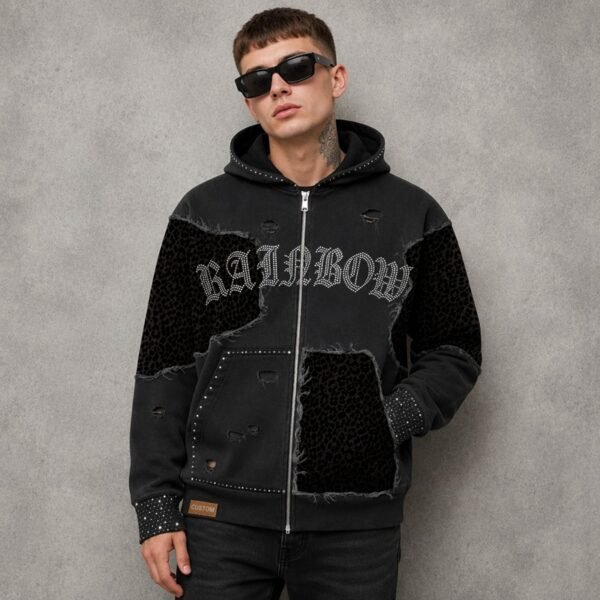
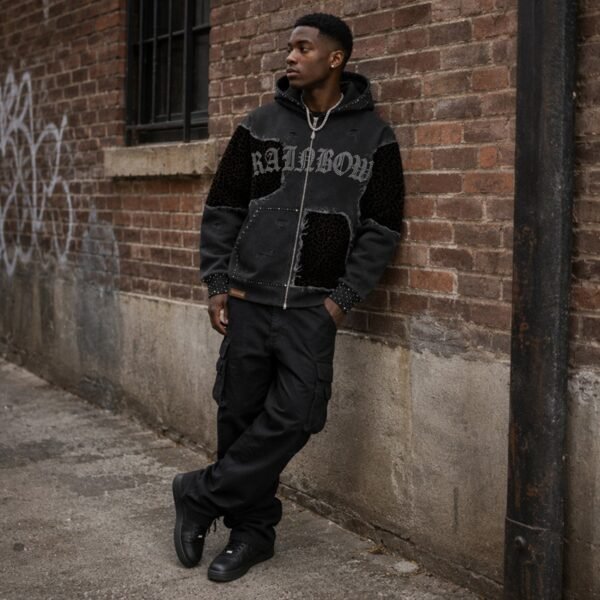
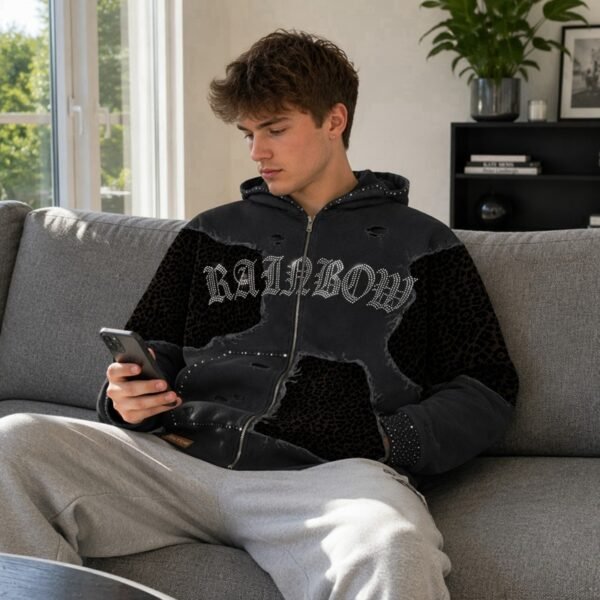

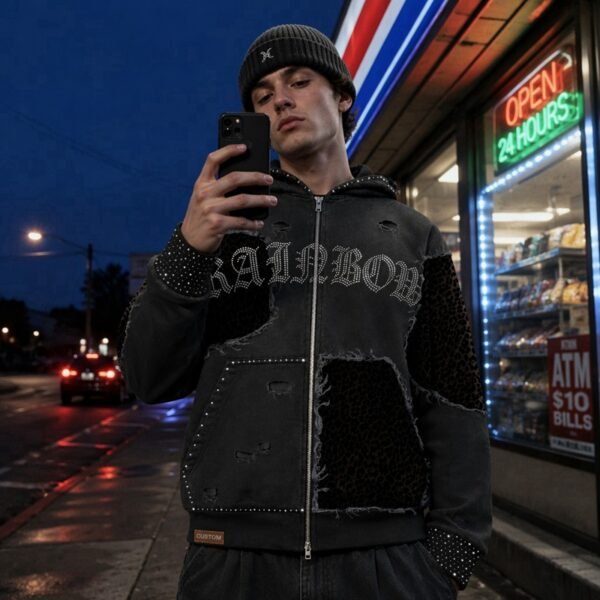






This custom zip hoodie turns seam alignment into the primary development standard. Leopard-pattern inserts, exposed raw edges, split rhinestone lettering, distressed openings, pockets, and a central zipper create linked visual paths. Their positions must be engineered as one garment map, not approved as isolated decorations.
Why Alignment Defines This Design.
The hoodie's identity comes from multiple elements crossing or terminating near visible seams. Leopard inserts meet washed charcoal sections at curved raw edges, while bright lettering divides at center front. Small placement errors would read immediately as broken flow rather than harmless sewing variation.
Alignment must be defined in the finished, zipped state because zipper application, seam allowances, washing, and fabric behavior can shift relationships. The technical package should identify critical match points and distinguish them from intentionally irregular raw-edge contours that allow controlled visual variation.
Mapping Panels Before Pattern Cutting.
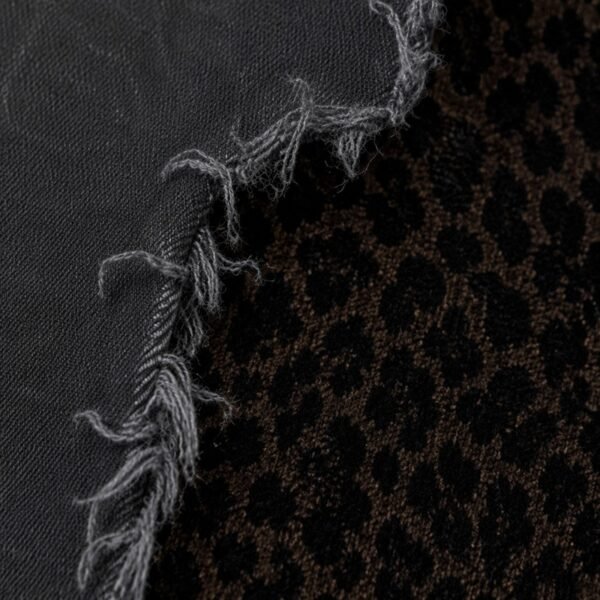
Each contrasting insert should be developed as a pattern-integrated panel rather than a surface patch positioned after assembly. Pattern edges, seam allowances, notch locations, grain direction, and visible leopard orientation need coordinated references so operators can recreate the intended paths consistently across sizes.
The large lower-front insert curves around the pocket region, while upper inserts travel from chest toward the sleeves. Nested pattern review should test whether these lines retain their direction after grading. Buyers must approve whether motifs align exactly or only maintain balanced distribution.
Managing the Center-Front Split.
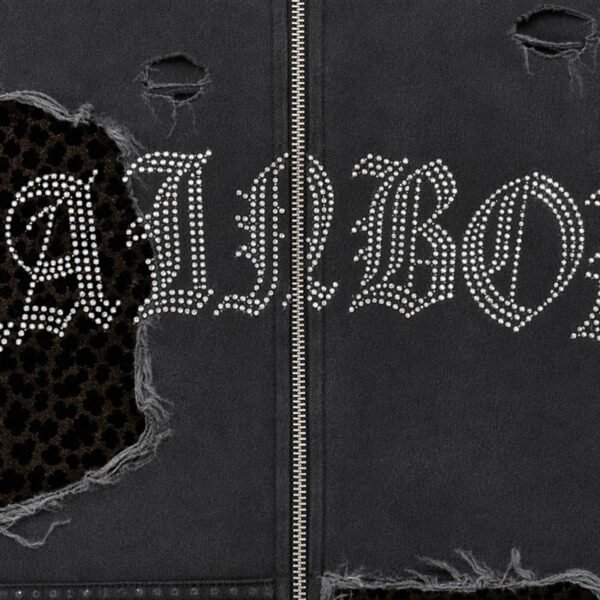
The rhinestone-style lettering spans both front halves, making zipper symmetry a critical inspection point. Letter height, center gap, baseline, and distance from the upper panel seams must be established after accounting for zipper tape exposure and the garment's finished center-front width.
Application guides should register from center front and stable seam landmarks, not from raw panel edges that may change during washing. A closed-garment approval image can document acceptable continuity, while an open view confirms that embellishment remains clear of zipper sewing and hardware.
Resolving Raw Seams and Pocket Junctions.
Exposed seam allowances create the pale, frayed outlines separating dark leopard panels from the washed body. Their width and irregularity affect the composition, but excessive fraying could obscure intended curves or interfere with pocket openings, zipper tape, and nearby embellishment attachment.
Pocket geometry is especially important because the two sides interact differently with surrounding panels. Opening length, angle, edge studs, and seam clearance should be checked independently, then compared as a balanced pair. The buyer should approve intentional asymmetry without accepting accidental functional mismatch.
Synchronizing Sleeves, Hood, and Cuffs.
Leopard sections extend across both upper sleeves, creating visible transitions at the armhole and lower sleeve seams. Matching every motif may be impractical, but panel heights and directional flow can be controlled through notches, placement templates, and paired component checks before assembly.
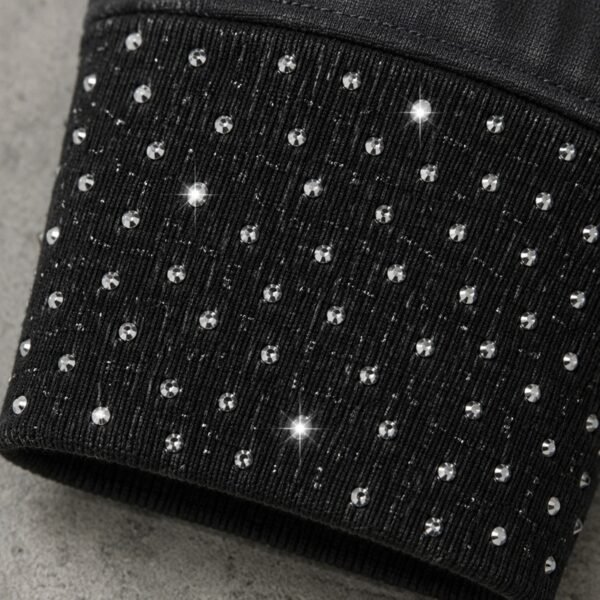
Stud-like accents around the hood edge and dark cuff areas repeat the front embellishment language. Spacing must accommodate seam turns, cuff stretch, and hood curvature. Exact component type, attachment method, durability expectation, and acceptable spacing variation remain To Confirm during sample review.
VeeWen Workflow and Alignment Approval.
VeeWen should consolidate the panel map, graded pattern, zipper specification, embellishment templates, raw-edge standard, and wash reference into one development revision. This connects cut-and-sew decisions with decoration placement, reducing the risk that separate approvals produce conflicts at final assembly.
Approval should use a finished sample photographed fully zipped, laid symmetrically, and shown at sleeve transitions and pocket junctions. Buyers should sign off critical match points, permitted raw-edge variation, lettering continuity, and postwash panel behavior before authorizing the production specification.
Buyer Questions
Must the leopard motifs match exactly at every seam?
Not necessarily. Exact motif matching can increase material consumption and cutting complexity. Buyers may instead approve controlled panel height, directional consistency, balanced motif distribution, and clearly identified critical junctions.
How is the split front lettering kept visually continuous?
VeeWen can register application templates from center front, control the zipper gap, and verify the baseline on a closed finished sample. Final artwork dimensions and embellishment attachment remain To Confirm.
Will exposed raw edges look identical on every garment?
Some variation is inherent to the intended frayed appearance. The approval standard should define visible allowance width, fraying boundaries, protected functional zones, and unacceptable distortion around pockets, zipper, and embellishments.
What is the commercial minimum for this zip hoodie?
MOQ: 100 pieces per style. Order planning should account for the approved size ratio, panel materials, zipper, embellishment components, wash treatment, labels, and packaging defined in the final specification.
Align Every Visible Junction Before Production.
Share your target measurements, panel artwork, leopard reference, zipper preference, and embellishment files with VeeWen. We will organize sampling around the visible match points that determine whether this complex zip hoodie reads as intentional.


Reviews
There are no reviews yet.