


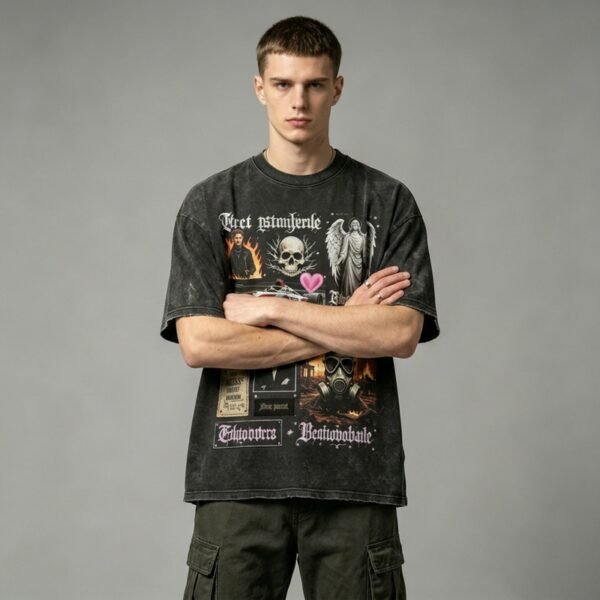





This oversized graphic tee should be developed from the finished garment backward. The supplied image shows a washed charcoal-black body, substantial rib crew neck, and dense light artwork, while the source wording adds DTG and frayed-edge direction. Post-process weight must anchor fit and decoration decisions.
Why Finished Weight Controls the Tee
A tee's pre-process fabric weight cannot fully predict the finished garment's hand. Washing can change moisture content, surface character, shrinkage, and perceived density, so the post-wash sample is the meaningful reference for buyer approval.
The supplied image presents a softened charcoal surface beside a firm-looking rib collar. That contrast suggests the body and neckline should be evaluated together, because a lighter finished body can make the collar feel disproportionately heavy or visually dominant.
Wash Change and Oversized Proportion
Oversized proportions rely on stable finished measurements, not only the starting pattern. If the body shortens or narrows during washing, the intended relaxed balance can shift even when the original cutting dimensions were correct.
VeeWen should compare pre-process and post-process chest, length, sleeve, and shoulder measurements on the same development sample. The buyer's approval should prioritize the washed measurements and hand, then update grading to reflect the accepted finished state.
Rib Collar as a Weight Reference
The close image shows a ribbed crew neckline with clear vertical texture and a stable rounded edge. That collar provides a useful visual counterpoint to the washed body, but its recovery and width must be checked after processing.
If the body loses more apparent weight than the rib, the neckline may look too assertive; if the rib relaxes excessively, the tee can lose definition. The sample review should record collar width, attachment appearance, and post-wash shape before production.
Artwork Scale After Processing
The high-contrast collage artwork occupies a prominent chest area in the supplied image. Because washing can soften the ground and affect perceived contrast, the buyer should judge the graphic on the finished garment rather than on an untreated print panel.
The source wording references DTG artwork, but print durability, ink behavior, and exact process remain To Confirm. VeeWen should use the approved washed body to verify artwork scale, placement, edge clarity, and interaction with the distressed treatment.
Distressing Without Losing Weight Control
Frayed edges are identified in the source wording, while the supplied image provides close evidence of the washed body and neckline. Distressing should be treated as a controlled subtraction from the finished garment, not as an afterthought applied to an unapproved weight.
The buyer should specify which edges receive fraying, the visual intensity, and the acceptable variation range. VeeWen can then evaluate whether the treatment changes local stability, opening size, or perceived mass around hems, sleeves, and other exposed edges.
VeeWen Development Approval Gate
VeeWen's workflow should establish the untreated fabric reference, process the development sample, and record finished GSM alongside finished measurements. That sequence makes the manufacturing axis measurable before grading, artwork placement, and distressing are locked.
The final buyer checkpoint is a post-wash review of weight, dimensions, rib behavior, artwork appearance, and edge treatment. After approval, the technical pack should identify finished references clearly, with MOQ: 100 pieces per style as the commercial minimum.
Buyer Questions
Why is finished GSM more important for this tee?
Washing can change surface character, moisture state, shrinkage, and perceived density, making the processed garment more relevant than the starting fabric weight.
Does the image confirm the cotton composition?
No. The supplied materials do not state a verified fiber composition, so cotton content, yarn details, GSM, and wash chemistry remain To Confirm.
Should artwork be approved before washing?
Artwork direction can begin earlier, but final scale, contrast, placement, and edge clarity should be approved on the washed development garment.
What is the minimum order quantity?
The commercial minimum is MOQ: 100 pieces per style. Production remains dependent on approved specifications, accepted samples, and finalized technical documentation.
Approve the Finished Garment Reference
Share the target hand, measurements, artwork files, and distressing boundaries so VeeWen can process a development tee and document the finished weight for approval.


Reviews
There are no reviews yet.