


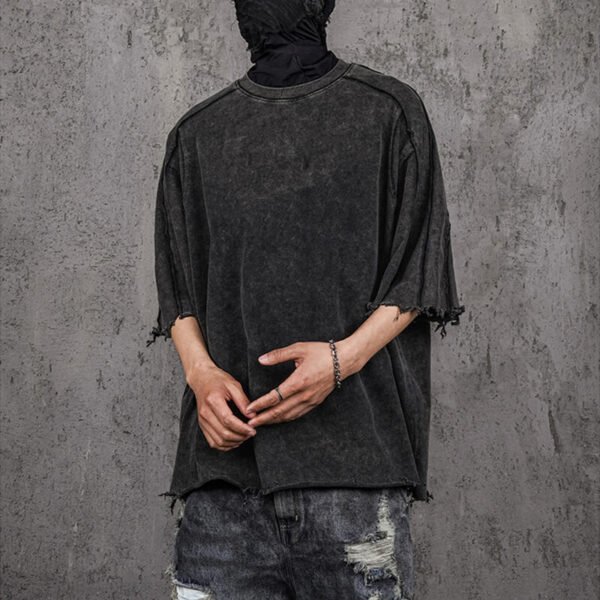
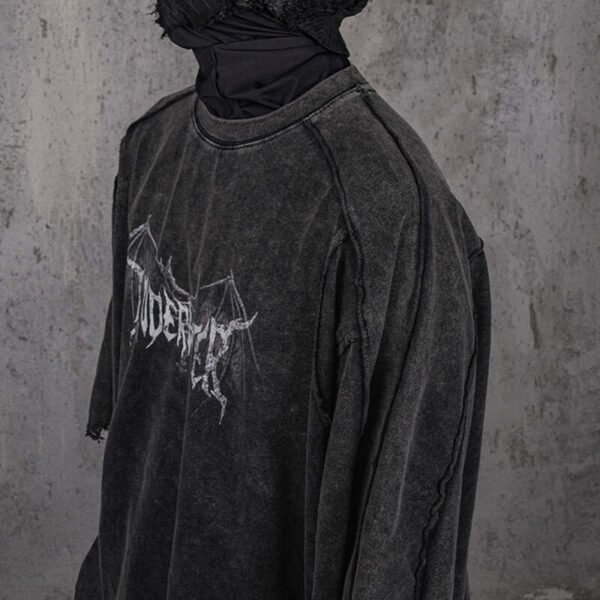

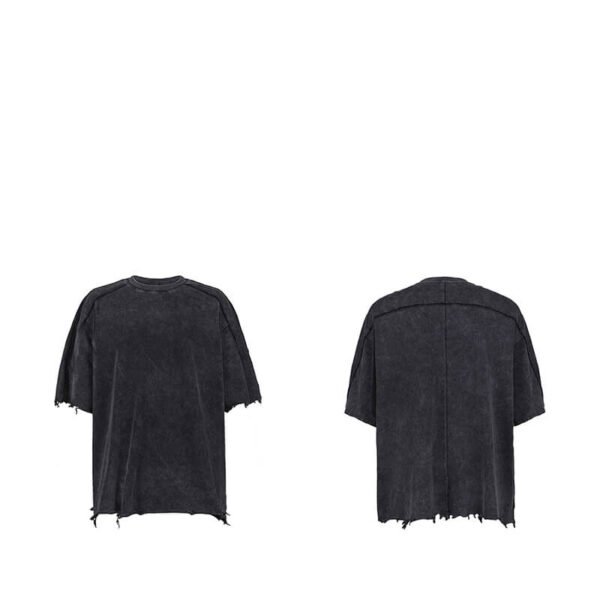


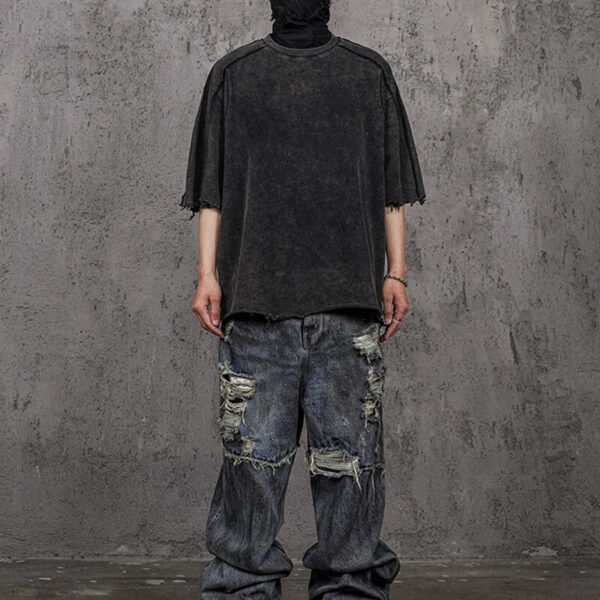







This custom washed oversized T-shirt should be developed from its final washed proportions backward. The broad body, dropped shoulders, irregular edges, and tonal charcoal surface create a silhouette where relaxation control is essential to prevent shrinkage from changing the intended balance.
Why Relaxation Controls the Silhouette
An oversized T-shirt has generous dimensions, so small dimensional changes can alter shoulder drop, sleeve reach, body width, and hem position. Relaxing the fabric before cutting allows the pattern to respond to its settled state rather than its freshly spread state.
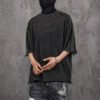
The supplied image shows a broad back, low shoulder line, and extended sleeve shape. Those proportions should be measured after the intended wash direction is understood, because a visually relaxed garment can become shorter, narrower, or more twisted after processing.
Reading the Washed Surface
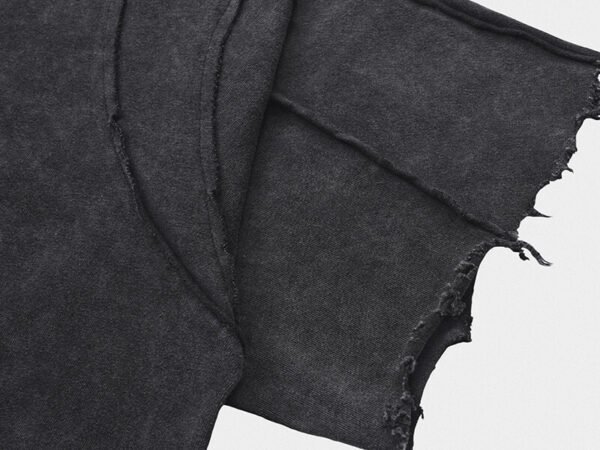
The charcoal body displays tonal variation rather than a perfectly uniform black appearance. That variation is part of the product language, but it can also reveal differences in fabric tension, panel exposure, wash loading, or finishing sequence.
A development sample should therefore be assessed under consistent lighting and photographed across front, back, sleeves, and hem. The buyer should separate acceptable tonal character from unwanted streaking, patchiness, or uneven concentration around seams.
Raw Edges Need Pattern Allowance
The sleeve openings and lower hem appear intentionally irregular, with a raw edge that contributes to the distressed visual direction. Raw finishing can change width and length as yarns release, curl, or continue to fray during washing and wear.
Pattern allowances should account for the finished edge rather than treating it like a standard folded hem. VeeWen should record edge exposure, fray limits, and measurement points so the irregular finish remains controlled instead of becoming inconsistent.
VeeWen Development Workflow
VeeWen should first establish the fabric reference, relaxation procedure, wash sequence, and oversized base measurements as one connected development package. The key checkpoint is a washed sample measured after relaxation, cutting, sewing, and finishing are complete.
The approved sample can then define graded measurements, raw-edge allowances, and acceptable shade movement for production. This links the manufacturing axis to the actual fit decision, ensuring the buyer approves the garment in its settled condition.
Trade-Offs in a Washed Oversized Build
More pronounced washing can strengthen the worn surface and soften the hand, but it may increase dimensional movement, shade variation, and edge instability. A lighter treatment may improve consistency while producing a cleaner appearance than the supplied reference suggests.
The buyer should decide which characteristic carries priority: stronger vintage irregularity or tighter size and shade control. That choice should be written into the approval notes before bulk cutting, because later correction can change the garment's character.
Approval Checkpoint and Next Step
The approval review should compare the washed sample with the intended block using shoulder width, chest width, sleeve length, body length, and hem behavior. Measurements should be taken after the fabric has completed the agreed relaxation and finishing process.
Release the style only when the buyer accepts the balance between oversized volume, washed variation, and raw-edge movement. VeeWen can then carry the approved tolerances into the technical pack and production inspection instructions.
Buyer Questions
Why relax the fabric before cutting this style?
Relaxation lets the fabric settle before pattern placement, helping VeeWen establish measurements that better represent the garment after washing and reduce unexpected proportion changes.
Is the cotton composition verified?
The source wording references cotton fabric, but no percentage or test evidence is supplied. Final composition, weight, knit construction, and performance should remain marked to confirm.
How should raw edges be controlled?
Define finished edge exposure, allowable fray, measurement points, and post-wash appearance in the technical pack. Review these details on a washed sample before production approval.
What is the minimum commercial quantity?
The commercial minimum is MOQ: 100 pieces per style. Quantity planning should follow approved fabric, wash, size-range, color, finishing, and inspection requirements.
Approve the Settled Fit
Share the target measurements, wash direction, and desired edge character for development. VeeWen can relax the fabric, build the oversized block, and present a measured washed sample for approval.


Reviews
There are no reviews yet.