


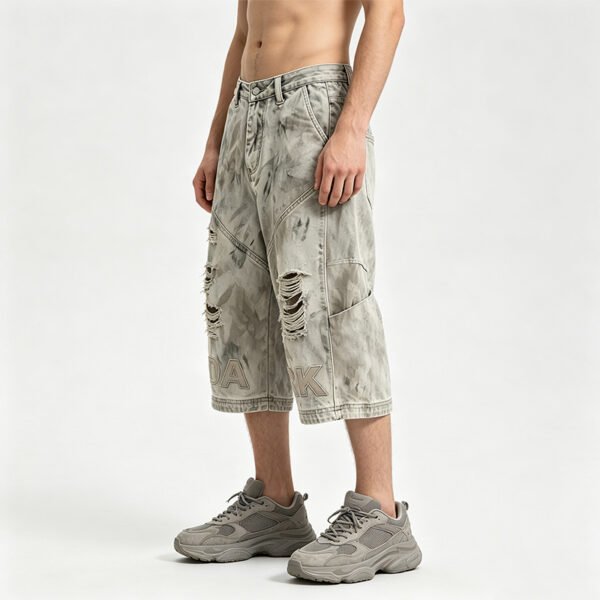


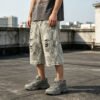


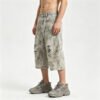
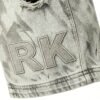

These cropped jeans turn a washed, graphic surface into a registration challenge: every applique or transfer must align as panels meet. VeeWen can develop the artwork as a placement map, then approve matching across the waistband, fly, front legs, pockets, and back panels before cutting.
Registration Begins with a Panel Map
All-over registration depends on a controlled coordinate system, not visual approximation. The artwork must be divided at every seam, pocket edge, fly extension, and waistband join, with compensation for shrinkage, sewing ease, and panel distortion. That keeps motifs visually continuous after assembly.
On these jeans, the supplied close-up shows a mottled grey wash crossing the fly area and waistband, while the source wording identifies applique and heat-transfer decoration. Those references make seam-to-seam tonal continuity and decoration placement the first development checks, even though the complete artwork remains unprovided.
Wash Variation Changes the Coordinates
Denim washing can alter panel dimensions before decoration is judged, especially when tonal effects create an irregular visual field. VeeWen should establish whether transfers and appliques are applied before or after washing, then record dimensional allowances for each route during sample review.
The close-up provides evidence of a deliberately uneven grey surface around the button, zipper, and fly. That variation is commercially useful, but it can disguise drift or exaggerate misalignment, so buyers should evaluate artwork continuity under consistent lighting and against approved wash standards.
Decoration Must Respect Denim Interfaces
Applique and heat transfer place different demands on denim. Applique introduces edge thickness and stitch or bonding boundaries, while transfer artwork relies on surface contact and pressure. Their locations should avoid zipper teeth, button folds, pocket openings, and high-abrasion edges unless deliberately engineered.
The visible close-up isolates a buttoned waistband, exposed zipper, belt-loop area, and layered fly construction. These interfaces demonstrate where decoration could buckle, interrupt, or lose alignment, making placement files and seam allowances essential parts of the technical package rather than styling afterthoughts.
Cropped Proportions Increase Placement Sensitivity
A cropped leg shortens the available vertical canvas, so artwork scaled for full-length jeans may terminate too abruptly near the hem. The buyer should approve motif scale, hem position, distressing locations, and front-to-back balance together, because each decision changes the perceived registration rhythm.
The source wording identifies cropped jeans and distressed styling, while the supplied image confirms a washed denim construction with a structured fly. Distressing remains visually unverified in the close-up, so its placement, intensity, and interaction with transfers require separate sample evidence before approval.
Sampling Should Prove Continuity, Not Just Appearance
The first sample should include every decorated panel, not a simplified front substitute. Reviewers should compare the physical garment against a flattened artwork map, checking center lines, pocket alignment, waistband joins, fly symmetry, and leg transitions before approving bulk cutting or final wash execution.
Use measurable tolerance notes for artwork drift, panel shrinkage, and edge placement, while recording which differences are intentional wash character. This separates acceptable handcrafted variation from production error and gives the factory a clear correction path when the sample misses the approved visual target.
VeeWen Workflow for This Registration Challenge
VeeWen's development handoff should begin with the buyer's artwork, panel pattern, decoration sequence, wash recipe reference, and tolerance sheet. The team can then prepare a registration proof, sample the complete garment, and route discrepancies back to artwork or pattern corrections before costing confirmation.
The approval checkpoint is a signed sample package showing front, back, waistband, fly, pocket, and hem views under agreed lighting. Buyers should confirm composition, decoration durability expectations, distressing, and grading separately, because supplied evidence cannot verify those technical details today.
Buyer Questions
Can the artwork continue across every denim panel?
Yes, development can map artwork across panels, but continuity depends on approved files, pattern geometry, shrinkage allowances, decoration sequence, and buyer-approved tolerance limits.
Does the image verify the denim fiber content?
No. The image shows denim appearance and construction details only; fiber composition, weight, stretch percentage, and performance specifications require source documentation or laboratory confirmation.
When should distressing be finalized?
Finalize distressing after reviewing the complete sample, because abrasion placement can interrupt transfers, expose applique edges, alter wash contrast, and change how registered artwork is perceived.
What is the commercial minimum for development?
The commercial minimum is MOQ: 100 pieces per style. Final quantities, size ratios, decoration details, and production terms should follow the approved technical package.
Approve the Registration Proof
Send the artwork, pattern references, wash direction, and target measurements for a mapped sample review. VeeWen can then document panel alignment, decoration interfaces, and the correction checkpoint before bulk approval.


Reviews
There are no reviews yet.