


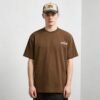

This T-shirt is developed around seam bulk at high-layer intersections. The supplied back view shows a wide skeleton graphic, oversized upper lettering, and sleeve-reaching decoration near shoulder joins, creating a specific need to balance visual coverage with flexible, cleanly sewn construction.
Why Seam Bulk Matters Here
The back graphic occupies a broad area and contains many close ribs, bones, letters, and internal shapes. When several decoration layers overlap near a shoulder or sleeve join, the fabric can become thicker, less flexible, or harder to turn accurately during sewing.
That matters because the visible image places the widest graphic elements close to the upper back and sleeve lines. The technical objective is not simply maximum coverage; it is preserving the graphic's scale while keeping shoulder seams flat enough for comfortable wear and consistent drape.
Artwork Boundaries Around Joins
VeeWen's workflow should convert the graphic into a seam-aware placement file before decoration approval. The artwork can remain visually expansive while establishing clear no-build zones around shoulder seams, sleeve heads, neckline joins, and any areas requiring dependable needle access.
Those boundaries should be defined from the finished garment, not only from a flat back panel. A placement that looks safe on paper may move toward a seam after shrinkage, handling, or sewing tolerance, so the sample must verify the actual assembled relationship.
Layer Planning for Dense Graphics
The supplied image suggests a high-contrast graphic with broad lettering, a central rib cage, and repeated smaller forms. Different decoration methods or passes may create uneven thickness when these elements overlap, especially around narrow bone shapes and tightly spaced outlines.
Development should separate visual layers by function and thickness. Broad structural shapes can carry the main impact, while fine internal details should avoid unnecessary stacking near seams. This protects readability and reduces the chance that decoration becomes stiff exactly where the garment must flex.
Protecting Shoulder Construction
Shoulder seams carry both the garment's shape and the upper edge of the back artwork. If decoration extends too close to that seam, sewing operators may encounter added resistance, or the finished join may hold a visible ridge that changes how the T-shirt sits.
A construction review should inspect shoulder width, sleeve insertion, neckline balance, and the graphic's distance from each join. The buyer should view the shirt worn or hung naturally, because seam bulk is most apparent when the fabric is allowed to fall without tension.
Washed Appearance and Decoration
The dark brown body and light skeleton artwork create a strong contrast, while the source wording references a normal-wash direction. Any wash or surface treatment must therefore be evaluated for how it changes decoration edges, color separation, and the feel of layered areas.
A heavier surface treatment may create desirable character but can also expose uneven thickness or soften small details. Buyers should choose the wash intensity alongside the decoration route, then approve the combined result rather than evaluating each process independently.
VeeWen Development Checkpoint
VeeWen should use the first assembled sample to record seam-bulk observations at the shoulders, sleeve joins, upper back, and neckline. The review should compare decoration density, seam flatness, drape, and graphic legibility against the approved placement file.
Before production release, the buyer should sign off on seam exclusion zones, layer order, wash direction, and acceptable thickness variation. That approval creates a practical cut-and-sew standard for MOQ: 100 pieces per style without sacrificing the graphic's defining scale.
Buyer Questions
What is the biggest construction concern for this graphic?
The concern is added thickness where broad artwork, outlines, or multiple decoration passes approach shoulder and sleeve seams, potentially affecting flatness, flexibility, and drape.
Does seam clearance reduce the visual impact?
Not necessarily; a mapped exclusion zone can preserve the graphic's scale while preventing dense decoration from occupying the areas that need clean sewing.
Should the wash be approved before decoration?
The wash direction can be selected early, but final approval should assess the washed garment and decoration together because surface change affects edges and hand feel.
What should be checked on the sample?
Check shoulder and sleeve seam flatness, neckline behavior, upper-back drape, graphic readability, decoration thickness, and whether the washed appearance remains evenly integrated.
Approve the Seam-Aware Artwork
Send VeeWen the graphic file, wash direction, target size range, and placement priorities so the team can develop a decorated sample with clear seam exclusion zones.


Reviews
There are no reviews yet.