
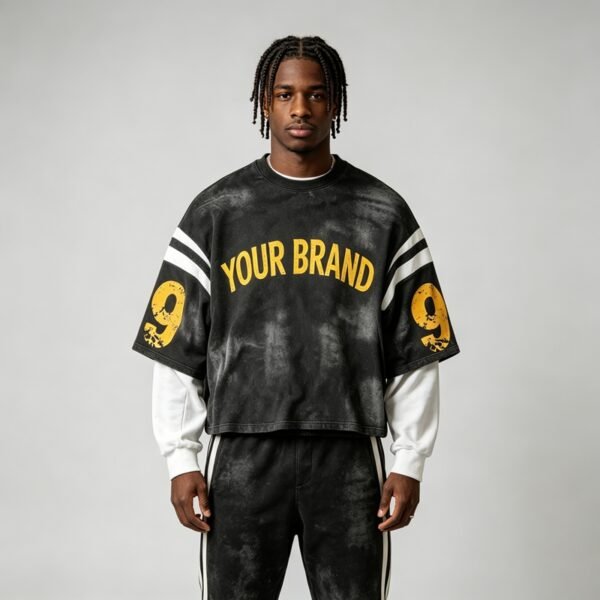

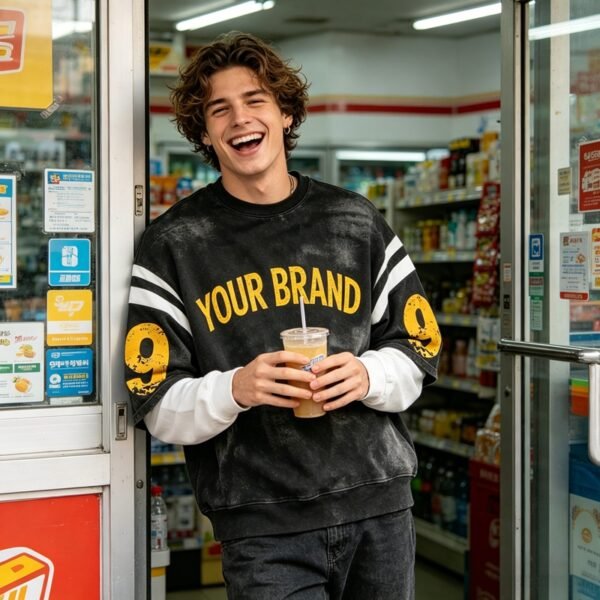










This custom faux two-piece T-shirt uses a shortened washed outer layer and exposed long-sleeve styling to create set-level impact in one garment. The development challenge is balancing spray-dye irregularity with decoration density, so the surface feels intentional while the body remains stable through production handling.
Why Decoration Density Controls the Visual Balance
The image concentrates yellow lettering across the chest and large numerals on both sleeves, creating high-contrast focal points. Dense print coverage can visually flatten a mottled ground, so artwork scale, ink deposit, and spacing should be reviewed against wash variation.
The faux-layer construction adds another graphic boundary where the black cropped body meets white sleeves. That boundary must remain legible beside printed areas, requiring placement checks that protect sleeve movement and prevent decoration from crowding seam lines or cuffs.
Base-Fabric Stability Under a Washed Recipe
Spray dye produces intentional tonal inconsistency, but the underlying fabric still needs predictable cutting and sewing behavior. If panels shift or shrink unevenly, the cropped hem, sleeve reveal, and print registration can lose the deliberate proportion visible in the supplied image.
VeeWen should translate the selected wash into a controlled development sequence: stabilize the base fabric, map expected dimensional change, then place artwork after the usable measurements are established. This links surface approval directly to pattern corrections rather than treating washing as decoration alone.
Faux Two-Piece Construction and Wearability
The image presents a short black T-shirt layer over white long sleeves, giving buyers the appearance of a layered set without separate upper-body pieces. This reduces styling complexity, while the joined construction demands comfortable armhole shaping and clean transitions at the sleeve attachment.
For a Tracksuits and Matching Sets assortment, the top should coordinate with the assigned set language through proportion, wash tone, and graphic placement. Buyers should decide whether the integrated layer is intended as a standalone top, a set component, or both before finalizing grading.
Graphic Placement Around Movement Zones
Chest lettering occupies a broad central field, while sleeve numerals sit near active elbow and forearm areas. Those locations experience repeated bending and handling, so the development review should examine print flexibility, edge definition, and clearance from seams rather than evaluating artwork only on a flat panel.
The visible white sleeve contrast makes any registration drift easier to notice at the outer arm. VeeWen's artwork review should therefore lock placement landmarks to the pattern, documenting sleeve orientation and print boundaries before the wash and sewing sequence is approved.
Managing the Trade-Off Between Character and Repeatability
A cloudy black wash gives every panel visual depth, yet excessive variation can make a production run look inconsistent. Buyers should define acceptable tonal range using approved physical references, separating desirable spray marks from defects that obscure lettering or weaken the faux-layer illusion.
Higher decoration density improves immediate shelf impact but increases handling sensitivity and inspection points. A practical approval should compare the wash, print coverage, and garment balance together, because optimizing any single element can make the finished combination feel less controlled.
VeeWen Development Checkpoint
VeeWen's product-development workflow should begin with a pattern and wash trial that establishes the cropped body length, sleeve reveal, and base-fabric response. The next checkpoint is a decorated sample reviewed under the intended wash appearance, not an unwashed blank evaluated in isolation.
At MOQ: 100 pieces per style, the buyer should approve the graded measurement chart, wash tolerance, artwork placement map, and inspection standard as one package. That decision confirms whether the faux two-piece effect remains commercially repeatable across the planned size range.
Buyer Questions
Can this faux two-piece design be developed as part of a matching set?
Yes, it can be developed as a coordinated set component, but buyers should first approve top proportions, wash matching, and whether the underlayer remains visually integrated.
Is the cotton-blend composition verified?
No. Cotton blend appears in the supplied source wording, while exact fiber percentages, fabric weight, and testing remain To Confirm during material development.
What should buyers approve before bulk production?
Approve the wash tolerance, print placement, graded measurements, sleeve reveal, and inspection standard together so decoration density and base stability remain aligned.
What is the minimum order quantity?
The commercial minimum is MOQ: 100 pieces per style. Final quantities should reflect the approved color, size range, artwork, and wash development requirements.
Approve the Washed Layering Direction
Send your artwork, target measurements, and wash references to VeeWen for a focused development review covering decoration density, base stability, and MOQ: 100 pieces per style.


Reviews
There are no reviews yet.