


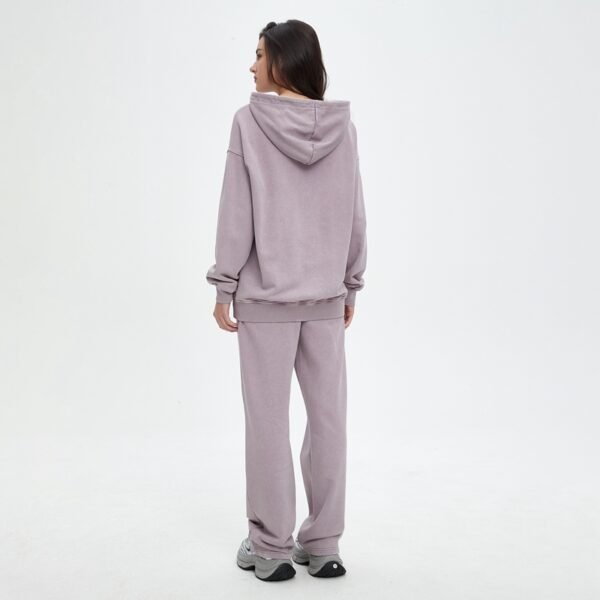
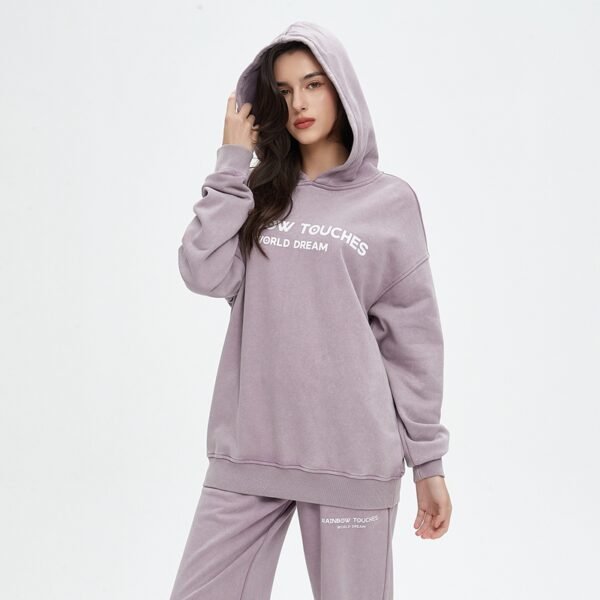











This women's matching set depends on controlled softness: the cropped hoodie, elastic-waist trousers, pocket panels, and ribbed openings must hold their lines while remaining comfortable. The development priority is localized interlining selection, because each edge carries a different shaping and recovery demand.
Where Edge Stability Matters Most
The hoodie's high neck and cropped hem create a compact visual frame around the torso. Interlining that is too light may allow curling or waviness, while excessive support could reduce softness. The first sample should isolate neckline, hem, and cuff behavior after repeated handling.
The trousers introduce different stresses through the elastic waistband, drawcord channel, pocket openings, and leg hems. These areas need support matched to seam direction and fabric weight, preventing distortion without turning flexible openings into hard borders during wear or laundering.
Interlining Should Follow the Garment Map
A single interlining choice across the complete set would ignore how each component moves. The hood opening needs controlled recovery, pocket mouths need clean entry lines, and rib joins need balanced bulk. VeeWen's development review should therefore assign support by component.
The visible pocket panels are especially important because their rectangular outlines contrast with the relaxed trouser body. A carefully selected support layer can preserve that geometry, while seam allowance control and pressing prevent the pocket edges from becoming visibly heavier.
Balancing Structure With Comfort
This set's appeal comes from a soft, easy silhouette rather than tailored rigidity. Interlining should reinforce only the areas that frame the body or receive repeated pulling. The approval sample must compare hand feel, edge roll, seam bulk, and visual recovery across several support options.
The cropped proportion also increases the importance of waistband and hem alignment. If the hoodie hem loses stability while the trouser waistband remains firm, the set can appear visually unbalanced. Coordinated testing should assess both pieces together, not as isolated garments.
Acid-Wash and Surface Variation
The source wording references an acid-wash direction, while the supplied image presents a light, tonal appearance. Any wash or dye process can influence interlining adhesion, shrinkage, edge memory, and color contrast. These effects should remain open development variables until the intended finish is confirmed.
VeeWen should sample the proposed outer material, interlining, and finishing route as one system. The key observation is not merely whether the surface looks even, but whether the hood edge, pocket borders, cuffs, and waistband retain consistent definition afterward.
VeeWen Development Checkpoint
For VeeWen's workflow, the useful handoff is an edge map attached to the pattern: neckline, crop hem, cuffs, waistband channel, drawcord exits, pocket perimeter, and trouser hems. Each location can then receive a support recommendation and a specific fit-review comment.
Before approval, the buyer should review a sewn sample with interlining options clearly identified by component. Record edge appearance, flexibility, seam thickness, and recovery after handling, then lock the selected construction into the technical specification for grading and production.
Bulk Approval Decision
The correct bulk decision is not simply choosing the heaviest support. It is confirming that every visible edge remains deliberate while the set still feels relaxed. The buyer should approve the sample only when silhouette stability and comfort remain consistent across hoodie and trousers.
Commercial planning should also preserve the exact requirement of MOQ: 100 pieces per style. Before purchase-order confirmation, approve color, wash direction, interlining locations, drawcord treatment, pocket dimensions, measurements, and the tolerance schedule together.
Buyer Questions
Why is interlining important for this tracksuit?
It stabilizes selected openings and panel edges, helping the cropped hoodie and pocket details retain shape without unnecessarily stiffening the complete sweatshirt set.
Should one interlining be used everywhere?
Not necessarily. Necklines, pocket perimeters, waistband channels, cuffs, and hems experience different forces, so component-specific support can produce a more balanced result.
What should the buyer inspect during sampling?
Inspect edge roll, seam bulk, hand feel, waistband alignment, drawcord exits, pocket geometry, and shape recovery after handling or the proposed finishing process.
When is the set ready for bulk approval?
Approve after color, finish, measurements, interlining placement, pocket proportions, drawcord details, grading, and MOQ: 100 pieces per style are documented together.
Approve the Edge Map
Send the target measurements, color direction, and finishing intent to begin a focused sample review covering interlining placement, edge recovery, comfort, and coordinated set balance.



Reviews
There are no reviews yet.