


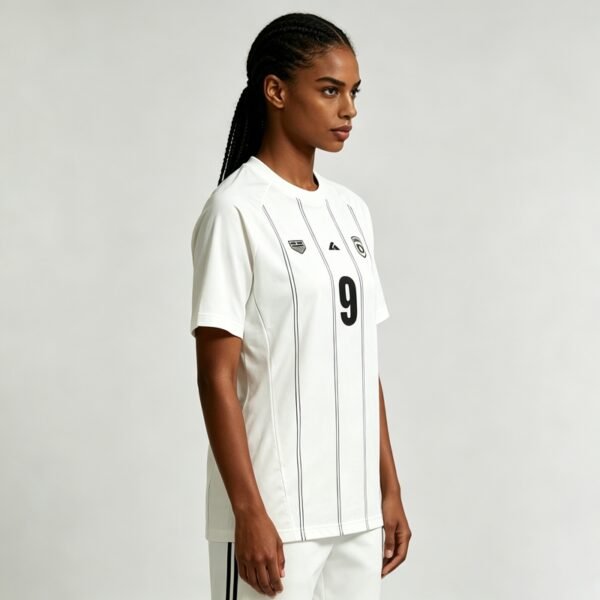
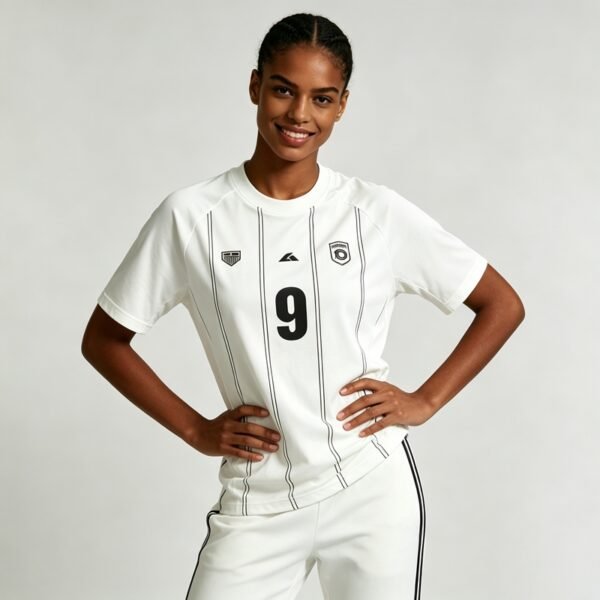








This custom women's jersey T-shirt is built around visual discipline: a narrow vertical stripe system must remain convincing as panels, seams, sleeves, and hem meet. The supplied image shows a white athletic silhouette where alignment, graphic placement, and proportion work together as the product's primary development risk.
Why Stripe Matching Controls the Jersey's Appearance
The image presents a clean white jersey interrupted by narrow black vertical lines. Because the stripes are repeated and high contrast, even a small lateral shift at a side seam can make the torso look twisted, lowering perceived quality despite otherwise sound sewing.
The pattern is especially sensitive where the body curves inward beneath the arm. A straight stripe mapped onto shaped panels changes visually as it approaches the seam, so the development team must decide whether continuity, symmetry, or a deliberate break governs each join.
Pattern Engineering Before Decoration
Stripe approval should begin with a full pattern map, not the chest artwork. VeeWen can identify the stripe repeat, establish matching points along side seams and sleeve attachments, then review how seam allowance, easing, and fabric relaxation affect the visible line.
The supplied garment also shows a centered numeral between the stripe columns. That placement creates a second control system: the artwork must remain centered relative to the finished body, while the stripe field stays balanced after sewing and pressing.
Managing Curves, Sleeves, and Hem Lines
The short sleeves widen from the shoulder and meet the body through angled underarm construction. These joins can distort a vertical repeat, particularly when the sleeve cap is eased. Matching should therefore be judged on the worn-facing surface, not only against flat pattern pieces.
At the hem, the visible stripes approach a straight horizontal edge and provide an immediate inspection line. Sampling should check whether the finished length, coverstitching, and fabric recovery pull the stripes upward, sideways, or unevenly across the front.
Graphics Must Respect the Stripe Architecture
The front carries a large black numeral and two smaller crest-like graphic areas. Their scale and spacing are visually subordinate to the stripe grid, so artwork placement should reference the finished stripe positions rather than a generic center measurement on the paper pattern.
Source wording references offset printing and embroidery, but the supplied image alone does not verify the final decoration process. VeeWen should confirm artwork layers, stitch or print boundaries, registration tolerance, and whether decoration occurs before or after panel assembly.
VeeWen Development Workflow for This Argument
For this jersey, VeeWen's workflow should treat stripe matching as a gate from concept to sample. The team can record the repeat, mark matching notches, build the graded pattern, and inspect the first sewn sample specifically at side, sleeve, neckline, and hem transitions.
The approval package should show front and back flats, close photographs of every critical join, and the graphic placement measured from finished seams. Any intentional interruption must be documented, allowing the buyer to distinguish designed breaks from production drift before MOQ planning.
Approval Checkpoint and Production Trade-Offs
Tighter matching improves visual coherence but can increase fabric planning complexity, marker waste, and cutting sensitivity. Relaxed matching may reduce development pressure, yet it risks a visibly broken stripe rhythm on a garment whose identity depends on repeated vertical lines.
Before production approval, the buyer should choose the acceptable tolerance for each join and review the garment after laundering or finishing simulation. The final decision is whether the stripe system remains balanced enough to justify the selected construction and decoration route.
Buyer Questions
What is the main development risk for this jersey?
The main risk is visible stripe displacement at curved side and sleeve joins, where shaping, easing, seam allowance, and fabric relaxation can alter alignment.
Should the graphics be approved before stripe matching?
No. Approve the stripe repeat and finished seam map first, then position graphics against the sewn garment so centering reflects the final visual structure.
Can the stripe layout be changed for another colorway?
Yes, subject to a new repeat review. Contrast, stripe width, ground color, and fabric behavior can change how much alignment variation the eye notices.
What quantity should guide the commercial discussion?
Use MOQ: 100 pieces per style as the commercial minimum, while final costing remains dependent on confirmed materials, construction, decoration, grading, and packaging requirements.
Approve the Stripe Map Before Sampling
Send the intended stripe repeat, size range, artwork, and tolerance priorities to VeeWen for a pattern-led review and a sample approval plan built around finished joins.


Reviews
There are no reviews yet.