
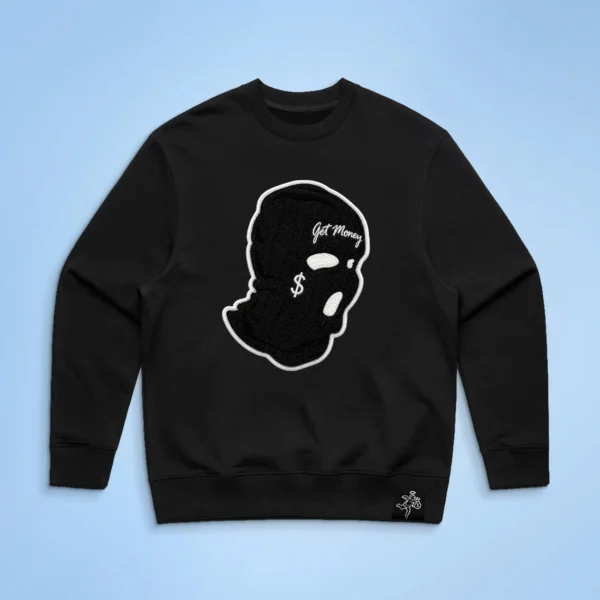
This crewneck sweatshirt should be developed around sleeve opening control, because a ribbed cuff determines wrist entry, stacking, and compatibility with an outer layer. The supplied image shows a clean black body, defined rib openings, and a raised chest motif that makes clearance a measurable product decision.
Why The Sleeve Opening Leads Development
The image presents a conventional crewneck body ending in visibly ribbed cuffs. That cuff is not decorative alone; its circumference, height, and recovery govern how the hand enters, how the sleeve settles, and whether an underlayer bunches at the wrist during wear.
For production approval, VeeWen should treat cuff opening and sleeve hem width as linked measurements. A tighter opening can stabilize stacking but restrict entry, while a looser opening improves access but may expose the underlayer or lose the intended compact silhouette.
Layering Clearance Around The Forearm
Layering clearance must be evaluated from the cuff upward rather than judged only from chest width. The photographed sleeve appears full before narrowing into the rib opening, so the pattern should preserve forearm movement while allowing a shirt or thermal layer to pass beneath without visible congestion.
The trade-off is visual discipline versus versatility. Excess ease may create sleeve collapse and interfere with outerwear, while insufficient ease can pull the cuff upward. A size-set review should compare relaxed, folded, and jacket-covered positions before approving the final sleeve block.
Managing The Raised Front Motif
The central mask-shaped graphic visibly projects from the black ground through a textured, outlined application. That raised surface may alter how the sweatshirt slides under a jacket, especially when the outer garment is close through the chest or when the wearer moves repeatedly.
This does not prove a specific backing, stitch count, or fiber content, so those variables remain open. The development question is practical: confirm whether motif height, edge softness, and placement require additional front ease or a revised layering target.
Cuff, Collar, And Hem Coordination
The garment shows rib finishing at the collar, cuffs, and lower hem, creating a repeated compression language around the body openings. Coordinating these components helps the sweatshirt retain visual balance, but each opening still needs its own tolerance because wrist, neck, and waist movement differ.
VeeWen's specification review should therefore separate rib dimensions while preserving a common appearance. Record relaxed width, stretched width, height, and attachment behavior for each component, then check whether the sleeve cuff remains proportionate when the body hem and collar are worn under layers.
VeeWen Product-Development Checkpoint
Within VeeWen's workflow, the first approval gate should isolate the sleeve block before finalizing surface execution. Build the measurement sheet around wrist entry, cuff recovery, sleeve pitch, and underlayer clearance, using the supplied image as a visual reference for the intended compact finish.
After the sleeve geometry is accepted, place the raised chest motif and reassess jacket compatibility on the same size range. This sequence prevents decoration bulk from disguising a pattern problem and gives the buyer a clear checkpoint before bulk cutting under MOQ: 100 pieces per style.
Approval Criteria For Bulk Readiness
The buyer should approve this sweatshirt when the cuff admits the hand comfortably, returns to its intended opening, and does not trap a standard underlayer at the wrist. The final review should also confirm that sleeve length and rib height maintain proportion across the selected size range.
If those checks fail, choose which priority governs the revision: easier entry, firmer stacking, or more generous layering clearance. That decision should be recorded with the approved measurement tolerance, motif placement, and construction references so production receives one accountable target.
Buyer Questions
Is the sweatshirt composition confirmed?
No. The supplied image shows appearance and construction cues only, so fiber composition, fabric weight, and any performance claim require confirmation before quotation or production approval.
Why is the cuff important for this style?
The cuff controls hand entry, wrist stacking, and underlayer clearance. Its dimensions should be tested with the sleeve block because changing one affects comfort and the visible silhouette.
Can the motif be changed for a private label range?
The visible motif is development evidence, not a fixed specification. Buyers can submit original artwork, subject to placement, application method, surface bulk, and approval of production-ready artwork.
What is the commercial minimum?
The exact commercial minimum for this product-development record is MOQ: 100 pieces per style. Final quantities, size ratios, colorways, and packaging requirements should be confirmed in the order brief.
Approve The Sleeve Block First
Send your target measurements, layering use case, and original artwork for a VeeWen review focused on cuff entry, sleeve clearance, motif bulk, and MOQ: 100 pieces per style.


Reviews
There are no reviews yet.