



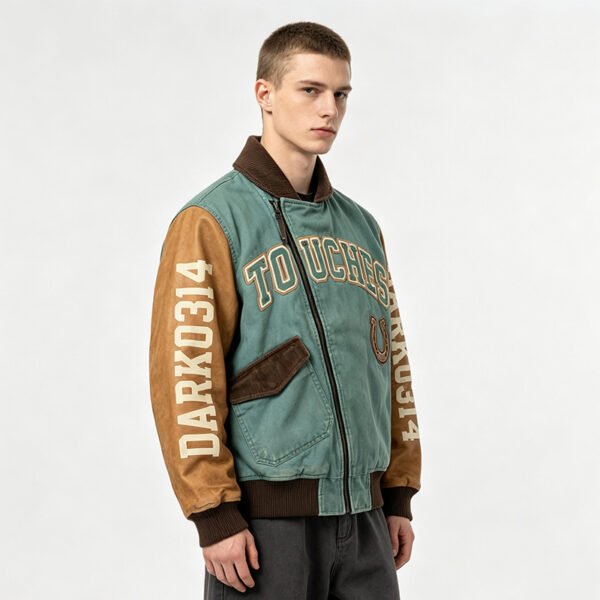




This custom vintage baseball jacket record centers on quilt or fill distribution across a multi-panel silhouette. The supplied flat-lay shows contrasting sleeves, rib closures, a diagonal zipper, pocket construction, and large graphics, but it does not verify insulation, lining, or internal quilting architecture.
Distribution Across Contrasting Panels
A baseball jacket changes hand feel where body, sleeves, rib trim, and pocket layers meet. If fill is introduced, those transitions can create visible ridges or thin zones unless the insulation map follows each panel's geometry and accounts for seam compression during assembly.
The supplied image clearly separates a muted green body from brown sleeves and rib finishes. That color blocking is also a construction map: VeeWen should treat each zone independently, then verify that warmth, loft, and drape remain visually balanced across the completed jacket.
Sleeve Mobility and Fill Migration
Sleeves need controlled loft because excess fill at the upper arm can restrict movement, while insufficient distribution near the elbow can create a collapsed appearance. Quilting intervals, lining tension, and seam allowance handling all influence how insulation settles during wear.
The reference has long contrasting sleeves with bold lettering, making surface smoothness especially important. The buyer should check whether the graphic remains legible when the sleeve bends, and whether the chosen fill arrangement avoids ridges that interrupt both movement and visual continuity.
Rib Closures as Compression Zones
Ribbed collar, cuffs, and hem compress the jacket edges and can push fill inward if the internal layers are not terminated cleanly. Uneven termination may produce bulky bands, cold spots, or waviness where the shell meets the knitted trim.
The supplied front view shows brown rib at all three major closures, giving the sample a clear boundary for inspection. VeeWen's pattern review should record fill stop points, lining turn-ins, and stitch access so the closures retain a controlled profile after joining.
Zipper and Pocket Intersections
A diagonal zipper and lower patch pocket introduce additional thickness beside the fill map. Without planned overlap, insulation can bunch against the zipper tape, while pocket reinforcement may create a hard step that changes front balance and makes the shell twist when opened.
The visible diagonal closure and pocket should therefore be sampled with the proposed lining and insulation together. VeeWen can check zipper operation, pocket access, panel alignment, and local loft in one construction review instead of approving each feature in isolation.
Graphics and Surface Regularity
Large sleeve lettering and front graphics depend on a sufficiently stable surface. Quilting, fill movement, or uneven pressing can distort placement, create shadows around applique or print, and make matched left-right sleeves appear inconsistent even when the pattern dimensions are correct.
Because the source image emphasizes graphic contrast, the buyer should define acceptable visual tolerance before decoration approval. The trade-off is deliberate: tighter quilting may stabilize the surface but reduce loft, while looser construction may improve softness yet increase movement risk.
VeeWen Development Checkpoint
VeeWen's workflow should translate the image reference into an insulation map covering body panels, sleeves, pocket zones, zipper edges, and rib termination points. The technical pack should identify whether the jacket is quilted, lightly filled, or uninsulated before pattern engineering proceeds.
Before committing to MOQ: 100 pieces per style, the buyer should approve the fill type, lining behavior, quilting scale, graphic method, and acceptable bulk at every transition. If the final brief excludes insulation, the assigned axis should be revised accordingly.
Buyer Questions
Is insulation visible in the supplied image?
No. The flat-lay shows the exterior construction but does not reveal fill, lining, quilting, or internal distribution, so the insulation architecture must be confirmed through specifications and sampling.
Why does panel blocking affect fill planning?
Contrasting body and sleeve panels create separate seam and compression zones. Fill quantity, quilting, and termination should follow those zones to prevent uneven loft, ridges, or restricted movement.
What should the buyer inspect on the sample?
Inspect sleeve mobility, rib transitions, zipper operation, pocket bulk, graphic stability, panel balance, and visible loft consistency after the jacket is worn and laid flat.
What is the commercial minimum?
The commercial minimum is MOQ: 100 pieces per style. Final quotation, timing, packaging, and compliance requirements depend on confirmed materials, insulation, construction, and decoration specifications.
Approve the Fill Map
Share the intended insulation level, lining, quilting, graphics, and measurement requirements with VeeWen, then approve the complete jacket sample before committing to MOQ: 100 pieces per style.


Reviews
There are no reviews yet.