
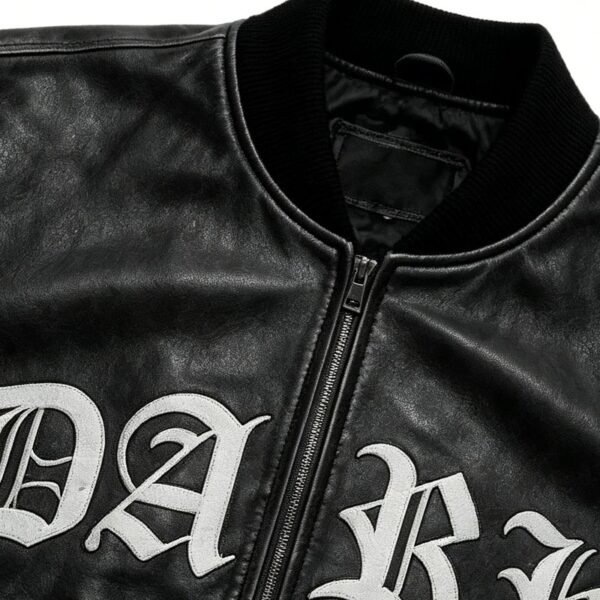



This custom varsity bomber jacket is developed around panel symmetry and mirrored components, because the centered zipper and contrasting applique make small alignment errors highly visible. The supplied close-up shows a black coated surface, continuous rib collar, vertical closure, and opposing light details that establish clear technical datums.
Symmetry Begins at the Center Front
The centered zipper is the strongest datum in the supplied image, dividing the jacket into two visually comparable halves. If the closure drifts, every surrounding element appears misaligned, including the collar curve, front panels, and contrasting applique.
The pattern should establish center front before secondary details are placed. VeeWen's technical review can control zipper length, tape exposure, seam allowance, and panel edge relationships so the closure remains straight from collar join through hem.
Controlling Mirrored Front Panels
Coated materials can reveal uneven seam tension through surface reflections, making small differences between left and right panels noticeable. The close-up shows broad black areas around the zipper, so panel width and grain direction need consistent handling.
A mirrored cutting plan should preserve corresponding front-panel shapes and notches. Sample approval should compare zipper-to-side-seam distances at several heights, checking whether sewing feed or material handling has introduced a gradual visual lean.
Rib Collar Alignment and Recovery
The rib collar forms a curved frame around the neckline and meets the zipper at the center. Unequal rib extension or an offset collar join can make the opening look tilted, even when the shell panels themselves are accurately cut.
The collar should be developed with matched left and right reference points, controlled extension, and a clean center-front meeting point. Review should include relaxed appearance, closure operation, and the collar's return after opening and closing.
Applique Placement as a Technical Gauge
The contrasting applique details provide a direct visual test for mirrored placement. Because they sit on opposite sides of the center closure, differences in height, angle, or distance can immediately change the jacket's balance and perceived quality.
VeeWen should position these components from fixed pattern coordinates rather than visual estimation during sewing. The approval sample should record each applique's center, edge clearance, and relationship to zipper tape, collar, and adjacent panel seams.
Surface Behavior and Construction Order
The supplied material appearance is smooth, dark, and reflective, while the jacket includes a rib collar, zipper, lining, and raised patch elements. These layers can shift during assembly, so construction order affects whether mirrored edges stay registered.
The development sequence should stabilize shell panels first, set the zipper second, and then place collar and applique references. Reviewing the assembled shell before decoration helps isolate panel distortion from later component-positioning issues.
VeeWen's Symmetry Approval Workflow
VeeWen should convert the image direction into a symmetry worksheet listing center front, collar join, zipper exposure, panel widths, sleeve joins, and applique coordinates. Source-referenced PU leather remains a direction until backing, thickness, and handling requirements are confirmed.
The buyer's approval checkpoint is a laid-flat and worn review using the same center-front datum. Confirm equal panel relationships, a level collar opening, straight zipper operation, and matched applique placement before authorizing the 100-piece style minimum.
Buyer Questions
Which jacket measurement controls symmetry most strongly?
Center-front zipper position is the primary datum, followed by equal zipper-to-side-seam distances, matched collar joins, and consistent applique coordinates across both front panels.
Why can coated material reveal panel imbalance?
Reflective surfaces emphasize changing angles, seam tension, and grain direction, so small width or feed differences may appear as uneven highlights beside the closure.
Should applique be placed before or after the zipper?
Approve and stabilize the zipper and shell panel geometry first, then place applique from recorded pattern coordinates to prevent decoration from masking underlying asymmetry.
What is the commercial minimum for this jacket?
The commercial minimum is MOQ: 100 pieces per style, with production proceeding after materials, measurements, construction, decoration, and symmetry approval are confirmed.
Approve the Mirrored Bomber Jacket Sample
Share the target measurements, applique artwork, material direction, zipper preference, and lining requirements with VeeWen for a symmetry-focused sample review aligned with MOQ: 100 pieces per style.

Reviews
There are no reviews yet.