
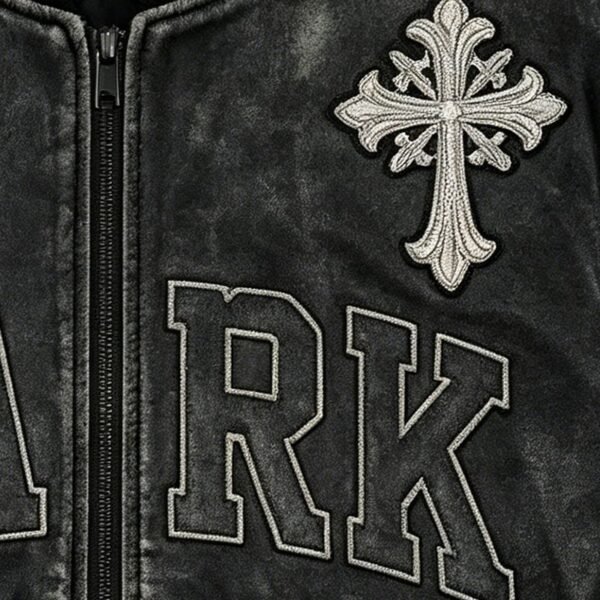
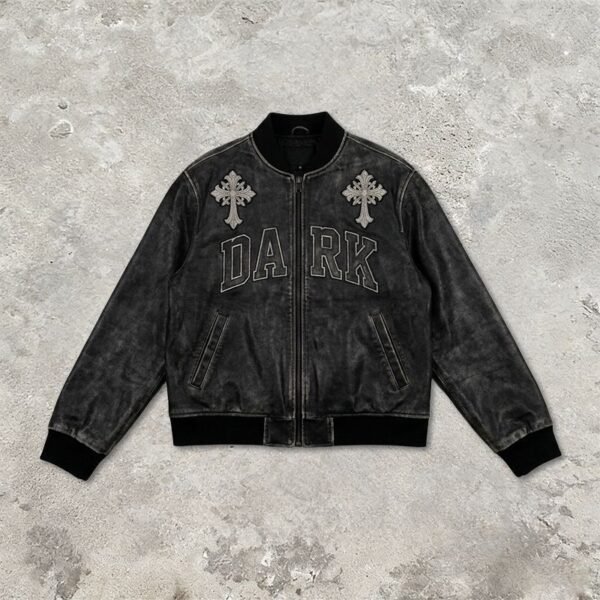





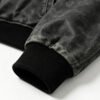
This custom varsity jacket program centers on usable arm movement beneath visually heavy decoration. The supplied image shows a zipped, mottled black surface with raised cross and letter appliques, while the source references PU leather. Those elements make armhole geometry and underarm handling decisive development controls.
Mobility starts with the intended wearing layer.
Armhole development should begin with what the buyer expects beneath the jacket. A style intended over a T-shirt needs different ease from one worn over a sweatshirt, and adding indiscriminate width cannot correct restricted forward reach caused by unsuitable armhole or sleeve geometry.
The buyer should define the thickest expected underlayer and the preferred silhouette before pattern work advances. VeeWen can then allocate chest, upper-back, bicep, and armhole ease as a connected system, preventing a roomy body from being paired with a restrictive sleeve entry.
Armhole depth and sleeve pitch must cooperate.
A lower armhole may feel spacious at rest yet pull the whole jacket upward when the wearer raises an arm. Conversely, an excessively high or tight armhole can pinch. The correct balance depends on armhole shape, cap dimensions, sleeve pitch, and shell flexibility.
Sleeve pitch should reflect the jacket's intended posture and styling rather than a neutral block alone. Streetwear proportions may favor visual volume, but the sleeve must still rotate forward without dragging the zipped front, collapsing the shoulder, or forcing pressure into the underarm seam.
Underarm construction manages concentrated stress.
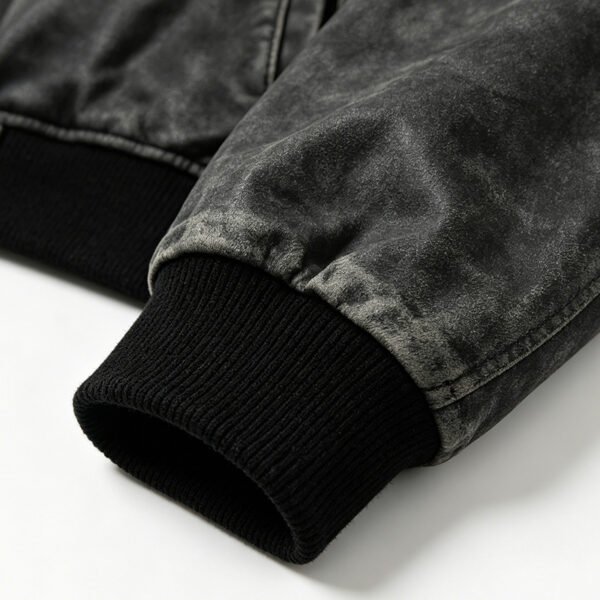
The underarm is where curved seams, sleeve movement, and multiple material layers converge. With a source-referenced PU shell, the production sample should be inspected for seam bulk, wrinkling, stitch perforation behavior, and uncomfortable ridges, without assuming performance from the source description alone.
A conventional set-in sleeve, modified seam shape, or gusset solution may each support different aesthetics and movement targets. VeeWen should evaluate the least complex construction that passes the buyer's reach standard, because added pieces introduce more seams, alignment steps, and potential visual interruption.
Applique placement can influence movement.
The image shows large layered decorations with dense contrasting borders across the front. These applications can create localized stiffness, especially when backing, adhesive, or multiple stitch rows are used. Their edges should remain clear of armhole turn and high-flex zones unless specifically tested.
Decoration clearance must be established on the pattern rather than judged only from a flat rendering. As the arm moves forward, the upper chest folds toward the armhole; an applique placed too close can resist that fold, distort its border, or transfer strain into stitching.
The vintage surface requires controlled handling.
The mottled black appearance suggests a deliberate vintage-style finish, although its method is not verified. Handling trials should establish whether sewing, pressing, folding, or applique attachment changes the visible surface, particularly near the zipper, decorative borders, armhole edge, and underarm seam intersections.
Aesthetic variation may be acceptable within an approved visual range, but mobility corrections should not create uncontrolled shine, crushing, or contrasting marks. The buyer needs to approve both the relaxed appearance and the jacket after repeated fitting movements during development, without implying a formal performance test.
VeeWen's workflow validates motion before bulk.
VeeWen's development workflow should combine the measurement chart, layering brief, shell reference, and full decoration map before resolving the armhole. A first sample can then isolate whether resistance comes from body ease, sleeve pitch, seam bulk, shell behavior, or applique placement.
The approval fitting should record neutral posture, forward reach, crossed-arm movement, and controlled arm raising while the jacket is zipped. The buyer should authorize bulk only after accepting hem lift, shoulder movement, underarm comfort, sleeve position, decoration behavior, and the final silhouette over the nominated layer.
Buyer Questions
Why can a roomy jacket still restrict arm movement?
Body width alone does not create reach. A low armhole, incorrect sleeve pitch, narrow bicep, stiff shell, bulky seam, or poorly positioned applique can pull against movement despite generous torso measurements.
Is an underarm gusset automatically necessary?
No. A gusset adds range only when its geometry addresses the actual restriction. VeeWen should first evaluate armhole shape, sleeve pitch, ease distribution, shell behavior, and the buyer's movement standard.
How should mobility be approved during sampling?
Fit the jacket over the nominated underlayer, zip it fully, and review forward reach, crossed arms, and raised arms. Approve acceptable hem lift, shoulder displacement, underarm comfort, and sleeve rotation.
Can appliques be moved after the pattern is approved?
Movement is possible, but late relocation can affect visual balance, stitch access, backing, and armhole clearance. Final decoration coordinates should be approved on the mobility-validated pattern before production preparation.
Define the movement standard before decoration is locked.
Send VeeWen the measurement chart, intended underlayer, shell reference, artwork files, decoration map, and required fitting motions. Development can then balance armhole geometry, sleeve pitch, underarm construction, and applique clearance. MOQ: 100 pieces per style.

Reviews
There are no reviews yet.