


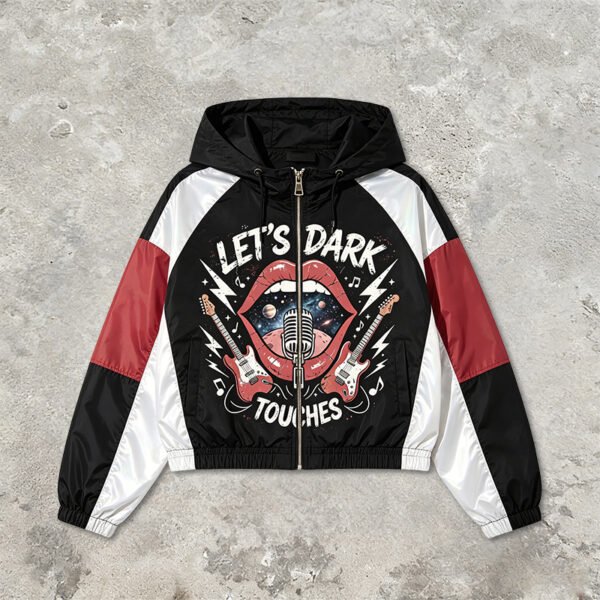



This jacket is a development study in how a lightweight color-block shell carries a high-impact front graphic without losing surface control. Its black, white, and red panel layout, gathered hem, and elastic cuffs make seam tension the critical approval variable for a commercial streetwear program.
Why Surface Texture Controls the Result
The image shows a lightweight shell whose visual character comes from crisp color boundaries, gathered edges, and a large illustrated front. Because the body is not visually plain, even small ripples at seams can interrupt the intended graphic rhythm and make the garment appear less controlled.
Panelled shells change tension whenever fabric layers, seam allowances, zipper tape, or elastic enter the construction. The red sleeve sections, white shoulder inserts, black body, and gathered waistband therefore require a consistent sewing sequence, balanced feeding, and an agreed tolerance for visible surface movement.
Reading the Supplied Visual Evidence
The main image presents a black central body framed by white upper sleeves and red outer sleeve panels, with additional black lower sleeves. This evidence supports a color-block development brief, but it does not verify fiber content, waterproofing, insulation, print durability, or measured garment dimensions.
The front artwork is large, high contrast, and interrupted by the full-length zipper, while the hood opening and drawcord area sit above it. Artwork registration should consequently be reviewed against the closed garment, zipper alignment, hood balance, and the natural distortion created when the hem is gathered.
Mechanism Behind Seam Puckering
Puckering can appear when joined layers feed at different rates, when thread tension is excessive, or when elastic recovery pulls a seam after sewing. On this design, the risk is concentrated at contrast-panel joins and the lower body, where gathering changes the shell surface and affects graphic.
A practical development target is not an artificially flat jacket everywhere, because elastic edges are intended to gather. The target is directional control: panel seams should remain visually smooth, gathers should distribute evenly, and puckering should not radiate into the printed artwork or zipper line.
Development Workflow at VeeWen
VeeWen can translate this axis into a focused product-development sequence by locking the panel pattern, seam allowance, elastic specification, zipper position, and artwork placement in one technical package. The first review should compare a sewn shell with the graphic applied, not evaluate print and construction separately.
At the sample checkpoint, the team should inspect the jacket zipped and unzipped, laid flat and worn, then record seam rippling by location. Revision priorities can address stitch balance, panel ease, elastic length, print clearance, or artwork scaling before the style advances toward the MOQ of 100.
Trade-Offs for Commercial Buyers
More contrast panels create stronger visual segmentation but also add seam intersections, handling steps, and opportunities for uneven feeding. A simpler panel map may reduce puckering risk and improve repeatability, while a more complex map can support a distinctive collection identity when the buyer accepts tighter sample.
A large front print increases recognition and gives the jacket a clear focal point, yet the zipper divides the artwork and the gathered hem can visually compress its lower area. Buyers should choose whether maximum graphic impact or easier construction control is the primary commercial objective.
Approval Checkpoint Before Production
The approval sample should be judged under the intended presentation conditions: fully zipped, hood resting naturally, sleeves relaxed, cuffs closed, and hem gathered. Reviewers should inspect whether color boundaries remain straight enough, whether the graphic reads continuously, and whether seam ripples stay within the agreed tolerance.
Record decisions by panel, seam, and edge rather than approving the jacket with a general comment. Confirm the final artwork file, zipper centerline, elastic measurements, panel color references, seam appearance, and grading approach before releasing the style for MOQ: 100 pieces per style.
Buyer Questions
What should be sampled first on this jacket?
Sample the complete shell with contrast panels, zipper, elastic edges, and artwork together, because seam tension can change the graphic appearance after final assembly.
Is the jacket confirmed waterproof or windproof?
No performance claim is verified by the supplied evidence. Treat the shell as a lightweight woven reference and confirm coating, seam treatment, and testing separately.
How should artwork be approved?
Approve artwork on the zipped garment as well as the flat pattern, checking center alignment, zipper interruption, lower-body compression, and readability across gathered construction.
What is the minimum commercial quantity?
VeeWen's exact commercial minimum is MOQ: 100 pieces per style. Final specifications, color standards, and approved construction should be locked before production planning.
Develop the Jacket Around Surface Control
Send VeeWen your panel artwork, target shell reference, size range, and edge measurements. We can organize the sample review around seam puckering, graphic registration, and production approval at MOQ: 100 pieces per style.


Reviews
There are no reviews yet.