
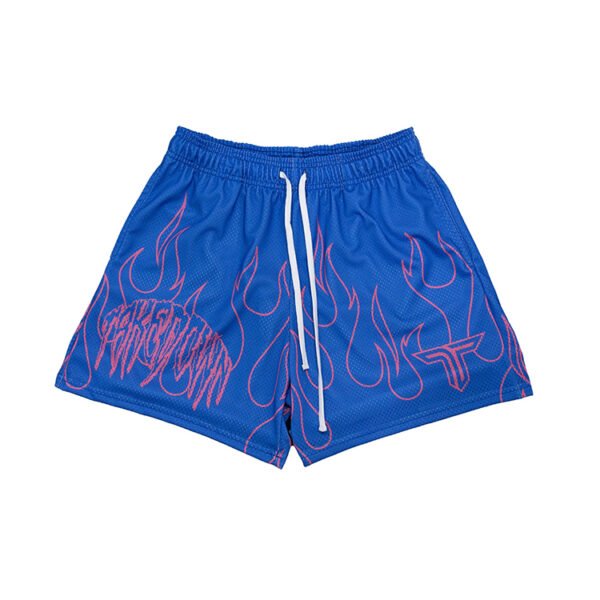


This short is built around a practical tension: open mesh can feel light and soft, yet excessive finishing or unstable recovery may weaken shape and presentation. The blue base, flame graphics, and gathered drawcord waist make softness and retention equally important approval criteria.
Mesh Changes the Hand-Feel Equation
The supplied image clearly shows an open-hole mesh surface, creating a ventilated visual structure suited to warm-weather activity. That openness can improve perceived lightness, but the final hand feel depends on yarn, finishing, edge treatment, and the density of the selected mesh.
A soft finish may improve skin comfort and reduce a crisp synthetic sensation, yet too much softening can make the short look slack. Development should compare hand feel on the body, not only between loose fabric swatches held in the hand.
Shape Retention Begins at the Waist
The gathered waistband and white drawcord are prominent front details, so recovery directly affects fit consistency and visual neatness. If the elastic relaxes too quickly, the waist can lose support, while excessive tension may undermine the intended easy summer profile.
Test the waistband after repeated extension, sitting, and laundering simulations appropriate to the collection. Record whether gathers return evenly, whether the drawcord remains centered, and whether the top edge rolls, twists, or develops unwanted pressure during movement.
Leg Openings Need Controlled Ease
The leg openings appear broad enough to support active movement and an easy short silhouette. Their stability depends on mesh resilience, hem construction, and finishing tension; a very soft treatment can encourage flare or uneven hanging after wear.
Approve the opening from front, side, and seated views. The buyer should decide whether the leg should remain nearly straight or show a controlled outward ease, then align hem width and finishing with the selected softness target.
Graphics Must Survive a Soft Surface
Pink-red flame lines span the blue body and create strong directional energy across both legs. On a flexible mesh ground, graphic registration and surface adhesion require careful development because holes, stretch, and movement can interrupt line continuity.
Confirm the decoration route with a physical strike-off or development sample before finalizing artwork scale. Review the graphics stretched, relaxed, and viewed at normal distance, checking whether flame edges remain clear without making the surface noticeably stiff.
VeeWen Development Workflow
VeeWen can organize this style around paired hand-feel and recovery checkpoints: first select mesh options, then compare finishing treatments, waistband constructions, and graphic applications on matching short blocks. This keeps softness decisions tied to the actual silhouette and artwork rather than isolated material preferences.
The development file should capture before-and-after measurements at the waist and leg opening, alongside worn photographs and graphic checks. That workflow gives buyers a traceable basis for choosing the softest finish that still preserves the short's intended shape.
Approval Checkpoint Before Production
Before production approval, inspect the shorts after movement and laundering simulations, focusing on waist recovery, drawcord placement, hem stability, and graphic continuity. Also assess whether the finish remains comfortable against the skin without causing cling, excessive limpness, or loss of structure.
Approve the style when tactile softness supports wearability and the silhouette remains controlled across tested conditions. If comfort improves only by sacrificing recovery or graphic clarity, revise the finish, elastic, mesh specification, or decoration route before confirming MOQ: 100 pieces per style.
Buyer Questions
Is polyester content fully verified?
The source wording identifies polyester mesh, but exact percentage, yarn specification, fabric weight, and finishing treatment require confirmation during development.
What should the first sample prove?
The first sample should prove next-to-skin softness, waistband recovery, leg-opening stability, drawcord function, and flame graphic clarity across normal movement.
Can the flame graphic be resized?
Yes, artwork scale and placement can be adjusted, provided the buyer reviews registration, line clarity, stretch behavior, and the selected application method.
What is the commercial minimum?
The exact commercial minimum is MOQ: 100 pieces per style, with final specifications and production acceptance confirmed before ordering.
Confirm Softness and Recovery
Share the target use, size range, artwork files, and preferred hand feel for sample planning. VeeWen can then develop the mesh short toward MOQ: 100 pieces per style.


Reviews
There are no reviews yet.