


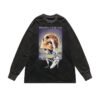



This custom acid-wash oversized crewneck is developed around edge stability: the relaxed body needs softness, while the neckline, cuffs, and hem must retain their visual boundaries. VeeWen can validate that balance through targeted support trials, wash review, and approval checkpoints before production release.
Why Edge Stability Leads This Development
An oversized silhouette places more fabric at the shoulder, body, and sleeve, increasing the need for controlled edge behavior. The clean crew neckline, wide rib cuffs, and straight lower hem shown in the image make those boundaries visually dominant during wear and laundering.
Interlining choice should therefore follow the intended recovery of each edge, not simply the sweatshirt weight. A light, flexible support can preserve neckline shape without stiffening the body, while firmer support may improve hem discipline but reduce the relaxed hand expected from an oversized streetwear block.
Reading the Supplied Garment Evidence
The supplied image presents a dark charcoal-black washed surface, a plain back, long sleeves, and a roomy rectangular body. Its visual simplicity shifts attention toward proportion, seam alignment, rib tension, and whether the edges remain even after the garment receives its final wash treatment.
The rib collar appears narrow relative to the body, while the cuffs and hem create stronger horizontal boundaries. That relationship suggests a development risk: excessive support could make the neckline or lower edge look rigid, whereas insufficient support could allow rolling, waviness, or uneven recovery.
Interlining Choices and Trade-Offs
For the neckline, a lightweight fusible or sew-in support can be evaluated for stretch control, bonding behavior, and comfort. The correct option should reduce collar growth without creating a hard ridge, especially because acid-wash processing may expose differences in surface texture, shrinkage, or adhesive response.
Cuffs and hem require a separate decision because they interact with rib structure and body panels differently. More support may sharpen the silhouette and improve presentation, but it can limit drape; less support preserves softness, yet increases the chance of edge deformation during handling and laundering.
Wash Process Must Be Tested With Support
Acid-wash development should be assessed after interlining is introduced, because the wash can alter color depth, hand feel, dimensional stability, and the visual contrast between rib and body. A support that looks balanced before washing may become visible, brittle, puckered, or detached afterward.
VeeWen's sample review should compare pre-wash and post-wash measurements at the collar opening, cuff width, and hem line. The approval focus is not only color consistency, but also whether each supported boundary returns cleanly without overpowering the garment's intentionally relaxed appearance.
VeeWen Workflow for This Exact Argument
VeeWen can translate the image evidence into a focused development brief covering the oversized block, charcoal wash target, rib proportions, and edge-stability checkpoints. The first sample should isolate support variables so buyers can judge construction behavior without confusing it with unrelated styling changes.
After fit review, the team can test selected interlining options through wash-controlled samples and record visible changes at the collar, cuffs, and hem. Buyer approval should lock the support specification, rib recovery expectation, wash appearance, and measurement tolerance before the style advances toward production.
Buyer Approval Checkpoint
The key approval question is whether the sweatshirt still reads relaxed after the edges are stabilized. Review the garment on a flat surface and on-body, checking collar symmetry, cuff return, hem straightness, shoulder drape, and whether the support can be detected through touch or appearance.
Request final confirmation of composition, GSM, interlining construction, wash recipe, graded measurements, and care implications before issuing production approval. The commercial release should proceed only when the selected support preserves the visual boundaries without compromising comfort, softness, or the intended oversized proportion.
Buyer Questions
Is the sweatshirt composition confirmed as 100% cotton?
No. The source wording references cotton, but VeeWen should verify fiber composition through the technical specification, purchase standard, and approved development sample.
Which edges require the closest interlining review?
Prioritize the crew neckline, rib cuffs, and lower hem because these boundaries are visually prominent and may respond differently to support, wash processing, and repeated wear.
Will interlining make the sweatshirt feel stiff?
It can, depending on weight, adhesive, placement, and application. Compare flexible and firmer options on washed samples to protect edge recovery while retaining the relaxed hand.
What should the buyer approve before production?
Approve the support type, wash appearance, rib behavior, graded measurements, composition, GSM, care details, and post-wash appearance after reviewing representative physical samples.
Develop the Edge-Stable Version
Send VeeWen your target measurements, wash reference, rib preference, and launch requirements. We will organize focused support trials for review, then align the approved construction with MOQ: 100 pieces per style.



Reviews
There are no reviews yet.