


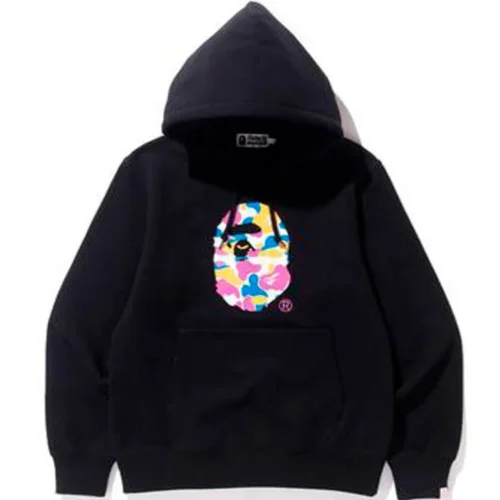
This custom black zip hoodie is built around a compact chenille artwork system rather than a generic logo placement. The supplied image shows how a small chest motif carries the identity, making scale control and repeatable application central to buyer approval.
Small Artwork Creates a Scale-Control Problem
A compact chest patch has limited surface area for outlines, internal shapes, and edge definition. If the motif is reduced too aggressively, small openings may close and adjacent elements may merge, weakening recognition after stitching or washing.
The supplied image shows a light multi-part motif against a black body, creating strong contrast but also exposing every boundary decision. The buyer should approve minimum line widths, enclosed spaces, and the finished patch envelope before sampling.
Placement Works Because the Body Panel Is Stable
The chest motif sits within a broad, relatively uninterrupted panel beside the centered zipper. That position gives the artwork a stable field, but proximity to the zipper and pocket opening still requires measured clearance for symmetry and comfortable wear.
Placement should be recorded from fixed pattern landmarks rather than from the garment edge alone. Use the zipper center, shoulder point, and chest line to establish coordinates, then check those coordinates after grading across the selected size range.
Chenille Texture Needs Boundary Discipline
Chenille-style surfaces create tactile depth through raised yarn, but the texture can soften fine internal details. A clean outer boundary and sufficiently open artwork structure therefore matter more than adding unnecessary complexity to a small patch.
The development sample should examine edge fullness, corner behavior, loose fibers, and any distortion caused by application. These observations are production decisions, not assumptions, because the supplied image cannot verify the actual yarn, backing, or stitch method.
Grading Should Preserve Visual Weight
A patch that remains identical in size across every garment may appear oversized on smaller bodies or underweighted on larger ones. Conversely, proportional scaling can make the smallest version unreadable, so the artwork strategy needs a defined grading rule.
VeeWen can compare fixed-size, stepped-size, and proportional-size options against the approved hoodie pattern. The buyer should judge visual weight at each key size, ensuring the motif remains intentional without becoming the dominant element of the garment.
VeeWen Workflow Makes Repeatability Measurable
VeeWen's workflow can convert the artwork into an application file with a named patch size, border allowance, placement coordinates, and approval image for each grading group. This creates a repeatable handoff between design review, pattern development, sampling, and production preparation.
The first sample should be evaluated beside the approved artwork proof, not judged from memory. Record patch dimensions, center position, zipper clearance, and visible deviations, then lock the corrected specification before additional sizes are reviewed.
The Buyer Approval Point Is a Controlled Artwork System
Approval should cover the artwork file, patch dimensions, application method, placement tolerance, and grading logic together. Treating these as separate decisions can produce a technically acceptable patch that no longer carries the intended visual proportion.
Before production planning, request a signed reference sample or approval image showing the selected size group. Confirm that the motif remains legible, centered, and proportionate after application, while documenting any accepted compromise between detail and repeatability.
Buyer Questions
Can the chest artwork be enlarged?
Yes. Enlargement is possible, but it changes visual weight, patch cost drivers, and available detail. Review the revised bounding box against zipper clearance and the graded pattern.
Should the patch scale change by garment size?
It may use fixed, stepped, or proportional scaling. The best rule depends on artwork legibility and collection intent, so approve a size-group comparison before finalizing.
Can the hoodie use embroidery instead?
Yes. Embroidery can replace chenille-style application, but surface texture, detail retention, hand feel, and appearance will change and require a separate approval sample.
What is the production minimum?
The exact commercial minimum is MOQ: 100 pieces per style. Confirm colorways, size ratios, artwork versions, and packaging requirements before quotation and production planning.
Lock the Artwork System
Share the vector artwork, intended size range, hoodie measurements, and preferred surface effect. VeeWen can organize sampling around patch scale, placement coordinates, grading logic, and repeatability checkpoints.



Reviews
There are no reviews yet.