

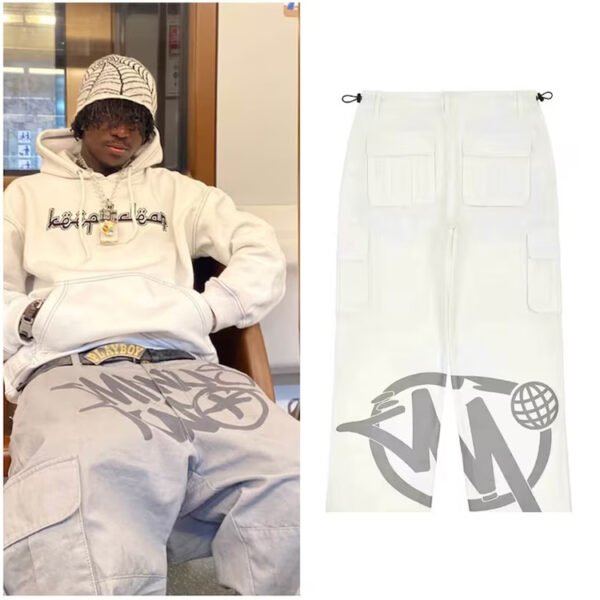


This black cargo style is defined by proportion: utility pockets, lower-leg volume, and a strong purple graphic must remain coherent as sizes change. The development focus is a traceable size-label system tied to graded measurements, because a visually correct base sample can still fail across the range.
The base size must establish a measurable silhouette
The product image shows a black cargo trouser with several pocket layers and a straight, substantial leg. Before grading, the buyer should define the base size through waist, rise, hip, thigh, knee, inseam, opening, and pocket dimensions.
A base size that is visually convincing but loosely documented creates downstream ambiguity. Every visible proportion should connect to a measurement point, especially the relationship between roomy upper-leg construction and the gathered or adjustable lower-leg appearance shown on the worn model.
Grade rules must protect pocket proportion
Cargo pockets do more than add storage; they make scale immediately visible. If pocket width, flap height, or spacing changes inconsistently between sizes, the style can appear compressed in smaller sizes or underdeveloped in larger ones despite acceptable body measurements.
VeeWen should grade pocket landmarks with the body pattern, then review the largest and smallest planned sizes physically. This confirms whether utility details remain functional-looking and visually balanced rather than merely satisfying a mathematical increment table.
Graphic placement becomes a size-control landmark
The purple lower-front artwork is a useful visual checkpoint because its position can reveal leg-length and panel-proportion drift. A fixed distance from the hem may behave differently across inseams, while a fixed knee relationship may change the visible composition.
The specification should state whether artwork is anchored to the hem, knee, side seam, or pattern coordinate. VeeWen's workflow can then compare graded artwork templates against sewn samples, reducing the chance that the graphic looks correctly placed only in the base size.
Labels need a defined sequence and location
The source wording points toward an OEM product requiring custom development, while the supplied visuals do not verify a particular label package. Size labels, care information, branding, and compliance wording should therefore be treated as separate decisions with documented positions and sequencing.
A clear label map prevents factory interpretation when multiple trims are introduced. During sample review, check that the size identifier is readable, consistently positioned, and compatible with the final waistband construction, while keeping the external appearance aligned with the intended streetwear presentation.
Worn review exposes grading problems
The image includes a worn styling reference alongside a product view, allowing the buyer to consider how the trousers gather and stack during use. That reference is directional evidence, not a verified fit test, so it should inform questions rather than replace measurement approval.
Review fit on representative bodies or approved fit models across the range, focusing on waist comfort, rise balance, thigh ease, knee position, and lower-leg control. Record observations beside finished measurements so subjective comments can be translated into actionable pattern changes.
Approval checkpoint for the size range
Before production release, approve one base-size sample and comparative samples at the range endpoints. Confirm the label sequence, measurement tolerances, pocket proportions, graphic anchoring, and lower-leg behavior against the signed specification rather than memory or a single photograph.
VeeWen's product-development file should retain the graded chart, pattern revision, label map, and approval comments as one controlled package. The buyer's final checkpoint is range consistency: every size must look intentional, measurable, and commercially wearable.
Buyer Questions
Which size should be developed first?
Start with the approved base size, documenting complete finished measurements and visual proportions before applying grade rules to the remaining planned sizes.
How should the purple graphic be graded?
Choose an anchor such as hem, knee, or pattern coordinate, then compare endpoint samples to ensure placement and visible composition remain intentional.
Are labels shown in the supplied evidence?
No. The images do not verify a label package, so size, care, branding, and placement should be specified separately during development.
What is the commercial minimum?
MOQ: 100 pieces per style. The final size ratio and production quantities should follow the approved graded specification and order confirmation.
Approve the Graded Specification
Share your size chart, target range, label requirements, and fit references for a coordinated review linking measurements, pocket proportions, graphic anchors, and worn-garment balance.



Reviews
There are no reviews yet.