
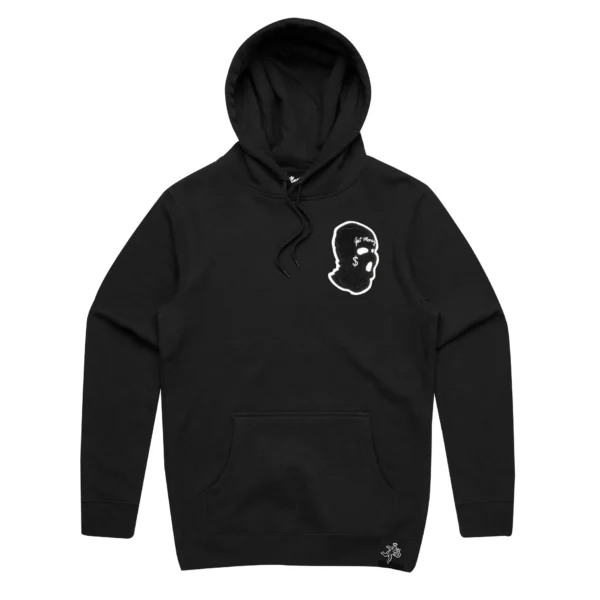

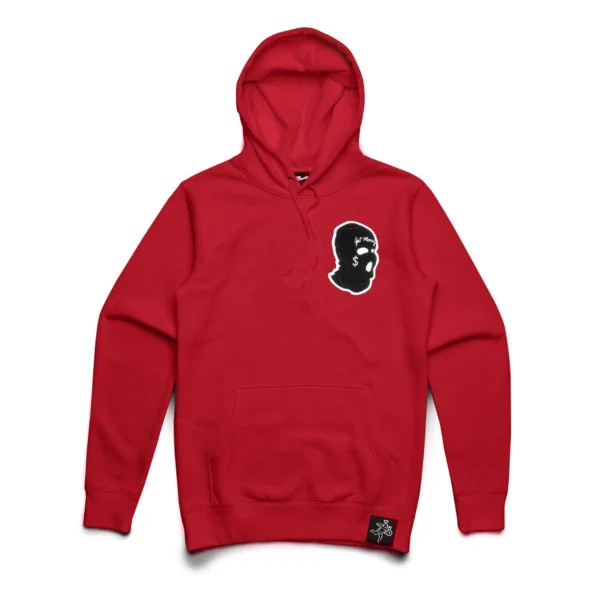



This pullover hoodie is a useful development reference for controlling stretch direction around concentrated chenille artwork. The supplied black image shows a strong chest focal point, a kangaroo pocket below, and a smaller hem mark, creating two placement zones that require coordinated pattern control.
Stretch Direction Defines Artwork Stability
A hoodie front stretches differently across chest width, pocket opening, and lower hem. If the body direction is ignored, a chenille motif can drift visually as fabric relaxes, especially near the pocket and broad torso area.
The supplied image concentrates the main motif on the upper chest while leaving the center lower front open. That spacing supports a controlled placement plan, but the pattern team must test distortion after joining, washing, and ordinary movement.
Pattern Landmarks Protect the Chest Motif
The chest graphic should be located from neckline, armhole, and side-seam landmarks rather than from the loose fabric edge. These references remain more dependable when the hoodie is stretched, handled, or graded across multiple sizes.
For sampling, VeeWen can translate the visual reference into a placement sheet showing motif height, horizontal balance, and clearance from the kangaroo pocket. The approval checkpoint is dimensional consistency on the actual sewn body, not only artwork scale on paper.
Pocket and Hem Create Secondary Controls
The kangaroo pocket interrupts the lower front and introduces additional seam tension, so the chest artwork must remain clearly separated from its opening. Pocket corners, topstitching, and body relaxation should be reviewed together during fitting.
A smaller graphic near the lower hem adds another alignment test. Its relationship to the ribbed hem must be measured after attachment, because rib contraction can change apparent height and make a correctly printed coordinate look misplaced.
Chenille Surface Needs a Stable Base
Chenille-style patches add localized thickness and visual weight, making substrate stability important. A flexible body may recover differently beneath the patch than beside it, so the development sample should reveal rippling, torque, or edge lifting before approval.
The image shows a high-contrast white outline against black fabric, which makes even modest movement easy to see. VeeWen should therefore review patch edge definition, attachment security, and surrounding fabric response as one placement decision.
VeeWen Workflow Converts the Axis into Checks
Within VeeWen's development workflow, the buyer's artwork file can be paired with a stretch-direction notation, landmark diagram, and graded placement table. That package gives pattern, sampling, and finishing teams one shared reference for the hoodie front.
The first approval should confirm the base block and artwork coordinates together. After fitting, the buyer should inspect the chest motif, pocket clearance, hem mark, and recovery behavior before releasing the specification for MOQ: 100 pieces per style.
Approval Gate for Bulk Readiness
Bulk readiness depends on whether the finished hoodie preserves the intended graphic hierarchy across movement and size grading. The key review is not simply whether the motif is centered on one flat sample, but whether it remains balanced on the worn garment.
Approve after checking the graded pattern, sewn sample, patch placement, and measurement tolerances against one signed reference. If any coordinate changes near the pocket or hem, update the placement sheet before production documentation is finalized.
Buyer Questions
How should the chest patch be positioned?
Position it from neckline, armhole, and side-seam landmarks, then verify pocket clearance and visual balance on the sewn, relaxed garment sample.
Why does stretch direction matter for this hoodie?
Uneven stretch can alter patch height, width, and perceived centering, particularly across the broad torso, pocket transition, and graded size range.
What should the first sample prove?
The first sample should confirm the base block, recovery behavior, chest and hem coordinates, patch attachment, and the relationship between artwork and pocket construction.
What is the minimum commercial quantity?
The commercial minimum is MOQ: 100 pieces per style, following approval of specifications, artwork placement, sampling, and production documentation.
Approve the Stretch-and-Placement Reference
Send the artwork, target size range, and preferred fabric direction to begin a controlled hoodie sample. VeeWen can then document coordinates, review recovery, and prepare the MOQ: 100 pieces per style checkpoint.


Reviews
There are no reviews yet.