
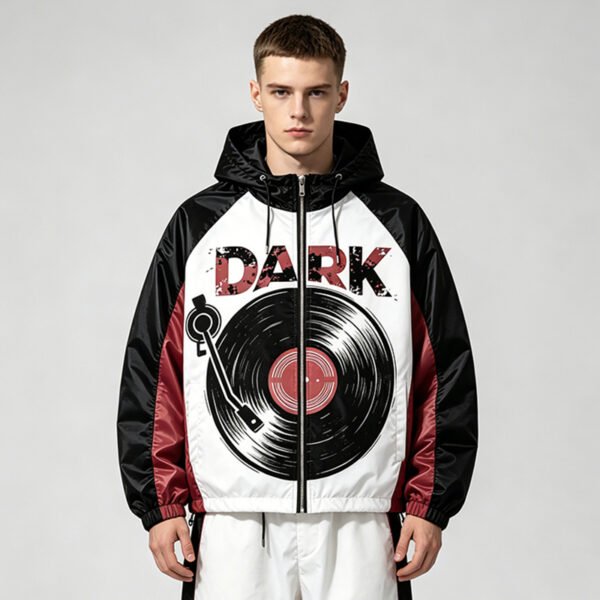
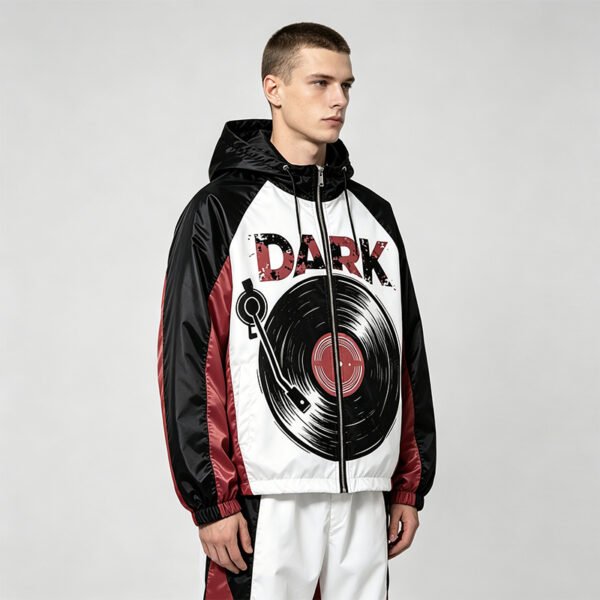





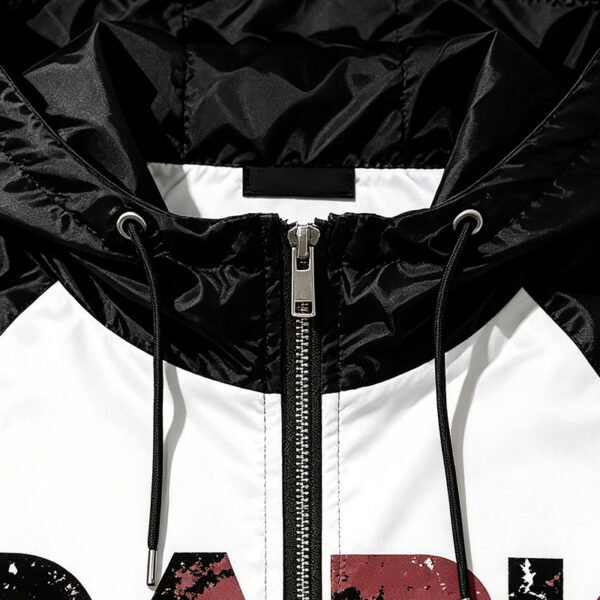
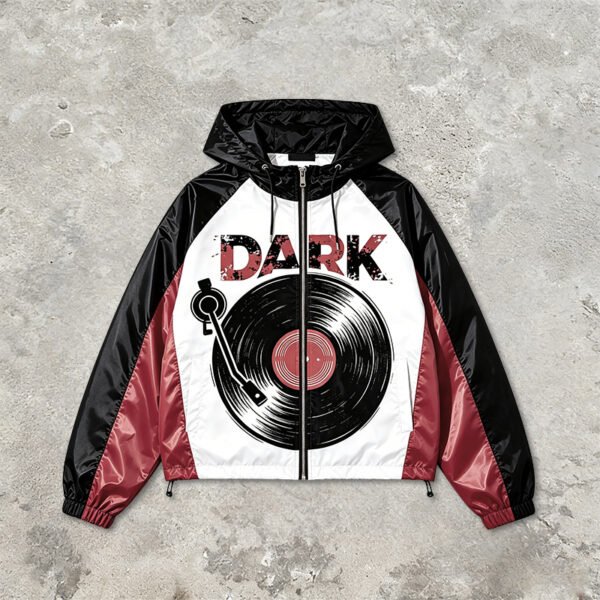






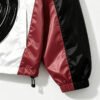

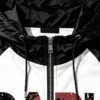

A graphic hooded jacket is approved by movement, not artwork alone. This development record treats the armhole and underarm as the main engineering decision, because the image combines broad contrast panels, a centered zipper, and a secured hooded silhouette that must move cleanly.
The Movement Problem Is Visible In The Color Blocking
The front image places black sleeve and shoulder areas around a large white body panel, while red inserts appear beneath the arms. That arrangement makes the underarm seam visually prominent, so restricted reach would show as pulling, diagonal distortion, or zipper misalignment.
Because the graphic spans the front and meets the center zipper, the body cannot absorb movement casually. A low or narrow armhole may lift the torso during reaching, while excessive ease can weaken the graphic placement. The correct solution balances rotation, lift, and visual control.
Armhole Geometry Should Carry The Reach
For this silhouette, VeeWen should test armhole depth, shoulder slope, and sleeve pitch together rather than approving each measurement independently. The black shoulder framing provides a clear visual boundary for checking whether the sleeve rotates naturally without dragging the white front panel upward.
A movement sample should include forward reach, overhead reach, and relaxed arm drop. Observe underarm wrinkling, cuff position, hood balance, and the center zipper. These checks reveal whether the pattern gives usable mobility or simply creates a larger garment without improving articulation.
Underarm Inserts Are A Controlled Trade-Off
The red underarm and side sections can function as shaped inserts that distribute strain away from the graphic torso. Their visible contrast makes them suitable for testing alternative gusset widths, seam angles, and sleeve joining points while preserving the intended color-block hierarchy.
More underarm volume may improve comfort but can create excess fabric, altered side proportions, or a less precise streetwear outline. A narrower insert may sharpen the silhouette while increasing seam stress. The buyer should select the smallest geometry that passes movement testing across the size range.
Graphic Alignment Depends On Pattern Stability
The large record-style front graphic is bisected by the zipper and bordered by black and red panels. This makes front pattern stability essential: if the body twists during wear, the artwork, color boundaries, and zipper line will appear uneven even when each component was cut accurately.
VeeWen's sample review should therefore inspect artwork placement after the jacket is zipped, unzipped, and worn through movement. Confirm whether seam allowances, zipper tape, and panel shrinkage alter the graphic center. Approval should be based on the finished garment state, not a flat lay alone.
VeeWen Workflow: Engineer Before Grading
VeeWen can begin with a measurement map identifying armhole depth, shoulder width, sleeve pitch, underarm insert height, and cuff opening. The first prototype should isolate these variables while retaining the visible black, white, and red arrangement shown in the supplied image.
After movement review, the approved construction can move into grading with specific checkpoints for armhole balance and underarm seam placement. Each size should be inspected for reach and panel tension, because a proportion that works in the base size may become restrictive or visually heavy after grading.
Buyer Approval Checkpoint
The buyer should approve this jacket when the wearer can reach forward and overhead without the torso rising excessively, the center zipper remains visually straight, and the red underarm panels do not form harsh tension lines.
Also confirm the final shell hand, hood volume, cuff recovery, graphic durability, and wash behavior separately, since those properties are not established by the supplied image. The decisive approval is a movement-tested size set with construction notes retained for production.
Buyer Questions
What is the main development risk for this jacket?
The main risk is restricted reach caused by an underarm seam or armhole that does not accommodate sleeve rotation within the color-blocked construction.
Should the underarm panel be treated as a gusset?
It may be developed as a shaped insert or gusset, but the final construction should follow movement testing, seam appearance, and buyer-approved silhouette requirements.
What should the first sample prove?
The first sample should prove forward and overhead reach, zipper straightness, graphic alignment, underarm comfort, cuff position, and hood balance in the intended relaxed fit.
What is the minimum order quantity?
VeeWen's exact commercial minimum is MOQ: 100 pieces per style, subject to final specifications, approved sample construction, and the confirmed production brief.
Approve The Movement Sample
Send the target size chart, artwork files, and shell preferences to VeeWen for an armhole-led prototype review, then approve the graded movement set before confirming production quantities.


Reviews
There are no reviews yet.