














This hoodie is built around directional planning: the cropped body saves length in one area, while oversized sleeves and raised back decoration demand deliberate marker placement to control fabric consumption without weakening the intended volume.
Marker Direction Controls More Than Fabric Yield
The hoodie places a compact torso beside unusually broad sleeves, so the cutting direction affects how much fabric each component consumes. Grain, nap, shade direction, and spray-wash behavior may also influence whether panels can be rotated without changing appearance.
VeeWen's development review should create a component-level consumption plan before final grading. The buyer should approve which panels must follow one direction, which may rotate, and where additional allowance is justified to protect the silhouette or surface consistency.
Oversized Sleeves Need a Balanced Material Budget
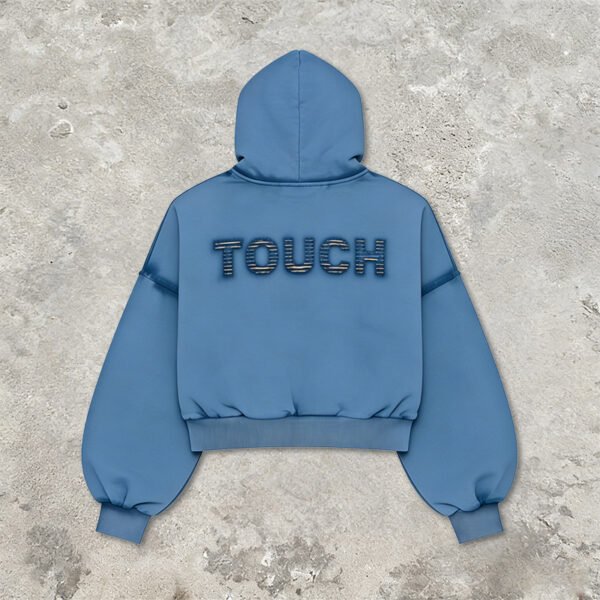
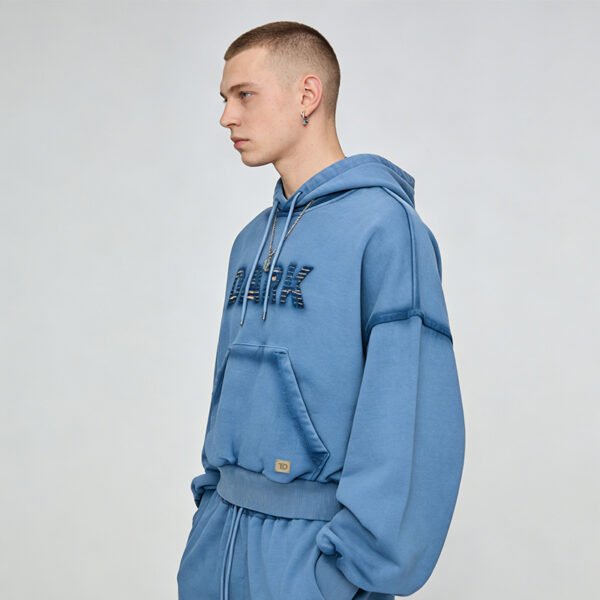
The sleeves extend dramatically from the shoulder area and finish with gathered cuffs, making them the dominant volume in the visual composition. Reducing their width may improve consumption but can remove the exaggerated proportion that gives the cropped hoodie its identity.
A practical sample comparison should test the approved sleeve width against body length and cuff position. VeeWen can review the pattern as a connected system, helping the buyer protect movement and visual volume while identifying areas where seam placement can reduce unnecessary waste.
The Cropped Body Concentrates Fit Risk
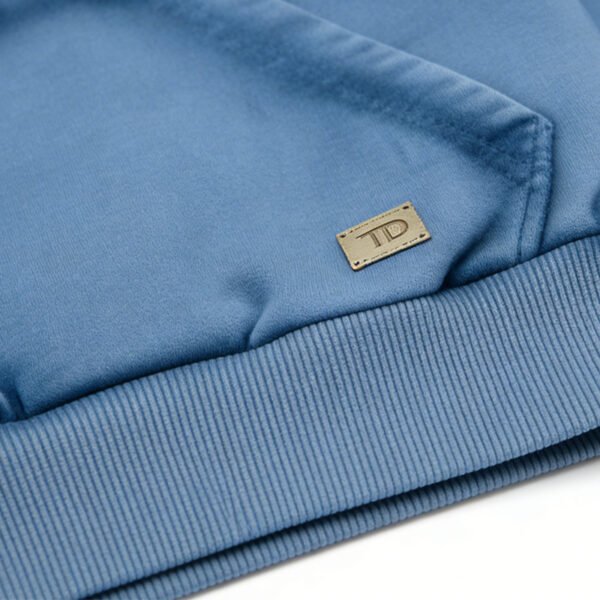
The short torso ends at a broad elasticated waistband, leaving little vertical distance for fit correction. Small changes in body length, band height, or waistband recovery can therefore shift the garment from intentionally cropped to visually compressed.
The buyer should approve the body-to-band relationship on a worn prototype, including front, back, and side views. VeeWen's workflow can record those proportions before grading, ensuring larger sizes preserve the same design logic rather than simply extending the body.
Raised Back Decoration Adds Directional Constraints
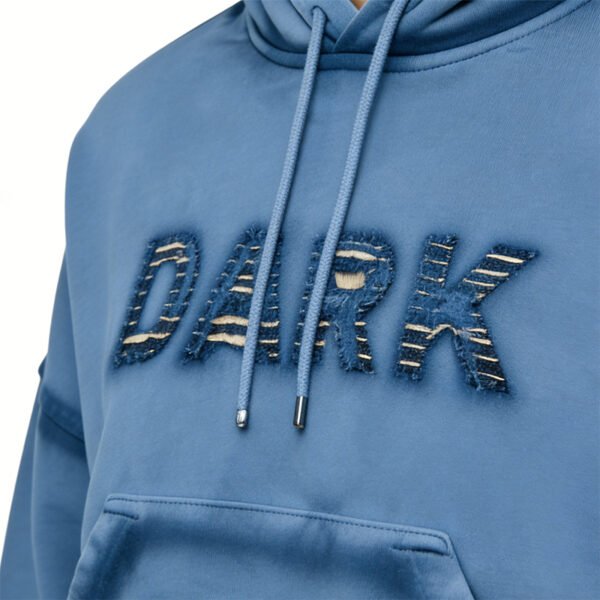
The upper back carries dark dimensional lettering or applique that reads through texture and shadow rather than color alone. This decoration introduces weight, handling, and placement considerations, especially where the back panel is cut, washed, pressed, and sewn.
Decoration sampling should confirm motif scale, edge definition, attachment method, and tolerance from neckline and side seams. The buyer should also decide whether the motif follows the garment's wash direction or remains visually stable as the surrounding fabric changes.
Spray-Wash Variation Must Be Mapped Around Components
The blue surface appears selectively varied, with tonal movement that supports the garment's technical streetwear character. Because sleeves, hood, waistband, and back panel have different shapes, uncontrolled spraying could create an uneven balance or obscure the raised decoration.
VeeWen should develop a panel map identifying intended light, dark, and protected zones before bulk finishing. Approval should compare a flat component view with the assembled garment, since the final effect depends on how separate pieces meet across seams.
VeeWen Workflow Makes Consumption a Buyer Checkpoint
For this hoodie, VeeWen's workflow should connect design approval to marker planning early, before decoration and wash decisions become fixed. The prototype must demonstrate that sleeve volume, crop, back motif, and component direction work within the agreed material priorities.
After the buyer approves the marker assumptions and dimensional sample, the team can proceed through decoration strike-off, graded pattern review, and pre-production confirmation. The commercial decision remains clear: MOQ: 100 pieces per style, with final consumption confirmed against the approved specification.
Buyer Questions
Why is marker direction important for this hoodie?
The oversized sleeves consume substantial fabric beside a short body, so direction choices influence yield, surface consistency, grain behavior, and whether the final proportions remain visually balanced.
Can the sleeve volume be modified without changing the concept?
Yes, sleeve width, cuff position, and armhole shaping can be developed together, but every reduction should be checked against movement, silhouette, material consumption, and the approved cropped proportion.
How should the back applique be approved?
Review a physical strike-off for scale, edge definition, attachment, hand, placement, and wash interaction, then assess it on the assembled garment before approving grading and production.
What is the minimum order requirement?
The commercial minimum is MOQ: 100 pieces per style. Final feasibility depends on approved fabric direction, graded measurements, decoration details, wash mapping, and the confirmed production specification.
Approve the Marker and Volume Strategy
Share the target measurements, back motif, and surface direction for a prototype review that tests sleeve volume, marker direction, material consumption, decoration placement, and cropped-body balance.


Reviews
There are no reviews yet.