


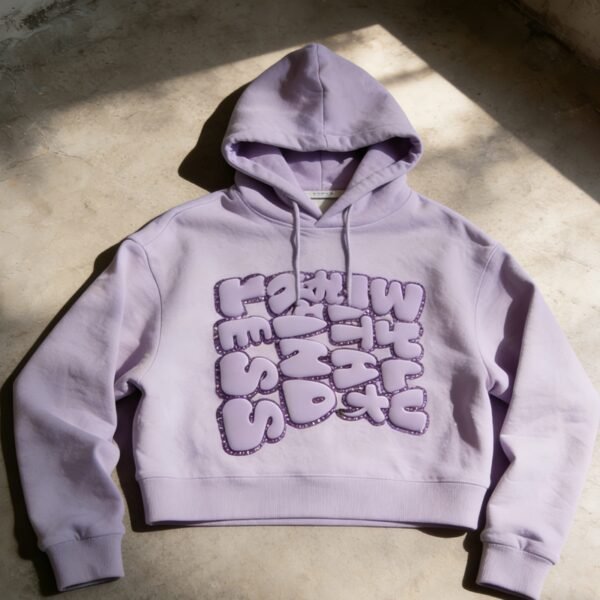




This custom crop pullover hoodie is a proportion-led development project, where the commercial result depends on preserving the intended relationship between shortened body length, sleeve coverage, hood volume, and oversized dimensional chest artwork across every approved size.
Cropped Body Requires Controlled Grading
The shortened torso is the hoodie's primary proportion signal. If grading adds length too aggressively in larger sizes, the garment loses its cropped identity; if length barely changes, wearability and coverage can become inconsistent across the size range.
VeeWen should establish body length from a defined high-point shoulder reference, then review hem position against chest, waist, and hip measurements. The approval target is a stable visual crop that remains intentional without restricting normal movement.
Sleeve Length Must Counterbalance the Hem
The image shows sleeves that visually extend well beyond the cropped body, creating a deliberate contrast between torso exposure and arm coverage. That balance can disappear when sleeve grading follows a standard hoodie block without proportional review.
Sleeve length, bicep width, cuff opening, and shoulder drop should therefore be assessed together. A larger size may need measured sleeve growth, while cuff placement must remain visually compatible with the shortened hem and intended relaxed streetwear stance.
Hood Volume Changes the Upper Silhouette
A substantial hood contributes strongly to the garment's visual mass, especially when the body is cropped. Excessive hood growth can pull the neckline backward and overwhelm smaller wearers; insufficient growth can make larger sizes appear visually compressed.
The development review should examine hood height, opening width, crossover allowance, and attachment balance at multiple sizes. These measurements influence drape around the neck and determine whether the elevated hood shape supports or disrupts the cropped silhouette.
Artwork Placement Must Grade with the Garment
The chest artwork is large, centered, and visually raised, so its position cannot be treated as a fixed distance from one shoulder point. On a cropped body, even a small vertical shift can move the graphic toward the hem and change the product's focal balance.
VeeWen's size-set review should map the artwork using chest width, neckline, and finished hem references. The approval sample should verify that the design remains centered, readable, and safely clear of seams, drawcords, and the lower edge.
Dimensional Decoration Adds Fit Trade-Offs
Raised foam printing and embroidered-style detailing create tactile depth, but they also add weight and stiffness to the front panel. On a cropped hoodie, that concentration can influence how the hem settles and whether the garment folds cleanly during movement.
The buyer should decide how much dimensional height is commercially necessary before finalizing decoration. A lower profile may improve softness and packing behavior, while greater relief can strengthen shelf impact but demands closer review of adhesion, cracking, and hand feel.
VeeWen Workflow Turns Proportion into Approval Gates
For this product, VeeWen's development workflow should begin with a measurement architecture linking body length, sleeve length, hood dimensions, and graphic coordinates. The first size sample establishes the design language; the graded set tests whether that language survives size expansion.
Before production, the buyer should sign off on the measurement chart, graded samples, artwork placement map, and decoration profile. The final checkpoint is not merely visual approval; it confirms that the cropped proportion remains consistent with the intended product category.
Buyer Questions
Is this hoodie suitable for menswear streetwear lines?
Yes. The supplied image presents a menswear-oriented cropped silhouette, while final grading should determine whether the approved range serves menswear, unisex, or both.
How should the crop length be approved?
Review finished body length on representative sizes against chest, waist, and hip references, then confirm movement coverage and consistent visual proportion before approving the complete graded set.
Can the chest artwork be changed?
Yes. Artwork scale, placement, technique, and relief can be developed as separate approval variables, provided the selected treatment remains compatible with the cropped front panel.
What is the minimum order quantity?
The commercial minimum is MOQ: 100 pieces per style. Final order quantities, size ratios, colors, and decoration specifications should be confirmed before production planning.
Approve the Graded Proportion Set
Send VeeWen your target size range, measurement references, artwork files, and preferred decoration profile so the crop, sleeve, hood, and chest balance can move into structured sample approval.


Reviews
There are no reviews yet.