


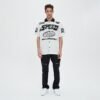


This custom knit shirt is developed around oversized artwork control: the visible front graphics, collar contrast, and sleeve markings need a mapped production system so each size preserves the intended visual balance without relying on subjective placement during assembly.
Artwork Scale as a Pattern Decision
The front graphic is not a small decorative mark; it occupies broad chest and lower-body areas. That scale changes how pattern pieces, button positions, and seam allowances are read, so the artwork should be placed against final panels rather than a generic flat garment outline.
A technical artwork map should identify the visible centerline, collar break, hem relationship, and sleeve reference points. Each size can then receive a controlled placement adjustment, preserving hierarchy while allowing the graphic to move naturally with grading and assembly tolerances.
Registration Across Multiple Zones
The image shows separate black graphic elements distributed across the body, sleeve, and shoulder area. Because these zones are viewed together, inconsistent scale or vertical drift can make the garment appear unbalanced even when every individual panel is technically acceptable.
VeeWen's development workflow should convert the visual into panel-level files, reference notches, and approval images for the front, back, and sleeves. The checkpoint is a measured strike-off or sample review confirming that adjoining artwork remains visually coherent after cutting and sewing.
Knit Surface and Graphic Behavior
A knit base introduces stretch and recovery variables that can alter how large artwork appears after handling, pressing, or wear. The supplied image shows a soft, flexible-looking surface, so artwork dimensions should be reviewed on the actual fabric structure instead of paper alone.
The development sample should examine edge sharpness, distortion near the button placket, and readability across the chest curve. If the chosen decoration method requires a stable surface, the buyer should decide whether backing, alternate application, or simplified detail is acceptable.
Fixed Details Create Alignment Anchors
The dark collar, button line, and sleeve markings provide useful visual anchors for controlling a graphic-heavy design. Their positions are easier to verify than an isolated illustration, making them practical references when reviewing samples across sizes and production batches.
VeeWen can use those anchors in the tech pack through measurement callouts from center front, shoulder seam, and sleeve edge. Approval should confirm both the artwork relationship and the hardware spacing, because misaligned buttons can exaggerate perceived graphic movement.
Trade-Offs in Oversized Placement
Large artwork creates stronger shelf visibility, but it also reduces tolerance for shrinkage, panel distortion, and grading differences. Extending a design across broad areas may improve impact while making replacement panels, corrections, or late artwork changes more costly.
The buyer should balance visual dominance against repeatability by identifying non-negotiable motifs and flexible background areas. A controlled hierarchy allows small production adjustments without compromising the key racing-inspired composition visible in the supplied reference image.
Approval Gate for Production Repeatability
The appropriate approval gate is a complete size-reviewed sample with the artwork map overlaid on measured garment panels. This verifies that scale, registration, collar interaction, and sleeve placement survive the transition from design file to physical construction.
For the commercial brief, VeeWen should record the approved artwork version, placement tolerances, construction notes, and packaging references before bulk release. MOQ: 100 pieces per style applies, while composition, decoration method, and final measurements remain To Confirm.
Buyer Questions
Can the artwork be changed for another collection?
Yes, artwork can be revised during development, but each change should receive an updated panel map and sample approval before production release.
Will the graphic scale remain identical across sizes?
Not necessarily. The visual hierarchy can remain consistent while dimensions and placement adjust through a documented grading and registration plan.
What material information is currently verified?
The images support a knit construction reference only. Fiber composition, yarn details, fabric weight, stretch behavior, and care requirements require confirmation.
What is the minimum commercial quantity?
The exact commercial minimum is MOQ: 100 pieces per style, with final production dependent on approved specifications and documentation.
Approve the Artwork Control Pack
Send the intended artwork, size range, and target measurements to begin a mapped development review. VeeWen can then align panels, grading, decoration decisions, and the production sample checkpoint.



Reviews
There are no reviews yet.