


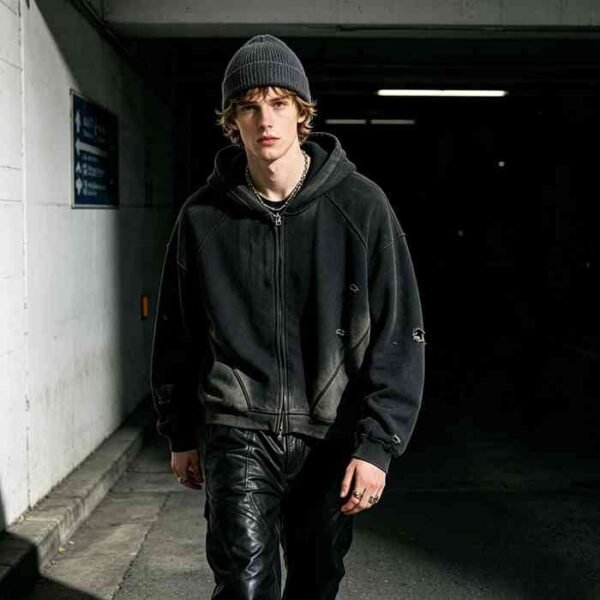
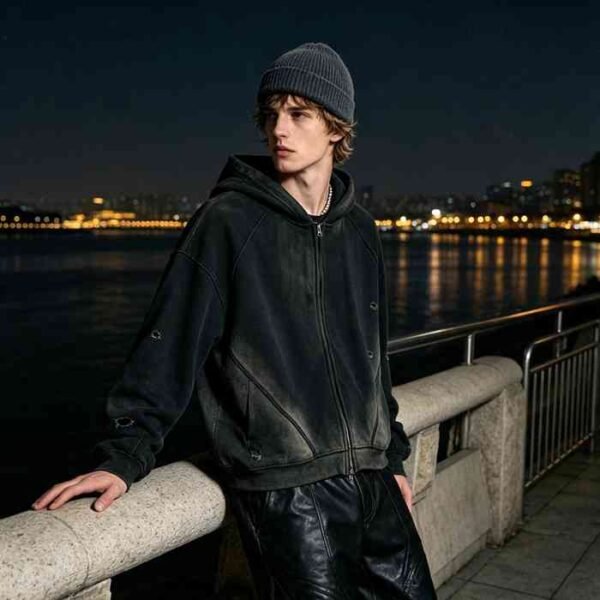




This hoodie is defined by how its substantial layers meet, not simply by fabric weight. The hood, raglan-style sleeves, zipper, angled pockets, rib edges, and distressed marks create high-bulk intersections that VeeWen must engineer as one connected construction system.
Why Seam Bulk Is the Core Risk
The supplied image presents a dense garment architecture: hood, shoulder lines, sleeves, zipper tape, pocket openings, cuffs, and hem all add layers. At each intersection, excess seam allowance or stacked reinforcement can stiffen the garment, distort the silhouette, and make the heavyweight concept uncomfortable.
The central zipper is especially sensitive because it runs through the entire front while pockets and hem converge nearby. A clean zipper line requires coordinated seam allowances, stable edge handling, and a layer sequence that prevents the lower body from becoming visibly thicker than the upper body.
Hood and Shoulder Intersections
The hood sits high around the neck, while the visible sleeve routes sweep from shoulder toward cuff. This creates a three-dimensional junction where multiple panels pull in different directions. Pattern engineering should define seam turn, hood depth, and shoulder ease together rather than treating each component separately.
A bulky hood can overpower the wearer's neck and push the zipper away from center; a thin junction can undercut the intended substantial appearance. The buyer should assess hood balance, shoulder drape, and zipper alignment while the sample is worn, not only while it lies flat.
Pocket Layer Management
The image shows large angled pocket openings that extend across the lower front, adding visual structure and another layered route beside the zipper. Pocket bags, opening facings, and body panels must be sequenced to avoid hard ridges, trapped fullness, or a front hem that swings unevenly.
Pocket placement also affects how the hoodie hangs when hands enter. VeeWen should review opening angle, bag depth, and edge reinforcement against the body pattern, then inspect whether the pockets remain comfortable and symmetrical without creating a concentrated lump at the lower zipper area.
Distressing Without Weakening Seams
Small distressed marks are visible across the sleeves and body, but their proximity to seam routes determines whether they remain decorative or become structural damage. Abrasion should be mapped away from critical stitch lines unless the buyer specifically approves engineered distress that includes reinforcement or controlled exposure.
The tonal surface variation appears strongest across the black body, creating depth without changing the basic color family. The buyer should separate shade targets from abrasion targets, because a darker spray zone may need different handling from a frayed or cut-looking mark.
VeeWen Development Workflow
VeeWen's workflow should start with a seam-stack diagram identifying every high-layer intersection, including hood attachment, raglan or shoulder routes, zipper edges, pocket openings, cuffs, and hem. The first checkpoint is a construction mock-up that isolates thickness and turning methods before surface distress is added.
Once the layer sequence is approved, VeeWen can build a complete sample and test the visual interaction between bulk, drape, zipper tracking, and pocket use. A worn fitting should follow, because movement reveals pressure points and seam stiffness that measurements alone cannot show.
Approval Checkpoint and Trade-Offs
The main trade-off is substantial hand feel versus flexible movement. More layers and reinforcement can support a durable appearance, but they also increase rigidity and bulk at intersections. Reducing layers improves comfort, yet may soften the structured silhouette that makes the reference visually convincing.
Before bulk approval, the buyer should inspect the hood base, shoulder routes, zipper edges, pocket corners, cuffs, and hem while worn and flat. Confirm acceptable thickness, symmetry, movement, distress placement, and hardware behavior, then lock the approved seam hierarchy into the technical specification.
Buyer Questions
Why inspect seam intersections first?
High-layer intersections can create stiffness, ridges, and silhouette distortion. Reviewing them early prevents later distressing or finishing decisions from hiding construction problems that affect comfort.
Can distressing cross structural seams?
It can, but only as an engineered detail with approved reinforcement and exposure limits. Uncontrolled abrasion near critical seams may weaken the garment or change fit.
Should the zipper be approved before distressing?
Yes. Zipper alignment and lower-front thickness should be approved first, because distressing and tonal treatment must follow the stable construction rather than obscure it.
What is the minimum commercial quantity?
The commercial minimum for this VeeWen development record is MOQ: 100 pieces per style, subject to final technical approval and order details.
Approve the Seam Stack
Share the target size range and construction intent with VeeWen for a seam-stack review, physical mock-up, worn fitting, and final approval of bulk intersections before production.



Reviews
There are no reviews yet.