

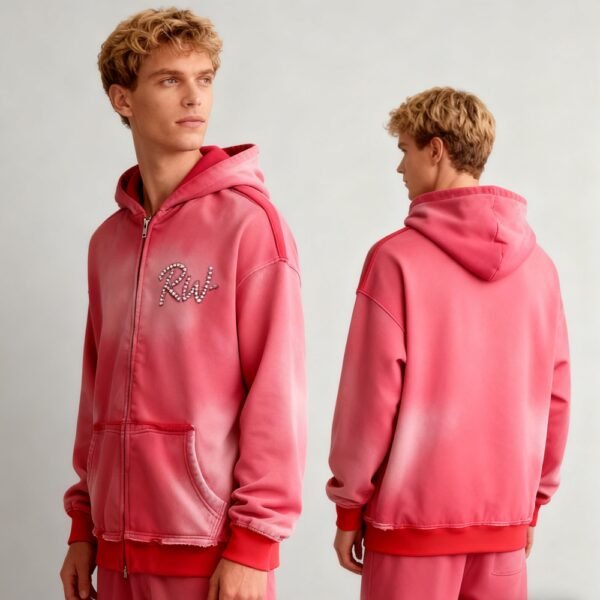
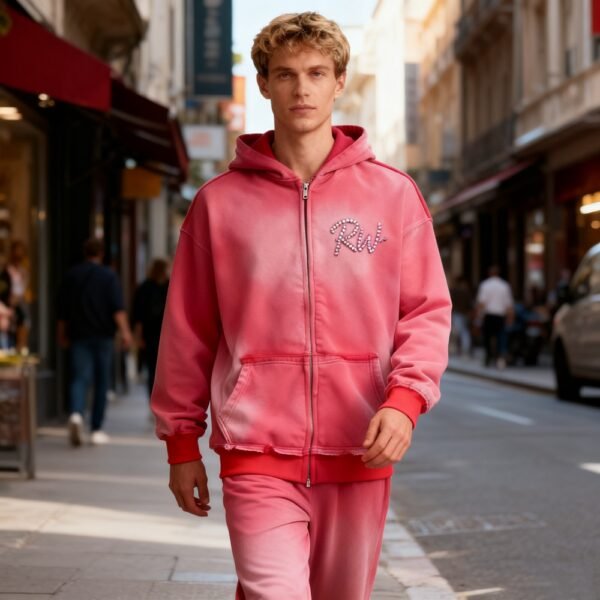

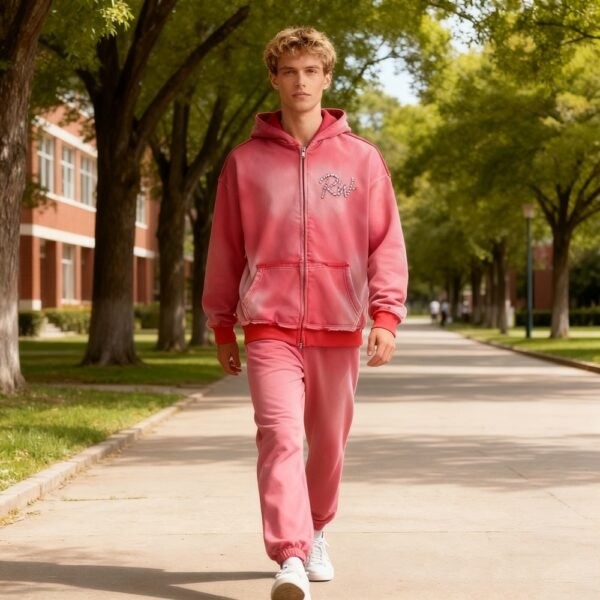
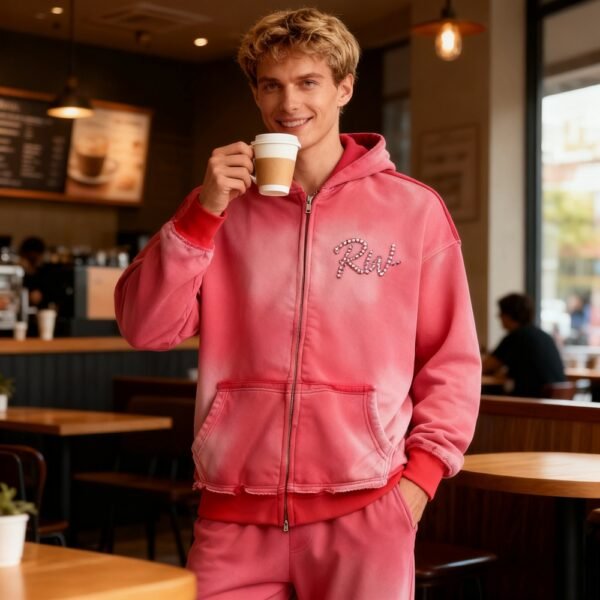












This custom men's zip hoodie develops a controlled contrast between a black washed body, sprayed tonal shading, and bright crystal-like decoration. The key approval issue is sequencing: wash behavior must be settled before final embellishment placement, so the surface remains intentional after finishing.
Wash Recipe Controls the Visual Foundation
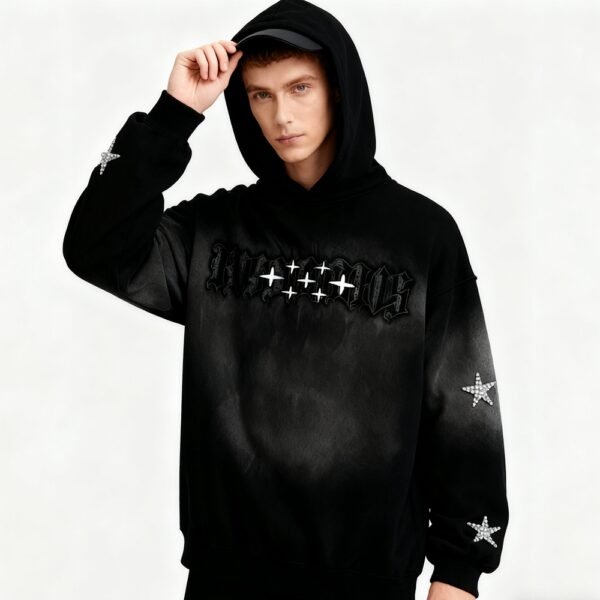
The supplied image shows a predominantly black hoodie interrupted by soft charcoal variation on the chest, upper sleeves, and lower body. That irregularity should be developed as a repeatable tonal map, because uncontrolled abrasion or chemical exposure can flatten the intended contrast.
A development swatch should record base shade, wash intensity, spray density, and acceptable variation before decoration is applied. The objective is not identical randomness, but a controlled range that keeps each garment recognizably related while preserving a worn streetwear character.
Decoration Timing Protects Surface Contrast
The chest lettering and star-like sleeve motifs are visually brighter than the surrounding fabric, making placement and timing central to the design. Applying reflective or raised elements too early may expose them to wash stress, while applying them too late can conceal useful registration references.
VeeWen's workflow should separate wash approval from decoration approval, then reconnect them through a finished-sample review. The buyer can compare an undecorated washed panel, a placement sample, and the completed garment before authorizing the final production specification.
Chest Graphic Needs Registration Discipline
The central chest treatment combines dark dimensional lettering with brighter crossing accents, so the graphic relies on layered contrast rather than a single flat print. Artwork files should define every layer, spacing relationship, and edge allowance before sampling begins.
A registration checkpoint should inspect the graphic against the actual washed surface, not a clean fabric substitute. This reveals whether spray variation obscures dark lettering, whether bright accents remain centered, and whether the final composition stays legible at the intended selling distance.
Sleeve Motifs Must Follow Garment Movement
The supplied image places star-like embellishment at multiple sleeve positions, including upper and lower areas that change shape when the arm bends. This creates a mechanical concern: motif spacing must account for seam placement, cuff movement, and distortion during ordinary wear.
Pattern development should mark sleeve grain, elbow bend, cuff allowance, and decoration boundaries together. A fit sample can then confirm that the motifs remain balanced on the body while avoiding placement directly over bulky seams or highly compressed rib areas.
Trade-Offs in a High-Contrast Finish
A stronger wash can create more visible tonal depth, but it also increases uncertainty around shade consistency and may soften graphic boundaries. Heavier decoration can improve shelf impact, while adding weight, stiffness, or attachment demands to selected panels.
The buyer should define acceptable variation rather than requesting maximum contrast without limits. VeeWen can then align the wash recipe, embellishment method, and inspection points to the commercial objective, making aesthetic individuality measurable during sample approval and bulk review.
Approval Gate for VeeWen Development
For VeeWen, this style should move through a sequence-specific development file: cleaned artwork, graded pattern, wash reference, decoration map, and completed sample photos. Each item records a decision that affects the next, preventing the finished appearance from being judged only after bulk processing.
The buyer's approval checkpoint is the fully finished sample after washing and decoration, evaluated under consistent lighting and viewed front, back, and sleeve angles. Confirm shade range, motif registration, zipper operation, and embellishment security before releasing the style for production.
Buyer Questions
Can the spray shading be adjusted?
Yes, the spray density and placement can be developed through approved visual swatches, while final variation limits should be documented before production.
When should rhinestone placement be approved?
Approve placement on the washed sample surface, because tonal changes can alter contrast, registration visibility, and the perceived balance of reflective details.
Is the fabric composition confirmed?
No. The supplied evidence identifies a hoodie and surface treatments, but exact fiber composition, fabric weight, and finish require technical confirmation.
What is the minimum order quantity?
The commercial minimum is MOQ: 100 pieces per style, with final specifications, color approvals, and decoration requirements confirmed before production scheduling.
Approve the Finished Surface Direction
Send the target artwork, size range, and preferred wash intensity for development. VeeWen can organize the wash reference and decoration map around MOQ: 100 pieces per style.



Reviews
There are no reviews yet.