

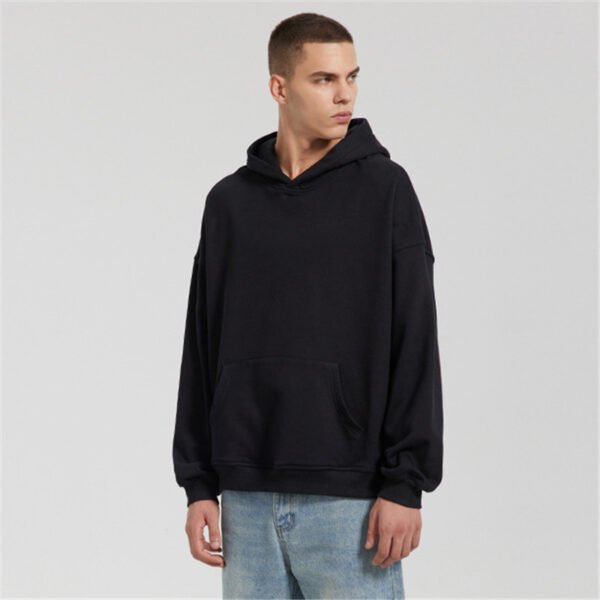


This pullover hoodie is a packaging-led development project: its drawstring-free front appears intentionally clean, while the rear image shows a structured hood, dropped shoulders, wide sleeves, and defined rib edges. The commercial question is whether folding protects that silhouette instead of flattening its presentation.
The Presentation Problem Begins With the Hood
A drawstring-free hood removes front cord clutter, but it also gives the hood fewer visible controls during packing. The supplied rear image shows a distinct hood peak and opening, so the fold must preserve that shape rather than compressing it.
For buyers, this changes the approval standard from simple flatness to controlled three-dimensional presentation. A compressed hood can make the garment appear smaller or untidy, while excessive volume can weaken carton efficiency. The fold must balance both outcomes.
Fold Around the Garment's Visual Center
The rear view places the hood and center-back seam on the garment's visual axis. A repeatable fold should establish that center first, then bring shoulders and sleeves inward evenly, preventing one side from projecting further when units are stacked.
The broad body and dropped shoulders indicate that folding too tightly at the upper back may create unwanted ridges. A buyer should inspect stacked samples from above and from the front, checking whether each unit presents the same width and neckline position.
Sleeve Volume Affects Stack Consistency
The sleeves appear wide and relaxed, with cuffs extending below the body's side lines. That volume can create uneven package thickness if sleeves are folded independently or trapped beneath the torso without a defined sequence.
A practical development check is to compare several folded units after short storage, then reopen them for visible pressure lines. The objective is not to promise wrinkle-free handling, but to identify whether the chosen fold produces repeatable presentation and manageable reconditioning.
Rib Edges Need a Clean Final Line
The ribbed hem forms a strong horizontal boundary across the lower back, while the cuffs add smaller edge lines at both sides. These details help the folded product look intentional, provided the edges meet without twisting or rolling.
During sample review, buyers should examine hem alignment, cuff orientation, and the transition between body and folded sleeves. If the rib edges are forced into the fold, the package may look distorted even when the garment itself is correctly sewn.
VeeWen Workflow: Approve the Fold as a Specification
VeeWen's product-development workflow should treat packaging presentation as an approval checkpoint alongside pattern and sewing review. The team can document a photographed fold sequence, then evaluate a physical sample against the intended hood, shoulder, sleeve, and hem positions.
That record gives production and packing teams a shared visual reference without assuming unverified factory performance. The buyer should approve the fold only after reviewing a packed sample, reopened garment, and repeat units representing the selected size range.
The Buyer's Final Presentation Decision
The central decision is whether the hoodie should be optimized for compact stacking or for immediate visual fullness. The supplied image supports a structured, relaxed appearance, but the preferred balance depends on retail channel, packaging dimensions, and tolerance for post-packing shaping.
Before bulk approval, request confirmation of the fold dimensions, protective materials if used, and presentation photographs. The selected method should keep the no-drawstring feature visually clean while maintaining consistent proportions across the approved production size set.
Buyer Questions
Does the hoodie include a drawstring?
No drawstring is visible in the supplied image, but the hood opening and internal construction should be confirmed from the technical sample.
What material is specified for this hoodie?
The supplied evidence does not state composition or weight, so VeeWen should confirm fiber content, fabric structure, and finishing requirements.
How should the fold be approved?
Review a photographed folding sequence, packed sample, reopened garment, and repeated units to verify hood shape, edge alignment, and stack consistency.
What is the minimum order quantity?
The commercial minimum for this development record is MOQ: 100 pieces per style, subject to final specifications and production approval.
Approve the Presentation Fold
Send your target packaging dimensions, size range, and labeling requirements so VeeWen can prepare a fold-focused development sample for buyer approval.


Reviews
There are no reviews yet.