


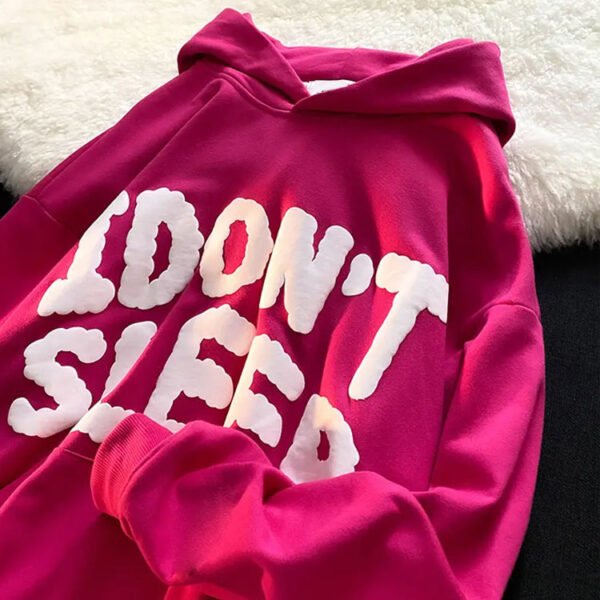


This pullover hoodie should be developed as a registration exercise, not simply a graphic garment. The supplied image shows raised white lettering crossing a saturated blue front panel, so pattern balance, seam placement, and fabric recovery must work together before decoration is approved for production.
Why Panel Alignment Controls the Graphic Result
The front artwork occupies a broad horizontal area rather than a small chest position. That placement exposes every imbalance in the body pattern, including uneven side seams, shifting hem levels, or a front panel that twists after washing.
A raised surface amplifies these issues because shadows collect around its edges. VeeWen development should therefore establish the artwork bounding box against the front pattern, then review its relationship with the hood opening, armholes, side seams, pocket area, and hem.
Reading the Supplied Image as Construction Evidence
The image visibly shows a blue pullover body, an attached hood, long sleeves, ribbed cuffs, and a ribbed lower edge. The raised white letters extend across the lower front, where bunching and hand movement can change the apparent spacing between forms.
The hood is folded toward the neckline and the lower body is gathered by natural handling, making this a useful stress view rather than a flat technical drawing. Sampling should include relaxed, worn, and laid-flat checks so alignment is judged in more than one state.
Mechanism: Seams Change Artwork Geometry
A cut-and-sew garment does not behave like a single rigid canvas. Stitch tension, panel ease, rib attachment, and fabric relaxation can alter the front surface, causing a straight graphic reference line to appear curved or displaced after assembly.
The practical control is a shared measurement system. Mark the center front, key horizontal levels, side-seam offsets, and decoration limits on the pattern, then inspect the sewn shell before finalizing the raised application. This connects visual approval to measurable production checkpoints.
Trade-Offs in a Raised Front Application
Large raised lettering creates immediate depth and a tactile focal point, but it also increases sensitivity to handling, folding, and uneven pressure during application. A softer fabric may improve comfort while allowing more surface movement beneath the graphic.
A firmer body can support sharper registration but may change drape and hand feel. Buyers should decide whether the priority is maximum relief, easier everyday wear, or a balanced middle position, then approve the decoration height and placement together.
VeeWen Workflow: From Artwork Map to Sewn Sample
For this style, VeeWen's product-development workflow should begin with a front pattern carrying the approved graphic coordinates. The team can then test panel dimensions, seam allowances, hood construction, rib proportions, and decoration placement as one connected package.
The approval sequence should move from digital placement to cut panels, sewn shell, applied graphic, and final review. At each stage, the buyer should compare center-front position, lower-edge clearance, side balance, and visible distortion before authorizing the next checkpoint.
Buyer Approval Checkpoint
Before approval, request a sample review that separates pattern accuracy from decoration appearance. Confirm the front panel remains balanced when laid flat, worn naturally, and viewed with the hood arranged, because each condition reveals different alignment behavior.
The final decision is whether the graphic remains legible without fighting the garment's seams and movement. Approve only after the panel map, raised-effect appearance, rib proportions, and handling instructions match the intended commercial presentation.
Buyer Questions
Is the hoodie confirmed to be 100% cotton?
The source title states 100% cotton, but the supplied image cannot verify composition. Request a material specification or lab-backed documentation before approving final claims.
What should the first sample prove?
The first sample should prove front-panel balance, graphic registration, hood and rib proportions, and decoration appearance in both laid-flat and naturally worn conditions.
Can the lettering be changed?
The lettering layout can be developed around a buyer-approved artwork file, provided its scale, relief, placement, and production tolerances are confirmed before sampling.
What is the minimum order quantity?
The commercial minimum is MOQ: 100 pieces per style. Final color, size, decoration, and packaging requirements should be fixed within the approved specification.
Approve the Panel Map Before Decoration
Send the artwork, target measurements, preferred fabric direction, and color references to begin a panel-alignment review with VeeWen's development team. Approve the sewn shell before committing to raised lettering production.



Reviews
There are no reviews yet.