



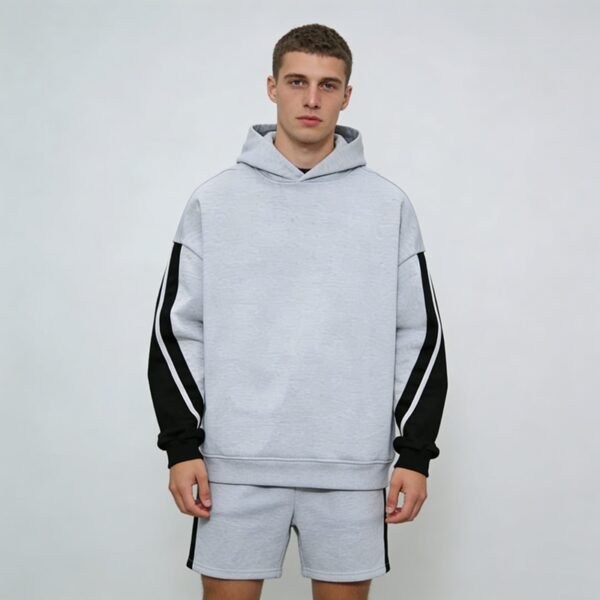







This matching hoodie and shorts set is best developed as a controlled color-block system, where every front opening decision affects stripe alignment, seam balance, and perceived finish. The supplied image shows a heather-grey base, black contrast panels, and white linear accents that demand disciplined sampling.
Design Thesis: Openings Must Respect Panel Geometry
The image presents a clean pullover rather than a buttoned garment, making the opening an unresolved development choice. If a buyer requests buttons, the placket must be positioned without interrupting the black sleeve-panel rhythm or visually competing with the white stripe system.
Button spacing controls more than appearance. Uneven intervals can pull the front edge out of balance, while excessive spacing may allow gaping during movement. A stabilized facing, suitable button diameter, and measured center-front placement should therefore be approved together during sample review.
Visual Evidence and Its Production Meaning
The heather-grey body provides a quiet field, while black panels create directional contrast from shoulder through sleeve and from hip through shorts side. These uninterrupted lines make any front opening highly visible, so placket width and top-button placement need proportional control.
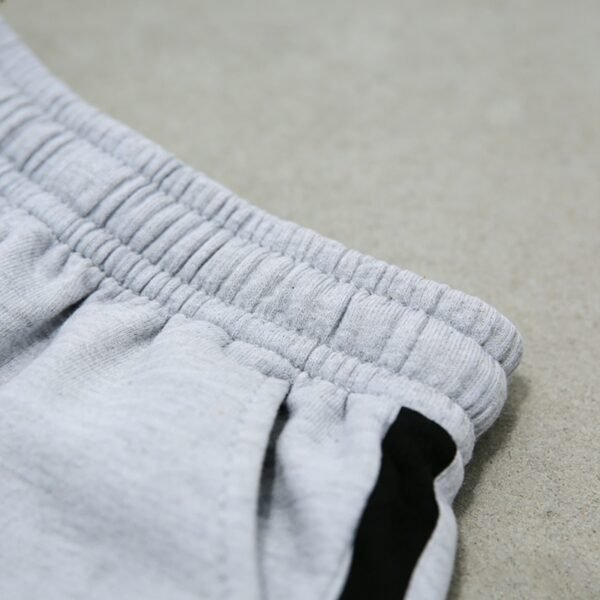
The supplied photograph also shows ribbed cuffs, a gathered waistband, and laid-flat garment separation. Those details support a casual athletic interpretation, but they do not verify button construction, fabric composition, or performance claims. The current image should guide form and contrast, not substitute for specifications.
Placket Stability Under Wear
A buttoned version should use a controlled front edge that resists rolling, stretching, or twisting against the softer body fabric. Stabilizer selection must be tested against the confirmed shell construction, because excessive stiffness could undermine the relaxed hand suggested by the photographed hoodie.
Stress concentrates around the top opening and lower fastening points when the wearer sits, reaches, or layers the garment. Sampling should inspect edge recovery, button attachment, and seam appearance after repeated opening and closing, with findings recorded before size grading approval.
Button Spacing and Size-Range Consistency
Spacing should be established from the intended neckline, chest ease, and hem relationship rather than copied as a fixed distance across sizes. A larger garment may require additional intervals or adjusted placement to retain a balanced front without creating a visibly sparse opening.
The hoodie and shorts operate as a coordinated set, so the jacket or top opening should not introduce a competing vertical rhythm. Buyers should review a graded sample alongside the shorts, checking that contrast stripes and front fastenings read as one deliberate system.
VeeWen Development Checkpoint
VeeWen can translate the supplied visual into a development brief separating confirmed appearance from open construction decisions. The first approval should identify whether the buyer wants the shown pullover or a buttoned interpretation, then document opening measurements, reinforcement, and hardware direction.
Once the direction is fixed, VeeWen's sample review should compare front stability with the panel map and stripe placement. The buyer's sign-off checkpoint is a measured sample covering closure spacing, edge behavior, and coordinated proportions before the style proceeds toward bulk planning.
Trade-Offs and Buyer Approval
A reinforced placket can improve control and presentation, but it may add firmness, visible bulk, and extra operation complexity. A lighter construction preserves softness yet may be less stable around fastenings. The correct balance depends on whether the garment remains pullover-based or becomes an opening style.
Approve this product when the intended opening, confirmed fabric reference, hardware dimensions, and graded spacing are documented together. If no buttons are required, retain the pullover design and remove placket assumptions from the specification, preventing unnecessary construction cost and sampling ambiguity.
Buyer Questions
Does the pictured set include a button placket?
No visible button placket appears in the supplied image. The shown top is a pullover hoodie, so any buttoned adaptation requires a separate construction decision and sample.
What should be approved first for a buttoned version?
Approve the opening type, facing width, reinforcement method, button size, and center-front spacing together. Reviewing these details as one package helps protect stripe alignment and front balance.
Is the fabric composition confirmed?
No composition percentage or GSM is supplied in the evidence. Treat the material as a reference only until VeeWen confirms the selected fabric and its measurable specifications.
What is the minimum order quantity?
The commercial minimum is MOQ: 100 pieces per style. Final order planning remains subject to the approved construction, material selection, grading, and production documentation.
Confirm the Opening Direction
Send the intended pullover or buttoned configuration, target fabric reference, and size range. VeeWen can then prepare a focused sample review for placket stability, spacing, stripe alignment, and coordinated set approval.


Reviews
There are no reviews yet.