







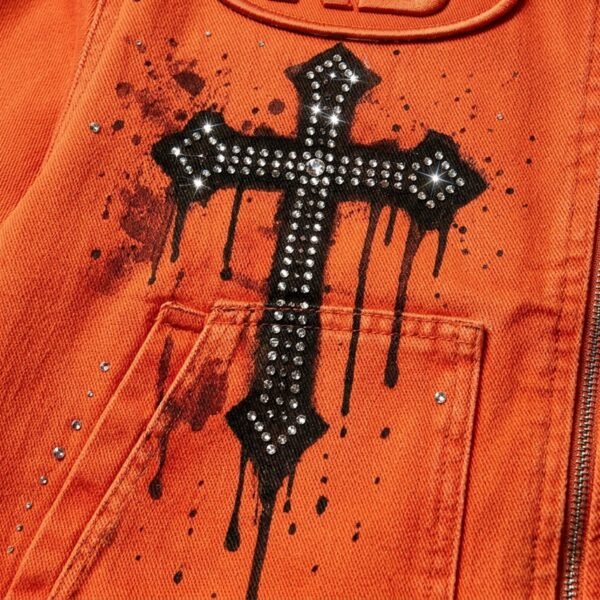
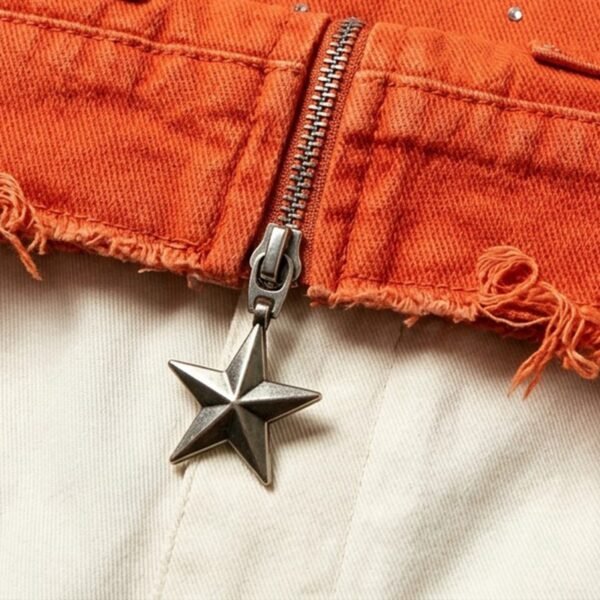







This custom men's cropped canvas jacket is built around concentrated front-panel artwork. The visible cross print, pocket geometry, collar detailing, and scattered reflective accents share a compact field, so print placement must be graded from stable landmarks rather than copied at one fixed distance across sizes.
Center the Print Against Construction Landmarks
The image shows a large cross graphic occupying the left front panel, with its lower reach approaching the pocket region. On a cropped jacket, that relationship is highly visible because the hem sits close to the artwork and leaves little vertical space for error.
The placement file should define the cross from pocket opening, zipper center, collar seam, and hem reference rather than from overall garment length alone. These landmarks remain more useful when sizes change, helping preserve the intended composition across the range.
Grade Artwork Without Losing Its Weight
A fixed-size print may feel oversized on smaller jackets and underpowered on larger ones, while proportional scaling can alter line weight and perceived impact. The cross therefore needs a documented grading rule that protects recognizable geometry while respecting each front panel.
VeeWen's development review should compare at least the smallest, middle, and largest approved sizes side by side. The buyer should judge visual balance, pocket interference, zipper clearance, and the distance from print edge to cropped hem before freezing production artwork.
Keep Embellishments Secondary to the Cross
Reflective points are visible across the collar, shoulder, and upper chest, creating a dispersed surface effect around the dominant front graphic. If their density changes with size without a map, the jacket may look sparse in one size and crowded in another.
The embellishment layout should be documented as repeatable zones, not as an improvised scatter. Placement must account for collar roll, seam allowances, pocket openings, and print boundaries, with each zone approved for both appearance and practical attachment access.
Coordinate Pocket and Graphic Geometry
The cross graphic descends toward a lower front pocket, making the pocket an active compositional landmark rather than a separate utility feature. Any print overlap, interruption, or clearance should be intentional, because the cropped proportion makes the lower front visually dense.
A technical drawing should show whether the artwork stops before the pocket, crosses its panel, or aligns with its edge. The buyer should approve that choice after reviewing a physical sample, since surface behavior and construction breaks cannot be judged from wording alone.
Account for Washed Surface Variation
The source wording references a washed finish, while the image shows a visibly saturated orange jacket. Washing can influence surface character and the final relationship between print, dimensional embroidery, and reflective embellishments, but the supplied evidence does not verify a specific wash recipe.
Development should therefore specify the intended visual outcome with a controlled color and surface reference, then review decoration after the proposed finish. The buyer should confirm acceptable variation limits because print contrast and embellishment sparkle may shift with surface treatment.
Freeze a Size-Range Placement Sheet
The approval document should list artwork width, vertical offsets, pocket and zipper clearances, embellishment zones, and crop measurements for every size group. It should also identify which dimensions grade and which remain anchored to construction landmarks.
VeeWen's workflow should move that sheet through pattern review, sample evaluation, and production specification sign-off. Bulk approval belongs only after the buyer confirms the cross remains balanced beside the pocket, collar details, cropped hem, and sleeve proportions.
Buyer Questions
Why is size-range print grading important here?
The cropped body compresses artwork and construction landmarks into a short front field, so unchanged print offsets can crowd pockets, hems, zippers, or collars between sizes.
Does the image verify rhinestone construction?
It shows small reflective-looking details, while the exact rhinestone or stud type, backing, attachment method, durability, and placement density require technical confirmation.
What should the buyer compare during sampling?
Compare key sizes for cross scale, pocket clearance, zipper alignment, embellishment density, cropped hem relationship, and surface appearance after the proposed wash process.
What is the commercial minimum?
The exact commercial minimum is MOQ: 100 pieces per style, with final requirements governed by approved artwork, materials, construction details, and production documentation.
Approve the Size-Range Artwork Map
Send the cross artwork, size chart, pocket references, embellishment preference, and wash target for review. VeeWen can then prepare graded placement controls for sample approval at MOQ: 100 pieces per style.



Reviews
There are no reviews yet.