

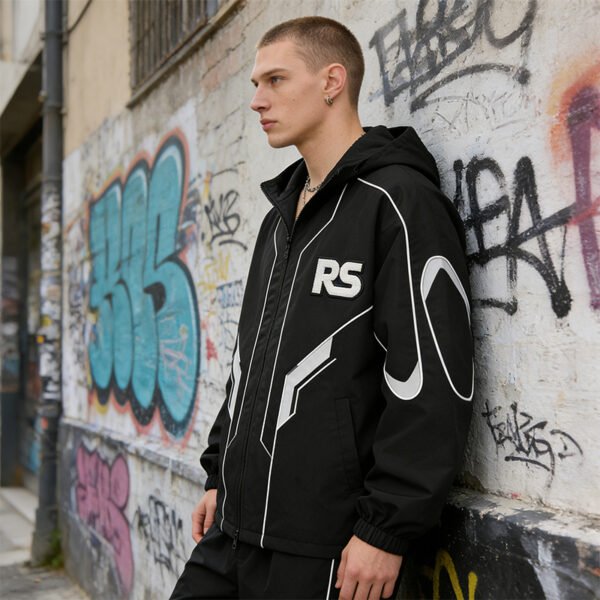
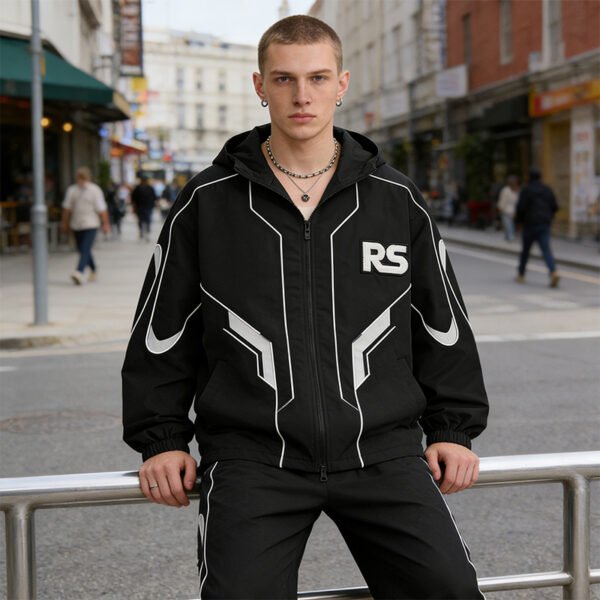
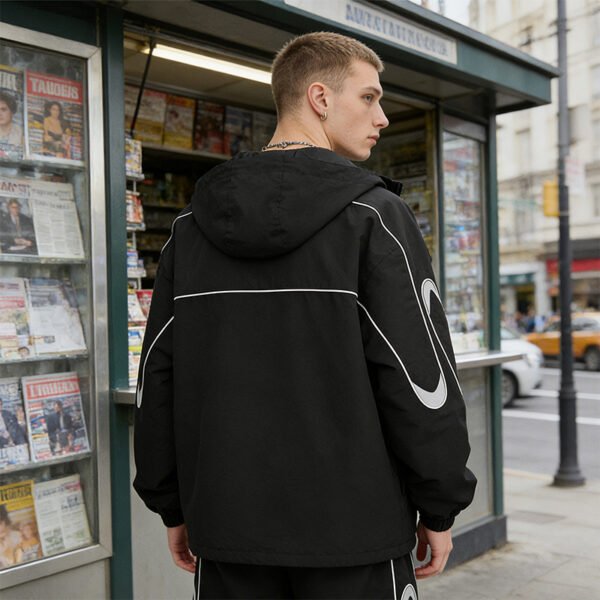
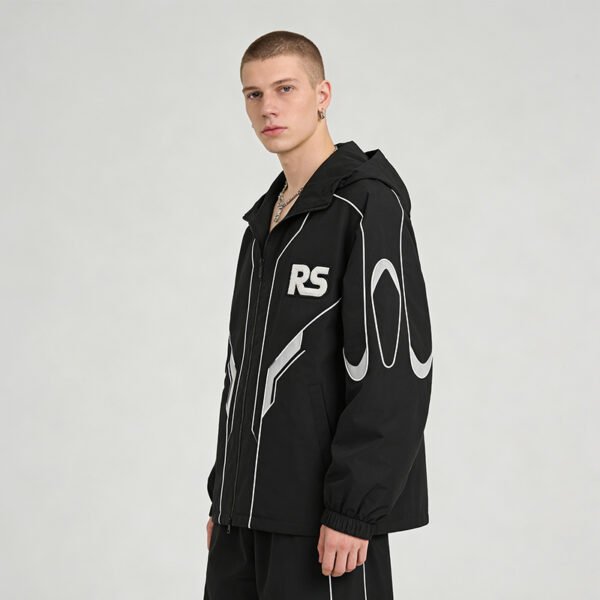
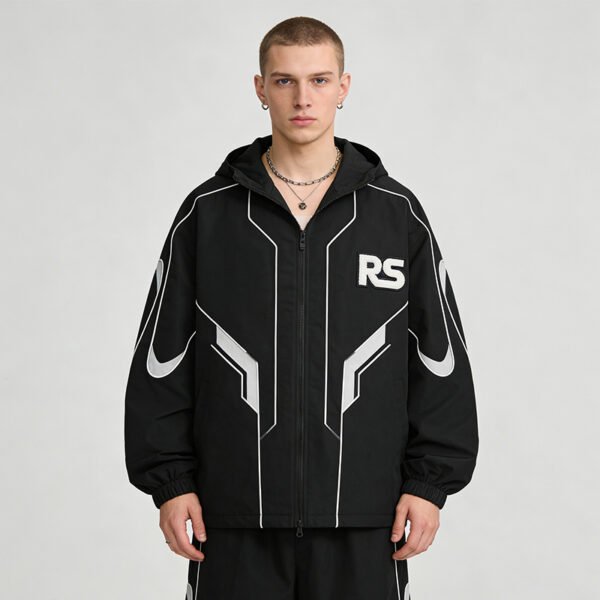
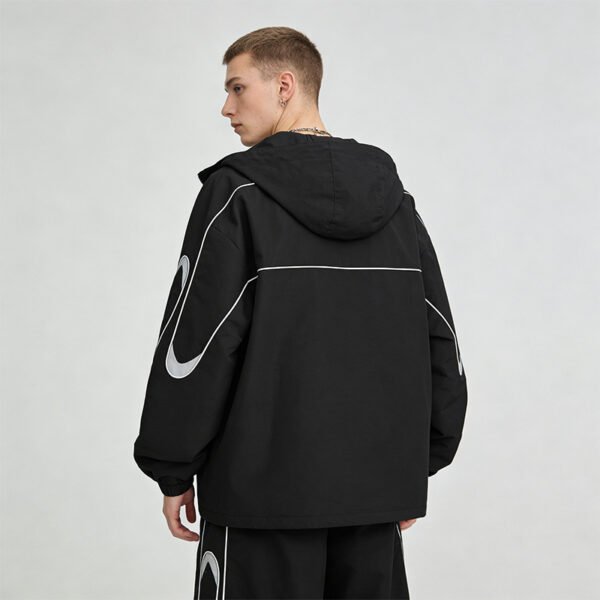

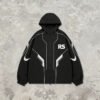
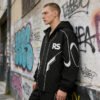


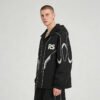

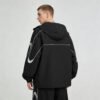


This custom hooded windbreaker is developed around one practical question: how can a large, high-contrast graphic remain aligned from sample to bulk production? The supplied flat-lay shows a black shell, centered zipper, angular white linework, sleeve graphics, and a compact chest emblem requiring disciplined artwork mapping.
Scale the Artwork Around Fixed Garment References
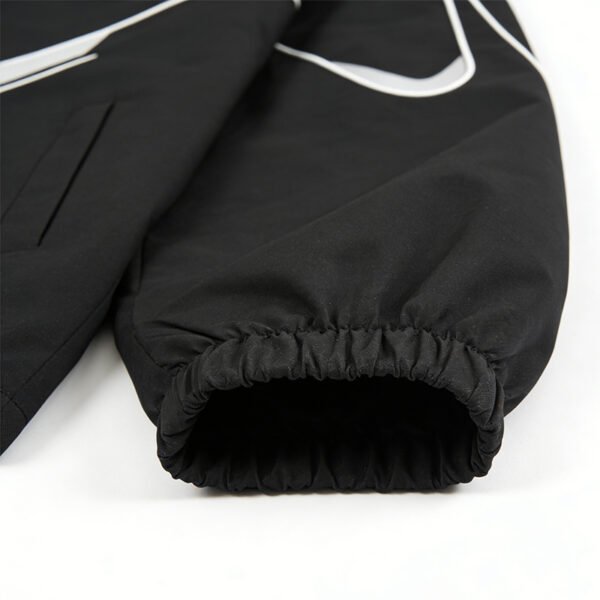
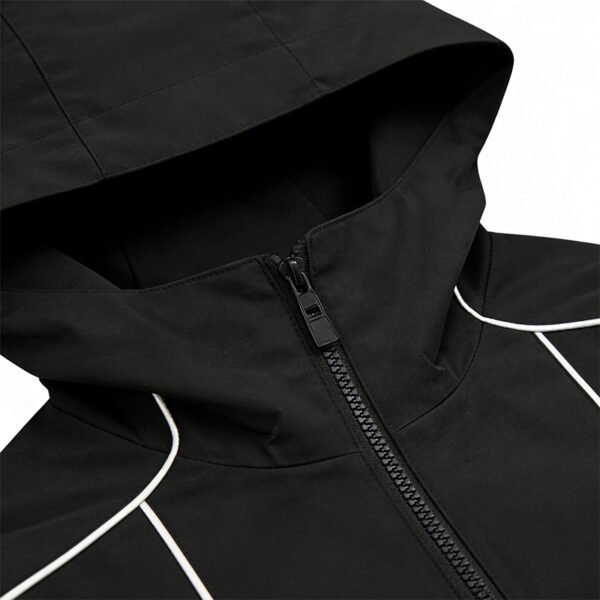
The strongest repeatability anchors are already visible: the center zipper divides the front, the hood opening establishes a top boundary, and elastic cuffs terminate the sleeves. Artwork should be dimensioned from these references instead of positioned by eye on loosely arranged panels.
For development, VeeWen can convert the graphic into a graded placement map covering front, back, sleeves, and hood. Each panel should carry artwork coordinates, seam offsets, and allowable registration movement, giving the sample room a measurable approval language before cutting begins.
Separate Decoration by Visual Function
The image presents two different graphic behaviors: thin white structural lines travel across broad areas, while the chest emblem acts as a denser focal mark. Treating them as separate decoration groups helps preserve line clarity without forcing every element through one production process.
The source wording references towel embroidery, applique, and screen print, but the final combination remains To Confirm. VeeWen's development checkpoint should compare handfeel, edge definition, and bulk at each scale, especially where dense decoration approaches the zipper or sleeve curvature.
Control Sleeve and Hood Registration
Sleeves and hood panels introduce movement, curvature, and seam interruption that can distort a graphic designed on a flat screen. The supplied image shows linework bending around shoulders and continuing toward cuffs, so artwork must be checked against actual pattern geometry before decoration.
VeeWen's workflow should create a paper or digital overlay from the approved pattern pieces, then mark notches, seam allowances, and registration points. A fit sample can reveal whether the graphic reads continuously when worn, while the production file preserves the approved relationship between panels.
Protect the Windbreaker Shell from Visual Drift
A dark shell makes small contrast changes immediately noticeable. Uneven ink coverage, shifting applique edges, or inconsistent thread direction could interrupt the precise white-on-black effect shown in the flat-lay. The development target is visual continuity, not simply applying the correct artwork file.
Shell composition, coating, water resistance, and fabric weight are not fully verified by the supplied image. VeeWen should therefore confirm the base fabric and decoration compatibility together, because heat, pressure, needles, or surface treatments may alter appearance and handfeel.
Build a Repeatable Approval Set
A useful approval set should include a front alignment image, close-ups of the chest emblem and sleeve graphics, and a worn view showing hood and shoulder transitions. These views test the exact zones most likely to expose scale or registration drift during production.
The buyer should approve artwork dimensions, technique by zone, acceptable edge tolerance, and the visual effect after any planned finishing process. Record those decisions against the style file so later size grading or replacement panels do not silently change the composition.
Connect the Argument to VeeWen Development
VeeWen's product-development role here is to turn a visually complex windbreaker into a controlled panel system: source review, pattern overlay, decoration separation, sample inspection, and production-file approval. That sequence directly addresses scale and repeatability rather than adding unrelated garment claims.
At the commercial checkpoint, the buyer should submit vector artwork, intended size range, decoration priorities, and shell expectations. VeeWen can then confirm feasible placements and unresolved specifications, with MOQ: 100 pieces per style guiding the initial production discussion.
Buyer Questions
Can the graphic be resized across different jacket sizes?
Yes, but resizing should follow a graded panel map. Confirm minimum line width, emblem dimensions, seam offsets, and sleeve placement for every approved size range before bulk production.
Is the jacket waterproof as shown in the source wording?
The source wording identifies a waterproof windbreaker, but the supplied image cannot verify performance. Request shell, coating, construction, and test requirements for technical confirmation.
Which decoration method should be used for the white graphics?
The source references several methods, while the image shows their intended visual contrast. Final selection should balance edge clarity, durability, handfeel, seam proximity, and production repeatability.
What is the minimum order for this development?
The commercial minimum is MOQ: 100 pieces per style. Final feasibility still depends on approved artwork, garment specifications, decoration choices, and confirmed production requirements.
Approve the Artwork Control Map
Send the artwork, size range, and shell expectations for review. VeeWen will organize the graphic into measurable zones, identify unresolved specifications, and prepare the next approval checkpoint for MOQ: 100 pieces per style.


Reviews
There are no reviews yet.