


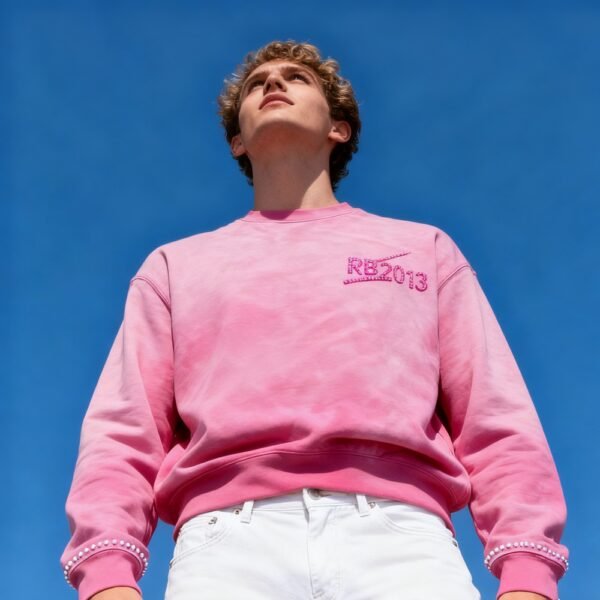





Designed for a men's streetwear sweatshirt where the lower edge must stay visually settled after movement, this development record treats waistband stretch recovery and size grading as the central approval issue. The pink acid-wash body, sparkling chest lettering, and cuff detailing create a strong finish that depends on controlled hem tension.
Why Waistband Recovery Controls the Silhouette
The sweatshirt has a broad ribbed hem beneath a relatively relaxed torso. That relationship lets the waistband frame the body, but insufficient recovery can leave the lower edge dropped, rippled, or rotated after sitting, layering, or repeated dressing.
Because the visual includes bright embellishment near the chest and cuffs, the eye reads proportion quickly. A waistband that settles unevenly can make the garment appear poorly balanced even when the body pattern and decoration are otherwise correctly executed.
How Grading Changes Hem Tension
A single rib measurement cannot simply be enlarged in proportion to every body size. Circumference, rib height, opening ease, and attachment stretch should be graded together, so larger sizes remain comfortable without losing the hem's anchoring function.
The development review should compare relaxed measurements and stretched openings by size. This reveals whether grading preserves a consistent visual proportion or creates a waistband that becomes too tight in smaller sizes and too passive in larger ones.
Acid-Wash Placement and Measurement Control
The supplied image shows a pink ground with lighter and darker sprayed-looking transitions across the front. Wash variation can influence perceived shape, so the approved sample should map waistband placement against the body pattern before bulk cutting begins.
If washing occurs after waistband attachment, shrinkage and torque can alter recovery or twist the lower edge. VeeWen should therefore confirm the wash sequence, stabilize the rib behavior, and review post-wash hem measurements alongside the approved color appearance.
Embellishment Makes Proportion More Visible
The chest lettering appears as a compact rhinestone decoration, while small sparkling details sit near the cuff edges. These focal points make the garment's intended vertical balance clear and increase the cost of correcting distortion after decoration.
Development should establish decoration placement from finished garment landmarks, including neckline, side seam, cuff, and waistband. The buyer should approve tolerances for both embellishment position and hem alignment, because inconsistent grading can otherwise make identical artwork appear misplaced.
VeeWen Workflow Checkpoint
VeeWen's workflow should begin by locking the rib construction, opening measurement, and recovery target in the technical pack, then testing the relationship across the planned size range. The product-specific checkpoint is a washed fit set reviewed from front, side, and seated positions.
After fit approval, decoration files and wash instructions should reference the stabilized pattern. The buyer can then sign off the size chart, recovery behavior, and placement tolerances together, ensuring the commercial sample represents the actual production sequence rather than an isolated prototype.
Trade-Offs Before Production Approval
More elastic recovery can improve hem stability, but excessive tension may create visible gathering, restrict movement, or make the relaxed body look cropped. A softer rib may improve comfort while increasing the risk of gradual extension during wear.
The correct decision is therefore a balanced recovery range, not the tightest possible hem. Approve the style when the lower edge remains level after movement, the graded opening feels wearable, and the acid-wash and embellishment still read consistently.
Buyer Questions
What should the first sample prove?
It should prove that the graded waistband remains level and comfortable after stretching, movement, washing, and repeated dressing across the intended size range.
Is the cotton composition fully confirmed?
The supplied source wording states 100% cotton, but fabric weight, fleece structure, rib composition, shrinkage, and embellishment compatibility still require confirmation.
Why review decoration after waistband testing?
Hem distortion changes the garment's overall balance, making chest and cuff embellishment appear misplaced even when artwork coordinates were initially correct.
What is the minimum order quantity?
VeeWen's exact commercial minimum is MOQ: 100 pieces per style, with final development scope and quotation confirmed during product review.
Approve the Recovery-Led Sample
Send the target size range, preferred wash direction, and embellishment artwork so VeeWen can prepare a recovery-focused development review before production approval.


Reviews
There are no reviews yet.