


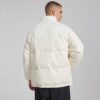


This custom men's winter coat is developed around controlled bartack placement, using reinforcement where opening hardware, cuffs, pockets, and quilt junctions concentrate force without disturbing the clean padded silhouette.
The Visual Construction Sets the Reinforcement Brief
The supplied image presents a clean, upright-collar coat with a centered zipper, broad horizontal quilting, and padded sleeves. Those visual lines establish natural load paths, while the pale surface demands reinforcement details that remain discreet and precisely aligned.
The torso panels appear substantially wider than the sleeve channels, so stress will not distribute uniformly during movement. Zipper operation, pocket entry, cuff adjustment, and hem handling can each create localized pull, making placement more important than simply increasing reinforcement quantity.
Bartacks Should Interrupt Stress, Not the Silhouette
A bartack works by clustering dense stitches across a short zone, limiting seam opening or fabric displacement where repeated pulling occurs. On this coat, the development target is compact reinforcement at attachment points rather than visible bars scattered across every quilt line.
Placement must respect insulation channels and seam geometry. Reinforcing directly across a padded compartment may compress the fill or distort the surface, whereas positioning beside a zipper end, pocket opening, or cuff seam can stabilize force with less visual disruption.
Map High-Load Zones Before Finalizing Details
The center zipper is the clearest repeated-load feature, especially at its top stop and lower termination. Cuff edges, pocket openings, and hem corners are secondary handling zones. Each should receive a measured reinforcement proposal after the pattern and opening construction are fixed.
The collar joins the zipper and neckline, creating a transition where opening force meets body movement. A development sample should examine collar ends, sleeve seams, pocket corners, and quilt intersections under practical manipulation, checking that bartacks secure layers without puckering or flattening.
VeeWen's Workflow Converts the Axis into a Sample Check
VeeWen's development process should begin by marking every proposed bartack directly on the pattern and annotated technical package. The sample then tests stitch density, bar length, thread contrast, and proximity to insulation channels against the intended clean front appearance.
During fit review, the team can compare stress behavior while opening the zipper, entering pockets, bending elbows, and layering underneath. Buyer approval should record accepted coordinates and construction notes, so later size grading preserves the reinforcement logic rather than copying marks casually.
Trade-Offs Between Reinforcement, Comfort, and Appearance
More bartacks may improve resistance at uncertain stress points, but excessive stitching can create stiffness, visible interruption, or compressed padding. Fewer bars preserve softness and visual calm, yet may leave zipper ends, pocket corners, or cuffs vulnerable during repeated handling.
Thread color and bar orientation also influence the result. Matching thread supports a quiet appearance on ivory fabric, while perpendicular placement can resist opening more effectively. The correct choice depends on seam direction, layer thickness, and the buyer's durability threshold.
Approve the Reinforcement Map with Evidence
The approval checkpoint is not a generic workmanship review; it is a coordinate-by-coordinate decision. Confirm whether each proposed bartack sits beside the actual force path, stays clear of insulation channels, and remains balanced across the coat's symmetrical front.
Before production release, review the sample's zipper operation, pocket access, sleeve mobility, collar comfort, and surface appearance. Record any moved, shortened, or removed bartacks alongside the approved pattern, because those decisions define the product's technical identity.
Buyer Questions
What should be confirmed before sampling this coat?
Confirm shell composition, insulation type, lining, zipper specification, pocket construction, cuff treatment, size range, and the proposed bartack coordinates before approving the first sample.
Where are bartacks most likely to matter?
Prioritize zipper terminations, pocket corners, cuff attachments, collar transitions, hem stress points, and any seam junction where repeated pulling could open or distort layers.
Can the bartacks remain visually subtle?
Yes, matching thread and compact bar dimensions can reduce visual interruption, but the final balance must be checked against fabric thickness, padding compression, and seam direction.
What is the commercial minimum for this program?
The commercial minimum is MOQ: 100 pieces per style. Final quantities, colorways, size ratios, and production details should be confirmed during quotation and development.
Approve the Coat's Reinforcement Map
Send your target measurements, opening details, color direction, and label requirements. VeeWen can review the bartack map, identify sampling checkpoints, and develop the coat from approved technical decisions.


Reviews
There are no reviews yet.