


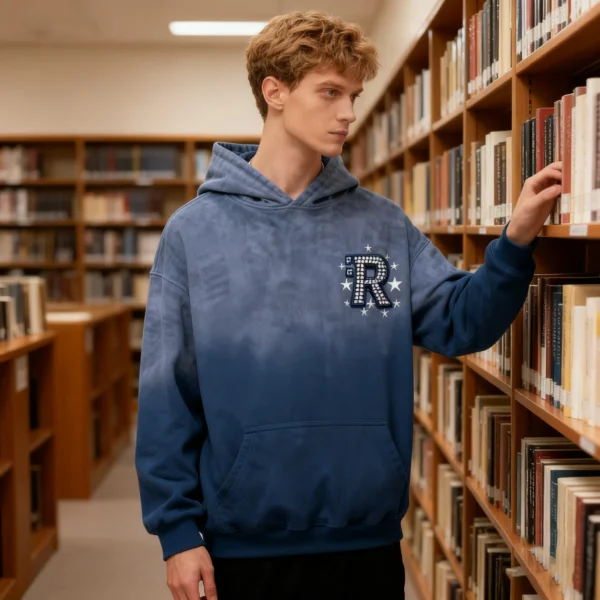





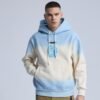

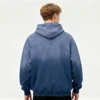


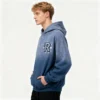
This custom pullover hoodie is developed around one practical risk: a high-contrast spray-dye body makes small cord-channel failures immediately visible. The design therefore treats eyelets, drawcord exits, and channel ends as controlled load points, while preserving the relaxed streetwear proportion shown in the supplied image.
Load Paths Behind the Hood Opening
The hood opening concentrates tension where the drawcord changes direction and exits the garment. A reinforced eyelet should distribute pull across stable fabric, while an internal channel finish prevents cord abrasion from turning a clean edge into a visible distortion.
Because the image presents a pale hood beside a dark body, uneven eyelet placement would read as a focal inconsistency. VeeWen's development workflow should map eyelet centers against the color boundary, then review cord travel on a measured prototype before approving grading.
Why the Center Color Break Matters
The dark-to-ivory transition is not a minor surface detail; it crosses the front panel, pocket area, and hood impression. Spray or overdye variation can alter perceived alignment, so the buyer should define an acceptable boundary range before production artwork is released.
A centered break also changes how reinforcement appears after washing. Dense stitching, bar tacks, or backing patches may absorb color differently from surrounding fabric. Development should therefore compare reinforcement samples on both color fields, recording which construction remains visually balanced after the intended finish.
Pocket Junctions and Channel Ends
The kangaroo pocket creates another stress zone directly beneath the front color transition. Its upper corners can pull against the body during use, especially when the pocket opening and drawcord channel visually compete. Clean corner reinforcement protects shape without adding unnecessary bulk.
Channel ends require equally deliberate containment because loose internal construction can migrate toward the hood seam. VeeWen should prototype the channel length, end stop, and seam allowance together, checking whether the finished hood keeps its opening symmetrical when the cord is adjusted.
Sleeve Artwork and Cuff Stability
The supplied image shows vertical sleeve artwork placed above a ribbed cuff, creating a long visual line down the arm. That placement makes artwork registration and cuff recovery connected decisions, since stretching the lower sleeve can shift the apparent relationship between print and edge.
A production review should separate decorative approval from structural approval. The buyer can confirm artwork scale and placement first, then inspect cuff attachment, sleeve seam balance, and reinforcement near the lower edge. This sequence keeps visual corrections from masking an underlying stability problem.
Trade-Offs in Reinforcement Design
More reinforcement can improve cord retention, but excessive backing or dense stitching may stiffen the hood and interrupt the soft drape visible in the image. Minimal construction may preserve hand feel, yet provide less resistance at repeated pull points. The right choice depends on intended wear.
The practical decision is not simply strong versus light. VeeWen's product-development workflow should compare at least two reinforcement layouts using the same base fabric and dye direction, allowing the buyer to judge hood comfort, eyelet neatness, channel behavior, and visual integration together.
VeeWen Development Checkpoint
VeeWen should convert the approved sketch into a reinforcement map showing eyelet position, channel width, cord exit, pocket junctions, and color-break tolerance. This exact map gives pattern, sewing, and finishing teams one shared reference for the garment's highest-visibility stress points.
Before the style moves toward a production-ready specification, the buyer should approve a measured sample with the intended surface treatment represented as closely as possible. Final sign-off should record cord details, artwork method, wash direction, and acceptable color variation in writing.
Buyer Questions
Can the center color break be repositioned?
Yes, the break can be developed as a pattern and finishing reference, but the buyer must approve placement tolerance after reviewing a representative sample.
What should the eyelet sample prove?
It should show clean alignment, stable backing, smooth cord movement, resistance to edge distortion, and acceptable appearance across both contrasting body colors.
Is the listed cotton composition final?
No. The source wording states 100% cotton, but VeeWen should verify the final fiber composition against the approved fabric specification.
What is the commercial minimum?
The commercial minimum is MOQ: 100 pieces per style, subject to final approval of construction, materials, artwork, measurements, and finishing requirements.
Approve the Reinforcement Map
Send VeeWen your target measurements, color-break direction, cord preferences, and artwork files so the first development sample can resolve appearance and load-path decisions together.


Reviews
There are no reviews yet.