


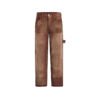

This utility trouser is defined by repeatability. Its supplied image combines tonal brown patchwork, extended double-knee panels, familiar front-pocket geometry, and a worn surface effect. Because those visual relationships can drift between runs, a sealed approval sample becomes the central control for reorders and production release.
Patch Mapping Is the Reorder Identity
The main image uses several brown tones across the front leg, with lighter panels placed over darker surrounding areas. That map is more than decoration: its proportions, edges, and tonal hierarchy define the product identity and must be documented before a reorder can be evaluated.
A replacement run may preserve measurements yet still look materially different if patch boundaries shift or the tonal contrast changes. VeeWen should therefore capture panel templates, seam references, approved color standards, and placement photographs within the sealed sample record.
Double-Knee Coverage Requires Fixed Landmarks
The knee overlays extend vertically across both legs, creating a broad reinforced-looking zone from upper knee toward the lower leg. Their length, width, and relationship to the inseam determine mobility, visual proportion, and whether the pant reads as intentional utility design.
For repeat production, measurements should reference stable landmarks such as waistband, crotch point, outseam, and hem. This prevents grading or pattern adjustments from quietly moving the knee panels and changing the protective or visual coverage expected by the buyer.
Tonal Variation Needs a Controlled Vocabulary
The faded brown appearance includes lighter central areas and deeper perimeter tones, producing dimension without bright contrast. The supplied image supports a washed or aged visual direction, but it does not verify the process, recipe, or durability of that finish.
A sealed approval sample should name the accepted appearance in practical terms: base tone, light-panel tone, dark-panel tone, edge definition, and permissible variation. This vocabulary gives production and inspection teams a common reference when natural process variation appears.
Pocket Geometry Anchors the Front Body
Despite the patchwork surface, the front waist and pocket arrangement remain familiar and structured. The waistband, belt loops, fly, and curved front pockets provide stable anchors that help the buyer judge whether the patchwork and knee overlays have altered the underlying trouser fit.
Those anchors should be measured and photographed on the approval sample before any reorder. If the base pattern changes, patch placement may appear correct while pocket balance, rise comfort, or front-body proportion shifts enough to require a new approval.
VeeWen Workflow Makes the Sample the Control Record
VeeWen's development workflow should build a reorder pack around one sealed physical sample: approved pattern, material references, patch map, color notes, finish direction, measurement chart, and inspection photographs. Each item addresses a different source of drift while preserving the product's combined technical and visual argument.
The buyer checkpoint occurs when the sample is reviewed under normal movement and held beside its documentation. Once signed, that package should govern grading, cutting, sewing, finishing, and reorder comparison, with any material deviation returned for written approval.
Approval Protects Speed Without Hiding Trade-Offs
A sealed sample reduces ambiguity, but it cannot eliminate every trade-off. More patch pieces can increase cutting and sewing operations, while stronger knee overlays may affect flexibility, bulk, or wash behavior. Buyers should decide which visual and functional details are essential before setting tolerances.
Approve the reorder system when fit, patch boundaries, tonal relationships, knee coverage, and surface finish all match the sealed reference. If one changes, treat the result as a new approval decision rather than silently accepting a different product.
Buyer Questions
Why is a sealed sample important for reorders?
It fixes the approved relationship between fit, patch mapping, knee coverage, color tones, construction, and surface appearance so later production can be checked consistently.
Does the image confirm the fabric composition?
No. Source wording references nylon, cotton, and canvas, but percentages, fabric construction, weight, and finishing should be confirmed before production approval.
What should the approval sample include?
Include the final fit, patch templates, color references, knee-panel dimensions, pocket geometry, finish direction, measurement chart, and inspection photographs.
What is the minimum order quantity?
The exact commercial minimum is MOQ: 100 pieces per style, subject to approved materials, specifications, grading, and production documentation.
Seal the Reorder Reference
Share your target fit, fabric direction, tonal palette, wash expectations, and reorder priorities with VeeWen to establish one controlled sample and specification record.


Reviews
There are no reviews yet.