


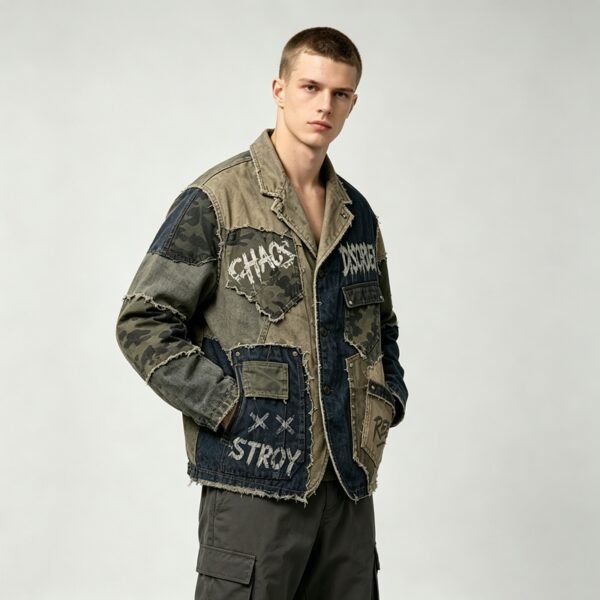
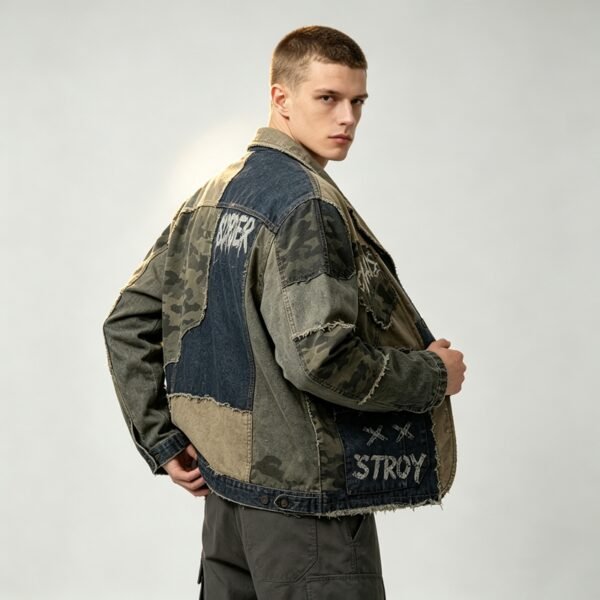





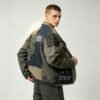
This custom patchwork canvas jacket is developed around sleeve opening and layering clearance. Its raw hems, mixed camouflage and denim-like panels, and substantial visual patching require controlled cuff dimensions so the jacket remains mobile over practical streetwear layers.
Sleeve Opening as the Mobility Control
A raw-edge cuff does not behave like a stable ribbed or turned hem opening. Fraying changes the visual boundary, while layered panel joins can add stiffness around the forearm. The opening must therefore be measured against wrist passage, hand movement, and sleeve-on-sleeve friction.
The supplied image shows sleeves assembled from camouflage, charcoal, khaki, and dark indigo sections, with visibly unfinished edges. That combination supports a deliberately irregular appearance, but the pattern must keep seam allowances and panel transitions from narrowing the usable opening.
Clearance Over Layered Garments
Streetwear outerwear is commonly worn over tees, sweatshirts, or heavier mid-layers, so sleeve clearance must be reviewed beyond the flat cuff measurement. A narrow lower sleeve can catch on underlying cuffs, pulling the jacket upward and disturbing the intended cropped or relaxed silhouette.
For this design, VeeWen can translate the approved layering intention into bicep, forearm, cuff, and armhole measurements before cutting the full patchwork set. The buyer should identify the thickest intended base layer, then approve movement photographs and measurement tolerances together.
Patch Boundaries and Opening Stability
Patchwork construction creates more than a color story; each boundary can affect grain direction, seam bulk, and local flexibility. The visible sleeve divisions suggest a deliberately assembled surface, making it important to position joins away from the exact folding zone whenever comfort and opening stability require it.
The cuff finish should be assessed after washing or distressing trials because raw edges may curl, shed, or widen visually. VeeWen's development review should compare the pre-finish opening with the post-finish opening, recording the approved appearance without treating fraying as a performance claim.
Graphic Placement Around Movement
The jacket image includes contrasting chest, pocket, and lower-body graphics that reinforce the panel composition. Although the manufacturing axis is sleeve clearance, artwork and labels near armholes or upper sleeves can become distorted when the wearer reaches forward, so placement should follow the final movement-tested pattern.
A placement sheet should define artwork distance from armhole seams, cuff edges, pocket openings, and patch boundaries. VeeWen can use the buyer's approved artwork scale and panel map to protect legibility while preserving the intentionally worn, uneven visual language shown in the reference.
VeeWen Development Workflow
VeeWen's relevant workflow begins with a measurement-led block, not a generic jacket template. The buyer confirms intended layering, sleeve opening, cuff edge behavior, panel map, and graphic zones; those decisions establish the technical base for a first sample and its review comments.
During sample evaluation, the team can inspect the jacket on the thickest planned layer, check wrist passage, and compare sleeve balance after surface finishing. The next approval checkpoint is a signed measurement and appearance standard covering opening circumference, edge treatment, panel order, and decoration placement.
Approval Checkpoint for Production
Before bulk cutting, approve a complete sample with the actual sleeve opening, raw-edge treatment, patchwork sequence, and intended graphics. A visually accurate body without confirmed cuff clearance is insufficient, because wearability depends on how those details interact during dressing and movement.
The buyer should release production only after confirming the layered fit on the selected base garment, the acceptable amount of fraying, and the tolerances for sleeve opening and lower-arm width. This checkpoint converts a dramatic reference image into a repeatable development specification.
Buyer Questions
What should be measured first on this jacket?
Confirm cuff opening, lower-sleeve width, forearm circumference, and bicep clearance against the buyer's thickest intended layering garment before sampling.
Does the image verify canvas composition?
The source wording identifies canvas, while the supplied image shows mixed textile panels; exact fiber percentages and fabric weights require source or laboratory confirmation.
Can raw edges remain visually consistent?
They can be standardized through approved seam allowances, edge treatment, washing references, and tolerance photographs, but the buyer must define acceptable variation before production.
What is the commercial minimum?
The commercial minimum is MOQ: 100 pieces per style, with final ordering subject to approved specifications, artwork, measurements, and development details.
Approve the Sleeve Clearance Direction
Send the target layer thickness, cuff opening, panel map, and artwork files so VeeWen can prepare a measurement-led sample for buyer approval.
Reviews
There are no reviews yet.