


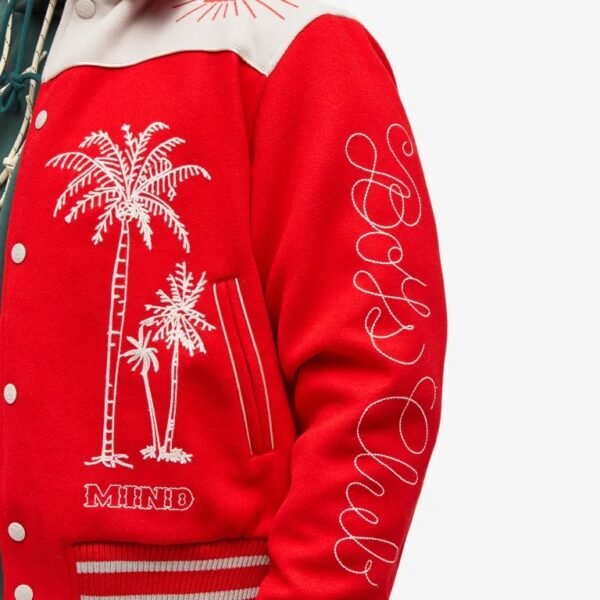
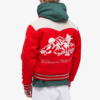
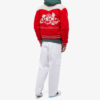


This custom red colorblock embroidered jacket is developed around branding placement and wearer comfort at the neck and upper back. The supplied rear image shows a contrast yoke, substantial back embroidery, striped rib trims, and a hooded layer, creating a precise approval point for labels and pressure management.
Treat Label Placement as a Comfort Decision.
The rear image places visual interest across the upper back, while a dark green hooded layer rises behind the jacket collar. That layering makes label position more than a branding choice: a label placed too high or rigidly can create rubbing, bunching, or pressure during wear.
VeeWen should map the label against the finished collar, yoke seam, hood overlap, and wearer's neck contact area. The buyer should approve both location and attachment method on a dressed sample, because comfort can change when the jacket is worn over a hooded garment.
Keep Branding Clear of High-Movement Zones.
Large white embroidery is visibly concentrated across the central back, with additional decorative lettering below. This creates a strong focal area but may add stiffness or backing bulk where the wearer bends, reaches, or sits against a chair, especially if the embroidery coverage is dense.
The development review should examine embroidery density, backing feel, edge sharpness, and distance from shoulder blades and collar seams. Label placement should reinforce the visual hierarchy without adding another hard or abrasive element near the neck or across the most active back zones.
Use the Contrast Yoke to Guide Internal Details.
The cream upper panel forms a clear line across the red jacket body, giving the garment a natural visual boundary for labels, seam references, and internal construction decisions. Any label positioned without regard to that boundary may look visually disconnected or interfere with seam comfort.
A technical review should align label width, distance from the neckline, yoke seam allowance, and embroidery placement within the same back map. This preserves the visible colorblock logic while giving production a repeatable reference for sewing, inspection, and size grading.
Apply the Argument Through VeeWen's Development Workflow.
For this jacket, VeeWen's product-development workflow should begin with a back-panel layout review before finalizing branding components. The sample must show the collar, yoke, hood interaction, embroidery backing, and label together, allowing comfort decisions to reflect the actual layered construction.
The approval record should capture label coordinates from fixed seams, attachment method, embroidery boundaries, backing specification, and wearer comments from the dressed fitting. This turns a decorative jacket detail into a controlled production instruction that remains usable when sizes and color panels are graded.
Balance Statement Decoration With Wearability.
The red, cream, green, and white palette creates a high-contrast statement, while ribbed cuffs and waistband visually frame the jacket. Strong decoration can increase perceived structure, but it may also make the garment less flexible if trims, backing, or seams accumulate in the same area.
The buyer should decide whether the priority is maximum graphic presence or easier movement at the upper back and neck. Review the jacket over a sweatshirt or hooded layer, then confirm that the label and embroidery remain comfortable without assuming unsupported lining, insulation, or performance specifications.
Release the Jacket With a Defined Branding Gate.
The commercial minimum is MOQ: 100 pieces per style, so the initial run should be tied to one approved branding map and one confirmed comfort standard. Alternate colorways may change contrast relationships, but the label coordinates and backing review should remain deliberately controlled.
Before production release, confirm the approved shell and lining references, label artwork, placement measurements, embroidery files, rib details, color standards, size grading, and inspection points. These checkpoints protect the jacket's visual architecture while making wearer comfort auditable at the style level.
Buyer Questions
Where should the label be placed?
The final position should be mapped from the collar and yoke seams, avoiding direct neck pressure and hood overlap. Confirm the location and attachment method on a dressed sample.
Does the embroidery affect comfort?
It can. Dense embroidery and backing may add stiffness across the upper back, so backing feel, edge comfort, and movement should be reviewed before approval.
Is the jacket insulated for winter?
The source wording references winter, but insulation and lining are not verified in the supplied evidence. Fiber content, warmth construction, and fabric weight remain To Confirm.
What is the minimum order quantity?
The exact commercial minimum is MOQ: 100 pieces per style. Final quantities depend on the approved construction, color assortment, size breakdown, and production documentation.
Approve the branding comfort sample.
Share the label artwork, preferred neck location, embroidery files, and layering intent. VeeWen can then coordinate the yoke, collar, backing, and rib trims around MOQ: 100 pieces per style.


Reviews
There are no reviews yet.