


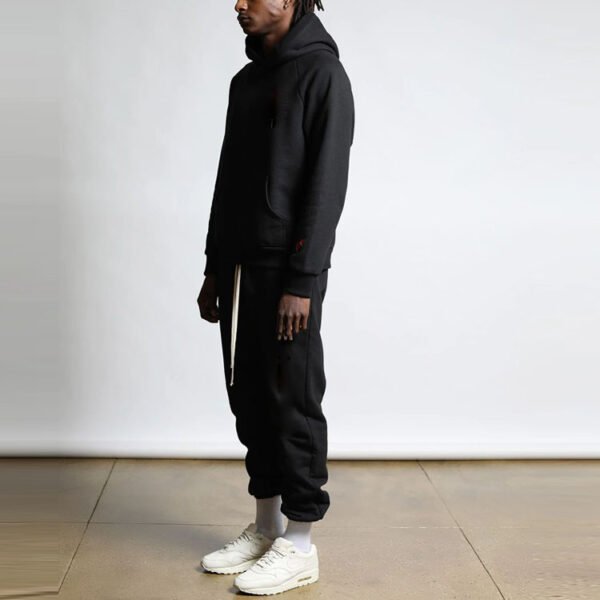





This custom solid black pullover hoodie is a focused development study in snap or button pull resistance, translated here into the hood opening's repeated entry and exit loads. Its minimal front makes neckline recovery, seam stability, and access comfort the primary approval checkpoints for production.
Why Hood Entry Is the Real Pull Test
The pullover's front view shows a clean, uninterrupted black body, making the hood opening the main access point during dressing, layering, and removal across intended size ranges. Every entry cycle can load the neckline binding, hood seam, and adjacent shoulder construction.
Unlike a buttoned opening, this design transfers force through fabric and seams rather than discrete fasteners. The development target is balanced resistance: enough structure to prevent stretching, but enough opening ease to avoid harsh pulling, seam stress, or uncomfortable restriction.
Reading the Supplied Image
The hood appears as a substantial layered form around the neck, while the visible raglan-style seams angle from the collar area toward the underarm. That geometry can distribute entry tension across a longer seam path instead of concentrating it at one shoulder point.
The solid black surface is commercially useful during approval because small distortions remain visible under controlled lighting. Inspectors should compare the opening before and after repeated pull cycles, checking edge waviness, seam grin, hood collapse, and neckline displacement.
Construction Variables to Lock
VeeWen's sample review should lock hood-opening circumference, seam allowance, binding or facing width, stitch density, and reinforcement placement before bulk approval. These variables determine how force travels through the layered opening and whether recovery remains consistent between sizes.
The pocket and lower body also deserve alignment checks because a stretched upper opening can change the garment's visual balance. Confirm pocket height, hem level, shoulder symmetry, and sleeve pitch after fitting, especially when adapting the block for plus sizes.
Trade-Offs for Buyers
More stabilizing structure can improve recovery, yet excessive stiffness may make the hoodie difficult to put on or create a bulky collar profile. Softer construction improves comfort but may permit neckline growth, hood slumping, and uneven wear after repeated access.
A larger hood opening may reduce entry force while weakening visual definition around the face. Buyers should therefore select the desired balance through wear testing, recording opening circumference, recovery behavior, and comfort rather than approving resistance from appearance alone.
VeeWen Development Checkpoint
VeeWen can translate the supplied reference into a measured development brief by documenting the hood-opening dimensions, seam architecture, grading expectations, and pull-cycle observations on the fit sample. The workflow should keep this specific tension question visible through pattern review and pre-production approval.
For commercial planning, the project proceeds at MOQ: 100 pieces per style after the buyer confirms the approved block, material reference, color standard, stitch specifications, and inspection method. Any composition, GSM, or performance claim remains pending until documented by the buyer or source.
Approval Standard Before Bulk Cutting
The buyer should approve a sample only when the hood opens comfortably, returns to its intended shape, and shows no visible seam separation after the agreed repeated-entry assessment. Record measurements at rest and immediately after testing for traceable comparison.
Also verify that the black color, pocket placement, hem balance, and sleeve proportions remain consistent with the approved size set. The final decision is a controlled construction approval, not simply confirmation that the garment looks clean in one photograph.
Buyer Questions
Is this hoodie designed with snaps or buttons?
No snaps or buttons are visible in the supplied image; it is a pullover. The assigned resistance axis is applied to repeated hood-entry pulling, pending construction confirmation.
What material is used for the hoodie?
The supplied evidence does not verify fiber composition, GSM, or fleece type. VeeWen should confirm the material reference, handfeel, weight, and interior finish during development.
Can the hood opening be adapted for different sizes?
Yes, the opening can be developed through measured grading and fit review. Each size should be checked for access comfort, neckline recovery, hood balance, and seam stability.
What is the minimum order quantity?
The commercial minimum is MOQ: 100 pieces per style. Final feasibility depends on the approved pattern, material reference, color standard, construction details, and inspection requirements.
Approve the Hood-Opening Development Brief
Send the target size range, material preference, color standard, and intended wear profile so VeeWen can define the hood-entry measurements and prepare the correct approval checkpoint.



Reviews
There are no reviews yet.